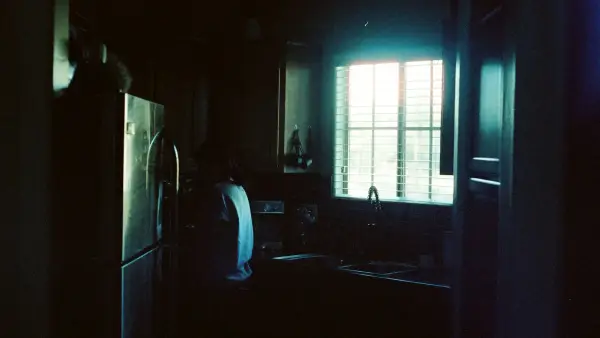
There are people who rehearse goodbye in the middle of hello, who carry the end of every good thing alongside the beginning, and it is not pessimism but the particular awareness of someone who learned very early that everything beautiful was also temporary

My daughter fell asleep on my chest last Tuesday. She’s seven now, almost too big for this, and she had curled herself into me the way she used to when she was small enough to hold in one arm. Her breathing slowed. Her fingers went slack around the collar of my shirt.
And I cried.
Not because anything was wrong. Because everything was right. Because I could already feel the future version of this moment - the one where she’s fifteen and wouldn’t dream of falling asleep on me, the one where she’s thirty and lives in another city, the one where this exact weight on my chest exists only in memory. I was grieving something that hadn’t ended yet. Something that was, in that very second, still happening.
If you’ve ever done this - held something beautiful and felt the ache of its disappearance even as it was still warm in your hands - then you already know what I’m about to describe. And you’ve probably spent years thinking something was wrong with you.
The Shadow That Arrives with Every Good Thing
You know the feeling. You’re at dinner with people you love, and the laughter is real, and the wine is good, and someone tells a story that makes the whole table lose it. And underneath the joy, quiet as a heartbeat, there’s a voice that whispers: this won’t last.
Not loudly. Not dramatically. Just a flicker of awareness - like noticing the sun has shifted and the shadows are longer than they were an hour ago.
You feel it on the first morning of vacation, when the unfamiliar light comes through hotel curtains and instead of excitement, you feel a low hum of sadness because you’re already closer to leaving than you were a moment ago. You feel it at weddings. At graduations. At birthday parties for parents who are getting older in ways you can see now.
You carry the ending alongside the beginning. You rehearse goodbye in the middle of hello.
And the world has a lot of names for this. Anxiety. Overthinking. Catastrophizing. The inability to “just be present.”
But none of those words are right. Because what you’re doing isn’t irrational. It’s not a malfunction. It’s something much older and much more honest than that.
When the Body Learned That Beautiful Things Leave
There’s a reason this pattern lives in some people and not others. And it almost always starts early.
Maybe you grew up in a home where happiness was real but unpredictable. Where a good weekend could be followed by a terrible Monday. Where a parent’s mood could shift without warning, and you learned to scan for the turn before it came.
Or maybe nothing dramatic happened at all. Maybe you simply lost something important at an age when you didn’t have the language to process it - a grandparent, a friendship, a family structure that quietly dissolved. And your nervous system recorded a lesson that your conscious mind never formally learned: good things end, and they end without warning, so you’d better start watching for the signs.
Bessel van der Kolk’s research on trauma and the body describes this with painful clarity. The body keeps a record of every loss, every rupture, every moment when safety disappeared. And it doesn’t file these memories neatly in the past. It carries them forward as predictions. The nervous system doesn’t distinguish between “this happened” and “this could happen again.” It simply stays ready.
A 2019 study published in the Journal of Personality and Social Psychology found that individuals with early experiences of unpredictable caregiving showed heightened sensitivity to the transience of positive emotional states. They didn’t enjoy positive experiences less - they actually rated them as equally pleasurable. But they simultaneously reported higher awareness of the experience’s impermanence. They held the joy and the grief at the same time.
That’s not a disorder. That’s a form of intelligence the body developed to keep you safe.
The People Who Plan Funerals for the Living
I want to speak directly to the person who has done this specific thing: you have mentally rehearsed the death of someone who is alive and healthy.
You’ve imagined the phone call. You’ve pictured what you would wear. You’ve thought about which songs would play, what you would say if you had to stand in front of people and explain what this person meant to you. You’ve done this not once but many times, and afterward you felt a strange combination of guilt and relief - guilt for thinking it, relief for having a plan.
You’ve never told anyone about this because it sounds morbid. It sounds like something is fundamentally wrong with your mind.
Nothing is wrong with your mind.
What you’re doing is called anticipatory grief, and psychologists have studied it extensively. It’s the emotional processing of a loss before it occurs. It shows up in caregivers, in people with seriously ill loved ones, but it also shows up - and this is the part nobody talks about - in people who simply love with a particular kind of depth.
You rehearse loss because you understand value. You mentally practice goodbye because you know, with every cell in your body, what it would cost to lose this person. The rehearsal is not morbid. It is a measure of how much they matter.
Why “Just Be Present” Doesn’t Work
People will tell you to be more mindful. To stay in the moment. To practice gratitude and stop borrowing trouble from the future.
And you’ll nod, because those are reasonable suggestions. And then you’ll go right back to holding your partner’s hand in the car and feeling a wave of sadness that has no source and no name, except that you love them and you know that one of you will eventually be in this car alone.
The reason mindfulness advice doesn’t land for people like you is that your temporal processing works differently. You don’t experience time as a single point. You experience it as a continuum - past, present, and future layered on top of each other, all equally real, all equally felt.
A 2021 study in Frontiers in Psychology examined what researchers called “temporal emotional blending” - the tendency in certain individuals to experience emotions from multiple time frames simultaneously. These individuals scored higher on measures of empathy, creative thinking, and emotional intelligence. They also reported higher baseline levels of what the researchers carefully termed “non-clinical melancholy.”
In other words: the same wiring that makes you feel the ending inside the beginning is the wiring that makes you a deeply perceptive, emotionally attuned human being. You can’t have one without the other. The sensitivity is not separable from the sadness.
Susan Cain has written about this in her work on bittersweet temperaments - people who are drawn to the beauty in impermanence, who find something sacred in what’s fleeting. She argues that this is not a flaw to be corrected but a orientation toward life that produces art, compassion, and an unusual capacity for love.
The Particular Cost of Loving Deeply
Here is what I want you to understand, if you’ve read this far and recognized yourself in every paragraph.
You are not broken. You are not anxious in the clinical sense, though anxiety may sometimes borrow your wiring. You are not pessimistic, though people who experience time differently may mistake your awareness for negativity.
You are someone who learned - probably before you had words for it - that the world gives and the world takes, and that these two things happen on the same breath. And rather than numbing yourself to that knowledge, you kept feeling it. Every time. In every beautiful moment. You let the ache in alongside the joy.
That is not a weakness. That is an enormous act of courage.
Because the alternative - the one your nervous system keeps suggesting - is to stop loving this much. To hold things loosely. To keep people at a distance where their loss wouldn’t level you. And you’ve tried that, probably. You’ve tried caring less. You’ve tried building walls.
But you couldn’t do it. You kept falling asleep with your child on your chest and crying about a future that hasn’t come yet. You kept looking at your parents and memorizing their faces. You kept loving people with the full knowledge that this would cost you everything eventually.
What the Rehearsal Really Means
There’s a particular kind of person who reads about a stranger’s loss and feels it in their own body. Who watches an elderly couple holding hands and has to look away because the tenderness is too much. Who saves voicemails from people they love, not out of sentimentality but out of something closer to preparation.
If that’s you, I’m not going to tell you to stop.
I’m not going to tell you that the present moment is all that exists, because you and I both know that’s a beautiful idea that doesn’t match how your mind actually works. The present moment is real, yes. But so is the knowledge that it’s passing. And pretending you don’t feel that passing doesn’t make you more enlightened. It just makes you lonelier.
What I will tell you is this: the rehearsal is not a sign that you can’t be happy. It is a sign that you understand exactly what happiness costs. You know that every hello contains a goodbye. Every first day contains a last day. Every person you love is also a person you will lose, or who will lose you.
And you love them anyway.
That is not pessimism. That is the bravest thing a human being can do - to love without the illusion that love is safe. To show up for the beautiful, temporary thing and let it wreck you, knowing full well that it will.
You learned early that everything beautiful was also temporary. And instead of closing your heart to beauty, you kept it open. You kept showing up for the hello, even though you could already feel the goodbye.
That’s not something to fix. That’s something to honor. It is the cost of being someone who loves deeply in a world where nothing - not one single thing - stays forever.
And it is worth every ache.