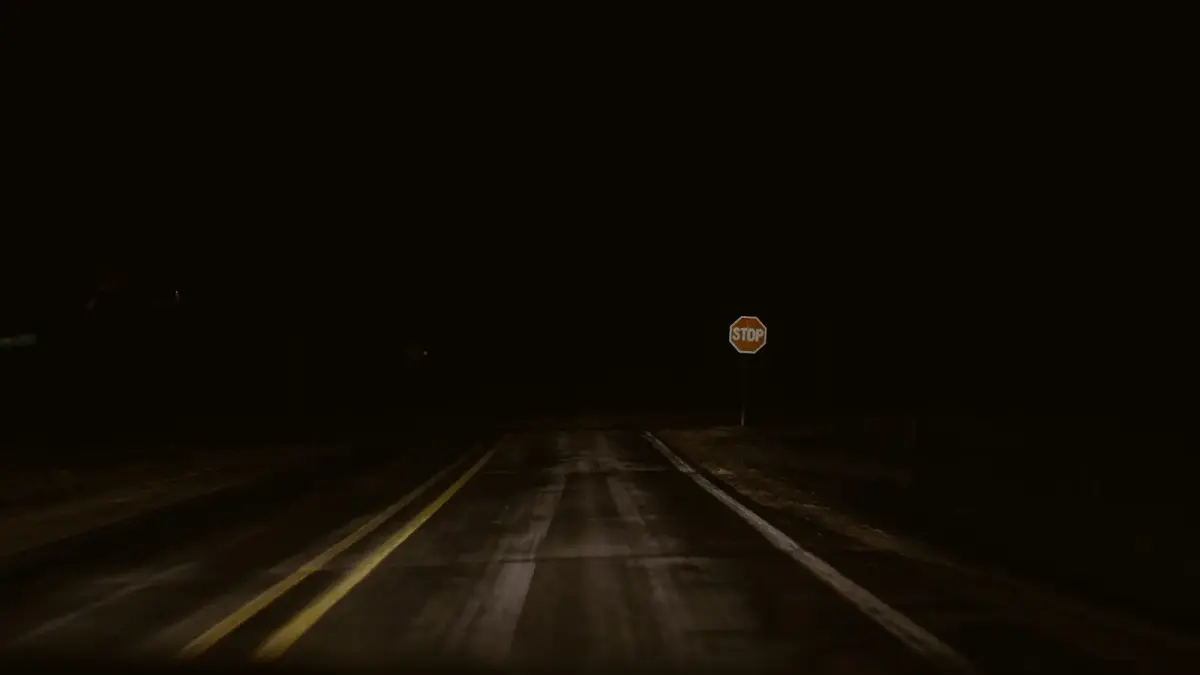
There is a particular kind of person who always takes the long way home - not the efficient route, not the suggestion the GPS keeps offering in a voice that sounds faintly disappointed, but the road that adds seven minutes and passes the lake or the stretch of trees that has looked different every season for twenty years - and the reason is not inefficiency or poor planning but the quiet recognition that the drive home is the last unscheduled stretch of the entire day, the only window where nobody is waiting for you to arrive yet and nobody needs you to respond to anything, and those extra minutes became the only room in a full life with no walls, no role, and no audience
The Seven Minutes That Belong to No One
I used to feel guilty about it. Every evening, right around the time the day’s last meeting ended or the final email got sent, I would pull out of the parking lot and turn left instead of right. Right was quicker. Right was what the GPS preferred, and it would recalculate with that slightly judgmental pause, as if it couldn’t understand why a person would voluntarily add time to a commute.
But left took me past the reservoir. Past the row of birch trees that had been there since before the subdivision went in. Past the house with the garden that changed every few months - roses in June, sunflowers in August, a pile of orange pumpkins by October.
I didn’t stop. I didn’t get out of the car. I just drove, and for seven minutes, I wasn’t anyone’s anything.
Not a colleague. Not a mother. Not the person who remembered to buy milk or knew where the insurance cards were filed. For seven minutes, I was just a woman in a car watching the light hit the water, and nobody in the world needed me to respond to that experience in any particular way.
If you know exactly what I’m talking about, this article is for you. And if you’ve ever wondered whether something is wrong with you for needing those minutes - for guarding them, even - I want you to hear this clearly: nothing is wrong. Something is profoundly right.
The Last Room Without Walls
Here is the architecture of a full life, if you map it honestly. There is the morning, which belongs to preparation and obligation. There is the workday, which belongs to performance and responsiveness. There is the evening, which belongs to the people you love and the home that needs tending. Somewhere in there, sleep happens - and even that often belongs to someone else, because you share the bed, or you set the alarm for a child who can’t be trusted to wake up on their own yet.
Every hour has a purpose. Every room has a role you play inside it.
The car on the long way home is the last space in the entire day that asks nothing. The trees along that road do not need you to be pleasant. The lake does not care whether you had a productive afternoon. The sky at that hour - whatever color it decides to be - is not waiting for your opinion.
This is not a small thing. For a certain kind of person, it might be the most important seven minutes of the day.
You know who you are. You are the person who functions beautifully in the presence of others but can feel yourself dimming by hour nine. The person whose social battery is not broken but genuinely finite. The one who loves their family completely and still needs a brief window of unclaimed silence before walking through the front door.
Why Certain Nervous Systems Need the Detour
There’s a reason this isn’t about laziness or avoidance, and the science has been catching up to what you already felt in your body.
Psychologists Christopher Long and James Averill published research in the Journal of Research in Personality exploring how voluntary solitude functions differently from loneliness. Their work found that people who intentionally sought brief periods of alone time - not isolation, not withdrawal, but chosen solitude - reported greater feelings of freedom, creativity, and what they called “intimacy with the self.” The key word is voluntary. When you choose the longer road, you are not running from your life. You are choosing a moment of unstructured contact with yourself.
This matters more than it sounds like it should.
For people who spend their days being responsive - answering questions, managing emotions, reading rooms, anticipating needs - the nervous system stays in a low-grade state of vigilance all day long. You might not feel anxious. You might not even feel tired, exactly. But your body is tracking. It is keeping score of every interaction, every adjustment, every moment you calibrated your tone or your face to match what was needed.
The long way home is where that tracking finally stops.
Nobody is going to walk into the car and need something. No notification is urgent enough to override the view of the field. For a few minutes, the only stimulus is the road and whatever your mind decides to do with the quiet.
And your mind, given space, does something remarkable. It exhales.
The Attention That Gets Restored
Environmental psychologist Rachel Kaplan developed what’s known as attention restoration theory, and it offers a framework for why that stretch of road past the trees or the water feels different from sitting in traffic on the highway.
Kaplan’s research, explored extensively in the journal Environment and Behavior, found that natural environments - even ones viewed through a car window - restore what she called directed attention. This is the effortful focus we use all day to concentrate, to inhibit distractions, to stay on task. It depletes like a battery. And nature, with its gentle, unpatterned stimulation, allows that battery to passively recharge.
You are not wasting seven minutes on the scenic route. You are recovering cognitive resources that the efficient route would never give back.
This is part of why the detour feels so specific. It’s not just any longer route. It’s the one that passes something alive and unstructured - water, trees, sky, a garden that changes with the seasons. Your nervous system is responding to the absence of demand. No signs to read. No lanes to merge into. No decisions that carry consequences.
Just the road, the trees, and the particular quality of light that happens at that hour, which you have memorized without trying because you have seen it a thousand times and it has never once been the same.
The Person Who Loves Their Life and Still Needs the Gap
I think the guilt comes from a misunderstanding that runs deep in how we talk about introversion and solitude.
The assumption is that if you need time alone, something must be wrong with the togetherness. That if the drive home is precious to you, maybe the home itself isn’t enough. That wanting seven minutes of silence before you walk through the door is a comment on what’s behind the door.
It isn’t.
Susan Cain wrote about this with devastating clarity - the way introverts are constantly asked to justify their need for space, as though solitude were a symptom rather than a capacity. The people who take the long way home are frequently the same people who show up most fully when they arrive. They are the ones who walk through the door and actually see their family, actually hear the story about the school day, actually sit down without bringing the residue of eight hours of performance with them.
The seven minutes are not subtracted from the evening. They are what makes the evening possible.
Self-determination theory, developed by psychologists Edward Deci and Richard Ryan, identifies autonomy as one of three fundamental psychological needs. Not autonomy as in independence from others, but autonomy as in the experience of acting from your own volition rather than external pressure. The long way home is one of the few moments in a fully committed life where you are doing something purely because you chose to. Nobody assigned the route. Nobody is evaluating your choice. The decision to turn left instead of right is entirely, quietly yours.
That matters to a nervous system that has spent all day responding.
The Road That Changes Every Season
There is something else happening on the long way home that I don’t think gets talked about enough.
You are building a private relationship with a landscape. You are watching the same trees move through the same cycle, year after year, and you are the only witness to that particular version of it - the one seen from the driver’s seat at 5:47 in the evening, in the specific light of mid-September, with the specific weight of whatever kind of day you just had.
Nobody else sees it exactly the way you do. That view belongs to you in a way that almost nothing else in a shared life does.
The birch trees don’t know your name. The reservoir doesn’t track your mood. And maybe that is exactly the point. In a life where you are known - deeply, gratefully, sometimes exhaustingly known - there is something restorative about spending a few minutes in the company of things that do not know you at all.
You are not performing for the landscape. You are just passing through it, and it lets you.
I think about the people I’ve known who do this. They are not the ones running from commitment. They are the most committed people I know. They coach the teams, they remember the anniversaries, they show up early and stay late. They carry more roles in a single Tuesday than some people hold in a month.
And then they take the long way home. Not every day, but often enough that the family knows. Often enough that someone has probably teased them about it. Often enough that the GPS has stopped suggesting the faster route, as if even the algorithm finally understood.
The Room You Built Out of Motion
If someone ever asks you why you don’t just take the highway, you don’t have to explain it.
But if you want the words, here they are: you are not avoiding anything. You are arriving. You are using the only tool available - a slightly longer road through a slightly more beautiful stretch of the world - to cross the bridge between who you were all day and who you get to be when you walk through the door.
Those seven minutes are the room you built out of nothing. No contractor, no renovation, no door that locks. Just a left turn where the GPS wanted a right, and a window of time where the only thing required of you is to keep your hands on the wheel and your eyes on the road.
The trees will be there tomorrow. The light will be different, the way it always is. And you will take the long way again, not because you’re avoiding home, but because you know something that efficient people sometimes forget.
You cannot pour from a cup that never gets a moment to simply sit on the counter, untouched, belonging to no one.
The long way home is where you set the cup down. And the people who love you - even if they’ve never said it this way - are glad you do.