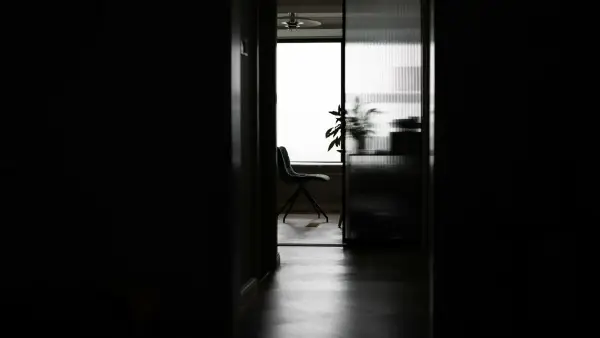
There is a kind of woman who reaches fifty-five and realizes she has spent three decades being easy to be around - choosing restaurants other people liked, watching shows other people wanted, laughing at timing that made other people comfortable - and she cannot name a single thing she would choose if the room were empty and the only opinion that mattered were hers

I was at a restaurant last year with a friend who asked me, without any particular weight behind it, what I wanted to order. And I froze. Not dramatically. Not visibly. But somewhere behind my ribs, something short-circuited.
I had been scanning the table for cues. What was she leaning toward? What would be easy for the kitchen if we shared? What wouldn’t make me seem like I was being difficult about the menu?
She was just asking me what I wanted to eat. And I genuinely did not know.
Not because I wasn’t hungry. Not because I didn’t care. But because I had spent so many years calibrating my choices around other people’s comfort that the muscle I used for wanting things - just for myself, just because I wanted them - had gone quiet. Not dead. Quiet. Like a voice you stop using until one day you open your mouth and nothing comes out.
If any of this sounds familiar to you, I want you to sit with me for a few minutes. Because this isn’t about food. It’s about something much older and much more tender than that.
The compliment that became a cage
You were probably called easy to be around before you were old enough to understand what it meant. Maybe a teacher said it at a parent conference. Maybe your mother repeated it with pride - “She’s no trouble at all. She just goes with the flow.”
And it felt good. Of course it did. You were a child, and a child who is told that their agreeableness is their best quality will build an entire self around that praise.
You learned early that flexibility was love. That having strong preferences made you difficult. That the safest version of you was the one who could walk into any room and make everyone else feel comfortable without ever drawing attention to yourself.
A 2013 study published in the Journal of Personality and Social Psychology found that people who score high in agreeableness are consistently rated as more likable - but they also report lower levels of self-knowledge and personal clarity over time. The researchers noted that chronic accommodation doesn’t just shape behavior. It shapes identity. You don’t just act agreeable. You become someone who genuinely doesn’t know what they want, because wanting was never part of the role.
You weren’t pretending. That’s the part that makes this so hard to untangle. You really did believe you were easygoing. You really did think you had no strong opinions about where to eat or what movie to watch or how to spend a Saturday.
But easygoing and emptied out can look exactly the same from the outside.
The slow edit
It doesn’t happen all at once. It happens in tiny, invisible cuts over years.
You let someone else pick the vacation spot. You watch a show you don’t care about because your partner is excited about it. You laugh a half-second early at a joke because you can feel the person telling it needs the room to land.
None of these moments feel like sacrifice. They feel like kindness. They feel like being a good partner, a good friend, a good daughter.
And they are kind. That’s true. But kindness without a self behind it becomes something else entirely. It becomes a disappearing act performed so gracefully that nobody notices - least of all you.
Susan Cain once wrote about the way certain temperaments are rewarded for self-erasure - how quiet, accommodating people are praised precisely because they make no demands. The world loves a person who takes up no space. It just doesn’t notice when that person stops existing inside their own life.
You edited out your music taste because someone in the car wanted something different. You edited out your preference for quiet mornings because the house was loud and it seemed selfish to ask for silence. You edited out the books you wanted to read, the places you wanted to visit, the clothes you actually liked but thought were “too much.”
And after thirty years of edits, you look at the document of your life and realize there’s almost nothing left that’s yours.
What fifty-five looks like from the inside
Here is what nobody prepares you for about midlife. It’s not the physical changes. It’s not the grief of aging, though that’s real. It’s the moment you sit down with yourself - maybe the kids are grown, maybe the house is quieter, maybe you finally have a Saturday with no obligations - and you realize you have no idea how to fill it.
Not because you’re bored. Because you don’t know what you like.
Someone asks what kind of music you listen to and you name whatever your husband plays in the kitchen. Someone asks about your hobbies and you list things you do for other people. Someone asks what you’d do with a whole free day and your mind goes blank - not empty, but panicked. Like a student who studied the wrong subject and is staring at an exam they can’t answer.
A 2019 study in Frontiers in Psychology found that adults over fifty who had spent decades in high-accommodation roles - caregiving, emotional labor, chronic flexibility - reported significantly lower scores on measures of self-concept clarity. They could describe who they were in relation to others with precision. They could not describe who they were alone.
You are not broken. You are not having a crisis. You are just meeting yourself for the first time without an audience, and you don’t recognize the person sitting there.
The grief that doesn’t have a name
There’s a specific kind of sorrow that comes with this realization, and it doesn’t fit neatly into any category. You can’t call it trauma - nothing terrible happened. You can’t call it regret exactly, because you made those choices out of love, or at least out of something that felt like love at the time.
It’s more like waking up in a house you’ve lived in for thirty years and noticing that none of the furniture is yours. Every piece was chosen to match someone else’s taste. The curtains, the dishes, the color of the walls. And now the house is quiet and you’re standing in the middle of it thinking - what would I have chosen?
And you don’t know. And that not-knowing is its own kind of grief.
Gabor Mate has written extensively about how the suppression of authentic self - not through force, but through the quiet, daily practice of making yourself acceptable - creates a deep disconnection that often doesn’t surface until the roles that defined you start to fall away. The mother whose children leave. The wife whose marriage settles into silence. The friend who was always available and is now, for the first time, alone with her own company.
You grieve not for something you lost. You grieve for something you were never given the chance to build.
The thing about “low-maintenance”
Let me say something that might sting a little, but I think you need to hear it.
“Low-maintenance” is not a personality. It is a survival strategy.
You became low-maintenance because the alternative - having needs, having preferences, taking up space - was punished. Maybe not harshly. Maybe just with a slight withdrawal of warmth. A flicker of annoyance on someone’s face. A comment about how “some people are just easier to deal with.”
And you, being someone who reads rooms the way other people read books, understood the assignment immediately. Be easy. Be flexible. Be the person who never makes it complicated.
But here is what I want you to understand - the fact that you accommodated so thoroughly for so long is not evidence that you have no preferences. It is evidence that you have an extraordinary capacity for attunement. You can feel what a room needs before anyone speaks. You can sense tension before it surfaces. You can calibrate your energy to match whoever you’re with.
That is not emptiness. That is a skill so refined it became invisible - even to you.
The preferences are still in there. They didn’t die. They just went underground, because the surface wasn’t safe enough to hold them.
Learning to hear yourself again
I’m not going to give you a five-step plan. That would be dishonest, and you’ve had enough people telling you what to do.
But I will tell you this. The first time you order something at a restaurant without checking anyone else’s face, it will feel transgressive. Almost rude. You will want to apologize for having a preference.
Don’t apologize.
The first time you put on music that you - just you - actually want to listen to, it might take you twenty minutes of scrolling because you genuinely don’t know where to start. That’s okay. The not-knowing is not a failure. It’s a beginning.
A 2021 study in the Journal of Research in Personality found that adults who begin practicing what researchers call “preference identification” - the simple act of noticing and naming what they want in low-stakes situations - show measurable increases in self-concept clarity within just a few months. Not because they become different people. But because they start listening to a voice that was always there, just buried under decades of accommodation.
Start small. Absurdly small. What do you want for breakfast? Not what’s easiest. Not what makes the least mess. What do you actually want?
What color would you paint your bedroom if nobody else had to sleep in it?
What would you do on a Tuesday evening if nobody needed you and nobody was watching?
These questions might feel silly. They’re not. They are the first honest conversations you’ve had with yourself in years.
You were never empty
I want to leave you with this, because I think it matters more than anything else I’ve written here.
You were never empty. You were never “just easygoing.” You were never a person without preferences or opinions or desires.
You were a person who learned, very early, that the safest way to be loved was to make yourself into a mirror - reflecting back whatever the people around you needed to see. And you did it so well, for so long, that you forgot there was a face behind the glass.
But there is. There always was.
And fifty-five - or sixty, or forty-seven, or whatever age you are when you finally sit down in an empty room and realize you don’t know what you’d choose - that’s not a crisis. That’s an invitation.
It’s the room, finally empty. It’s the only opinion that matters, finally yours.
You might not know what to do with that yet. That’s okay. You have time. And for the first time in a long time, the only person you need to check with is you.