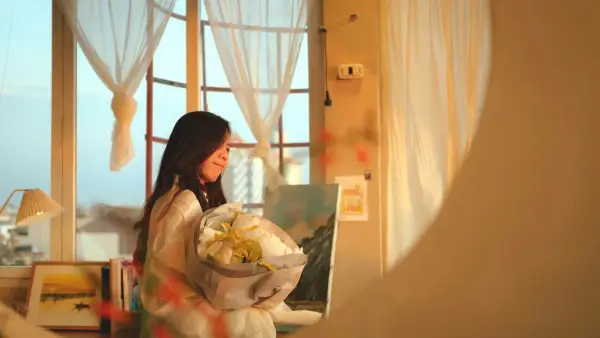
The woman who buys the expensive candle as a gift but burns the cheap one at home, who serves guests on the good plates but eats alone standing at the counter - this is not generosity, it is a girl who learned so early that the nice things were for other people that by fifty-five she cannot sit at her own table and believe she is worth the effort

I found a hand cream in my guest bathroom last month. It was in a glass jar with a brass lid, and the label said something about French lavender and shea butter. I had bought it eleven months ago.
For myself, technically. But my hands carried it straight to the room where visitors wash their hands twice a year, set it beside the nice soap and the soft towels, and I went back to the kitchen and kept using the cracked pump bottle of whatever had been on sale at the grocery store.
Eleven months.
I only noticed because a friend used the bathroom during dinner and came out saying, “That hand cream is beautiful - where did you find it?” And I heard myself say, “Oh, I keep meaning to try it.”
I keep meaning to try my own hand cream. In my own house.
And the thing that stops me cold, even now, is how little this surprised me. It felt like the most natural thing in the world.
The inventory nobody asks to see
I want to name this woman because I think you know her. I think you might be her.
She buys the expensive candle - the one that smells like fig and dark honey - and wraps it for her sister’s birthday. At home she burns whatever came in a three-pack from the discount store.
The wick mushrooms. The scent is listed as “vanilla” but smells like wax and nothing. She stopped noticing a long time ago.
She has stationery in a drawer that she has never used. Beautiful paper, cream-colored, with her initials embossed.
Someone gave it to her and she thought, I should save this for something important. Important has not arrived. She writes grocery lists on the backs of envelopes.
She has a bath bomb from two Christmases ago. It sits on the edge of the tub in its cellophane wrapper, gathering dust.
She takes showers. Quick ones. Five minutes, in and out, because there are things to do and people who need feeding and she has never once considered the bathtub a place she is allowed to linger.
She has a chair in the living room - the comfortable one, with the reading lamp beside it - and she does not sit in it. That is where her husband reads. Or where the dog sleeps.
Or where company sits when company comes. She takes the kitchen stool, or the corner of the couch with the broken spring, or she stands.
She is very good at standing.
Where the lesson begins
She learned this young. So young that the learning has no edges, no beginning she can point to.
She learned it from watching her mother wrap the good chocolates for the teacher’s gift and hand the children the broken pieces from the bottom of the box. From her mother saving the front seat for anyone other than herself.
From her mother wearing the same three blouses for a decade while making sure her daughters had new school clothes every September.
She learned it from the sentence, “That’s too nice for everyday.” From the sentence, “We’re saving that for company.”
From the sentence that was never spoken aloud but was communicated through a thousand small gestures - your comfort is real, but it is not urgent. Other people’s comfort is urgent. Yours can wait.
A 2019 study published in the Journal of Personality and Social Psychology examined what researchers called “conditional self-worth” in women - the internalized belief that one’s value depends on being useful, generous, or self-sacrificing. The study found that women who scored highest on these measures did not experience their self-denial as deprivation.
They experienced it as identity. Giving the best away and keeping the worst felt like being a good person.
That is the part that makes this so difficult to see. It does not feel like a wound. It feels like a virtue.
The mother who taught it did not mean to teach it
Here is the part that aches.
Her mother was not cruel. Her mother was doing her best. Her mother was probably the same girl once - reaching for something beautiful and being told it was not for her.
Her mother was managing a household where the good china and the guest towels were investments in dignity. The impression the family made on people who might be watching. Who might be judging.
In a home where resources feel uncertain, every beautiful object carries a double weight. It is both the thing itself and the proof that the family has enough.
The good plates do not just hold food. They hold worth. And worth, in a house where money is counted carefully, flows outward - toward the public-facing moments.
The private ones get the chipped mugs and the mismatched forks, because nobody is watching.
Except someone is watching. The girl at the table with the chipped mug is watching.
She is learning that comfort and beauty are currencies that flow outward, toward people who might leave if they are not impressed. Not inward. Never inward.
The architecture of an afterthought
Follow this girl into adulthood and watch what she builds.
She builds a beautiful home. She has exquisite taste, actually, because she spent her whole childhood studying what beautiful things looked like from a distance.
She knows quality. She knows fabric weight and thread count and the difference between a candle that fills a room and one that just smells like wax.
She uses that knowledge for everyone except herself.
Her children’s rooms are thoughtfully arranged. Her own bedroom has the furniture from when she got married and she has never updated it.
The living room where she entertains is curated. The corner where she reads at night has a lamp with a cracked base she keeps meaning to replace.
She hosts dinner parties with cloth napkins and flowers on the table. When the guests leave and she is cleaning the kitchen at eleven o’clock at night, she eats the leftover salad standing at the sink and does not bother with a plate.
If there is not enough left, she says she was not that hungry anyway.
Psychologist Kristin Neff, whose research on self-compassion has shaped how we understand caregiving and self-neglect, has described how many women develop what she calls a pattern of extending extraordinary compassion to others while systematically excluding themselves from the same care. It is not that these women lack self-awareness. It is that their self-awareness has a blind spot exactly the size and shape of their own needs.
A 2020 study published in Frontiers in Psychology examined what researchers termed “self-deprioritization” in women over fifty. The study found that women consistently ranked their own comfort below that of other household members, even when resources were abundant.
This pattern was not correlated with income. Women with significant financial security engaged in it at nearly the same rate as women with less. The behavior was driven not by scarcity but by identity - by a belief about who deserves care, reinforced so many times that it had become invisible.
Invisible. She does not notice she is doing it.
It does not feel like sacrifice. It feels like how things are.
The guest who never arrives
Here is what I keep returning to.
She arranges the guest room with fresh sheets and a small bottle of water on the nightstand. She sleeps on sheets she has had since her first apartment. She prepares the house for someone’s arrival - and the someone is never her.
She is, in her own home, the person the house was not prepared for.
She would never hand a threadbare towel to a stranger. She would be mortified.
But she wraps her own body in one every single day and does not register the difference. She would never serve a guest standing at the counter on a plate of scraped-together leftovers.
But she serves herself that way most nights of the week.
This is not generosity. Generosity involves a choice between two things you believe you deserve. What she is doing is a reflex - an automatic sorting that happens below thought, where she is placed last because that is where she has always been placed.
She is the company her house was never prepared for. She is the dinner party her mother never threw. She is the occasion that would have been special enough for the good things, except the occasion was just her, living her one life, on a Tuesday, and somehow that has never counted.
The towel that changed something small
I used the good towel last week.
I did not announce it. I did not make it into a moment or a ceremony. I just walked into the guest bathroom and pulled it off the rack and brought it into my bathroom and dried my face with it after washing up before bed.
It was soft. It was so soft it startled me. I had forgotten what a good towel felt like, even though I had bought it, even though I had chosen that exact shade of cream, even though I had folded it with care every time I straightened up the guest bathroom for someone who might never come.
I stood there with my face in this towel and I thought about my mother. About the way she set the table when company was coming - how careful she was, how beautiful everything looked. And then how she stood at the stove after everyone left, eating cold pasta from the pot, no plate, no chair, no ceremony.
She deserved the table she set. She just never believed it.
I am trying to believe it. It turns out that a belief held in the body for fifty years does not dissolve because you had one good night with a towel. But it is a start.
If you are this woman - if you recognize yourself in the candle, the towel, the plates, the chair - I want you to know that you learned this. It was taught to you by people who were also taught it, in houses where love and sacrifice got braided together so tightly they became the same rope.
You are not selfish for wanting to unbraid them. You are not ungrateful for deciding that your own hands deserve the same softness you have been offering everyone else for decades.
Sit down tonight. Use the good plate. Light the candle you have been saving.
You were always the occasion it was waiting for.