8 things people who always test the lock twice after locking it - who turn the key, pull the handle, walk away, and then walk back to pull it again, who cannot drive to the end of the street without a voice in their chest asking are you sure - do without realizing it, according to psychology
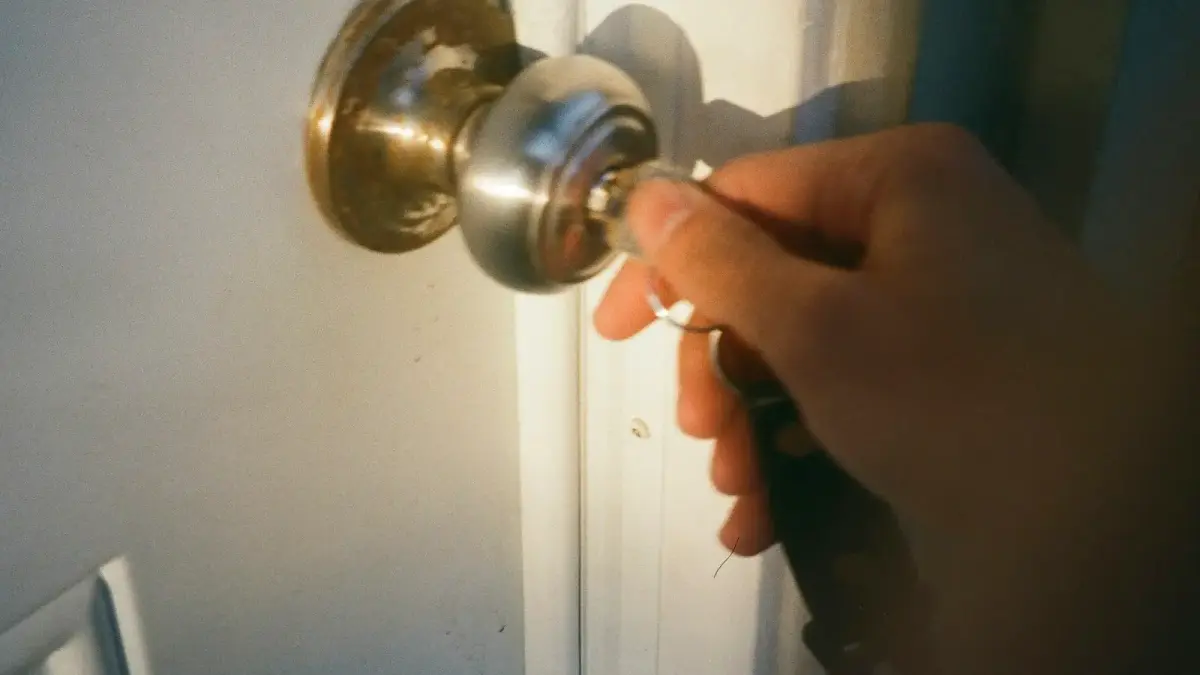
I do it every single night. Turn the key. Pull the handle. Feel the resistance. Walk toward the bedroom. And then - halfway down the hallway, sometimes already under the covers - feel that whisper rise up through my ribcage like a question I cannot put down.
Did I actually lock it?
I know I did. My hand remembers doing it. My ears registered the click. But knowing and feeling safe are two completely different languages, and my body has never been fluent in the first one.
For years I thought this made me neurotic. I thought something was wrong with me - some wire crossed, some fuse blown. But the more I studied the psychology of checking behavior, the more I understood something that changed how I saw myself entirely. I was not doubting the lock. I was doubting whether safety was something that could hold.
If you are someone who checks twice - who turns around in the driveway, who jiggles the handle one more time even though you just watched your own hand lock it - here are eight things you are almost certainly doing without realizing it, and what psychology says about every single one of them.
1. You are verifying safety, not verifying the lock
This is the distinction that changes everything. You already know the lock works. You watched yourself engage it. The mechanical question was answered the first time you turned the key.
What was not answered is the emotional question: am I safe now?
A 2019 study published in the Journal of Anxiety Disorders found that individuals with elevated checking behaviors did not have impaired memory for whether they had completed a task. Their recall was perfectly intact. What was impaired was their confidence in the emotional meaning of the completed action - the felt sense that the task had produced the desired state of security.
You do not go back because you forgot. You go back because your nervous system does not accept “locked” as a synonym for “protected.” Somewhere along the way, you learned that those two things could exist independently - that a locked door could still be the entrance to an unsafe night. And now your body demands a second confirmation not of the mechanism, but of the feeling.
2. You are running a childhood safety protocol that never got an expiration date
Most people who double-check locks did not develop the habit randomly. It came from somewhere. And when you trace it back honestly, you almost always arrive at a house where predictability was a luxury.
Maybe the rules changed depending on someone’s mood. Maybe bedtime was calm one night and a battlefield the next. Maybe “everything is fine” was something adults said right before everything was not fine.
Developmental psychologist Ed Tronick’s research on emotional availability showed that children who grow up with inconsistent caregiving develop heightened monitoring behaviors. They learn to scan, check, and re-verify - not because the world is inherently dangerous, but because the signals that were supposed to mean “safe” kept turning out to be unreliable.
Your lock-checking is not a glitch. It is an old protocol - a program that was written when you were too young to write it yourself, still running in the background because no one ever told your nervous system the original threat had passed.
3. You are practicing the only form of control that was ever available to you
Here is something I noticed about myself and about almost every person I have spoken to who checks locks compulsively: we were not controlling children. We were not rigid or demanding. We were, in fact, the opposite - adaptable, accommodating, always reading the room.
But the lock was the one thing we could actually manage. The one variable in the environment that responded to our input reliably. You turn the key, the bolt slides. Every time. No mood swings. No exceptions.
A 2016 study in Frontiers in Psychology found that checking behaviors often increase during periods when individuals feel a loss of agency in other areas of their lives. The checking is not the problem. It is the solution - the last remaining outpost of control in a landscape that feels ungovernable.
You check the lock because, for a long time, it was the only thing in your house that did exactly what you asked it to do.
4. You are carrying responsibility for safety that was never yours to carry
People who check locks twice tend to be the same people who check on everyone before they go to sleep. Who mentally inventory where every family member is. Who lie awake calculating whether the stove is off, the windows are shut, the car is in the garage.
This is not general anxiety. This is a specific pattern that psychologists call hyper-responsibility - the internalized belief that if something goes wrong, it will be because you failed to prevent it.
Gabor Mate has written extensively about how children in unstable homes often absorb the emotional labor of managing household safety. Not because anyone asked them to, but because the adults who were supposed to hold that role were unavailable, distracted, or the source of the danger themselves.
You check the lock twice because somewhere in your history, you became the person who was responsible for making the house safe. Not because you chose it. Because no one else was doing it, and you were too young to know that was not your job.
5. You have a body that treats uncertainty as physical danger
Most people experience an unlocked door as an inconvenience. A minor oversight. Something to fix and move on from.
You experience it as a threat that registers in your stomach before your brain can even name it.
A 2020 study published in Psychological Science examined how individuals with heightened checking behaviors process ambiguity. The researchers found that their nervous systems responded to uncertainty with the same physiological activation - elevated cortisol, increased heart rate, tightened breathing - that most people reserve for actual danger.
This is not weakness. This is a body that was trained in an environment where uncertainty and danger were genuinely the same thing. Where not knowing what was going to happen next was not a neutral state but a warning sign. Your nervous system is not overreacting. It is applying a lesson it learned perfectly well in a context where that lesson kept you safe.
The problem is not that your body is wrong. The problem is that it is still right about a house you no longer live in.
6. You are managing a gap between what you know and what you feel
This might be the most frustrating part. You know the door is locked. You are not confused. You do not have a memory problem. If someone asked you, “Did you lock it?” you would say yes without hesitation.
But feeling it - letting the knowledge settle into your body as actual calm - that is the part that will not land.
Daniel Goleman’s work on emotional intelligence describes this as a disconnect between cognitive processing and emotional processing. Your thinking brain completed the task. Your emotional brain is still waiting for evidence that the task produced the outcome it was supposed to produce. And for people who grew up in environments where correct actions did not reliably lead to safe outcomes, that gap can feel enormous.
You are not irrational. You are living in the space between knowing and believing, and that space was carved out a long time ago by an environment that taught you the two did not always match.
7. You are performing a ritual that your nervous system uses as a transition to rest
Pay attention to when the checking happens most intensely. It is almost always at night. Almost always during the transition from wakefulness to sleep. Almost always at the exact moment when you are being asked to surrender vigilance and trust the world to hold together without your supervision.
A 2018 study in the Journal of Research in Personality found that bedtime checking rituals were significantly more common among individuals who scored high on measures of emotional vigilance - people whose nervous systems remained in a low-grade scanning mode throughout the day and required a specific behavioral sequence to downregulate before sleep.
The lock check is not about the lock. It is about permission. Your body needs to complete the circuit - key, handle, resistance, confirmed - before it will allow you to close your eyes. It is the last item on a checklist your nervous system wrote decades ago, and skipping it feels not just careless but physically unsafe.
You are not being compulsive. You are asking your body for permission to rest, and your body has a very specific set of requirements before it will say yes.
8. You are someone who learned that love and safety are not the same thing
This is the one that sits deepest. The one that most people who check locks will recognize instantly and then try to look away from.
You grew up in a home where you were loved. Maybe genuinely, maybe imperfectly, but loved. And yet you did not feel safe. The love was real, but it did not protect you from the chaos, the unpredictability, the walking-on-eggshells quality of a house where the emotional weather could change without warning.
Research on attachment by psychologist Mary Ainsworth showed that children do not need perfect parents. They need predictable ones. A child can tolerate difficulty if the difficulty is consistent. What dysregulates a child’s nervous system is not hardship but randomness - the sense that safety is not a state but a gamble.
You check the lock because you learned the most painful lesson a child can learn: that someone can love you and still be the reason you do not feel safe. And rather than hold that contradiction in your chest forever, you found something you could verify. Something that gives you the same answer every time. Something that never changes its mind about whether to protect you.
The lock does not love you. But it is consistent. And for a nervous system that grew up without consistency, that is worth checking twice.
If you recognized yourself in any of this, I want you to know something. The checking is not a flaw. It is not a disorder. It is not something you need to fix or fight or feel ashamed of.
It is evidence that your nervous system did its job. It kept you safe in a world that was not reliably safe. It built a protocol out of the only materials it had - a lock, a handle, a moment of resistance that meant the bolt was home.
You are not broken for needing to verify. You are someone whose body learned that trust has to be earned one click at a time. And the fact that you still do it - still walk back, still pull the handle, still stand in the dark for three extra seconds waiting for your chest to settle - that is not weakness.
That is a person who never stopped trying to make the world feel as safe as it should have felt all along. And I think that deserves a softer word than neurotic. I think it deserves something closer to brave.