8 things people who always use their turn signal in an empty parking lot - who signal a lane change on a highway with nobody behind them for two miles, who flick the blinker before turning into their own driveway at midnight - do according to psychology, because a child who grew up in a house where the rules were unpredictable and the consequences for breaking them were disproportionate to the infraction built her own code of conduct she could carry in her body, and the woman at fifty-one who signals for no audience is not performing obedience but running the only version of safety her nervous system has ever trusted
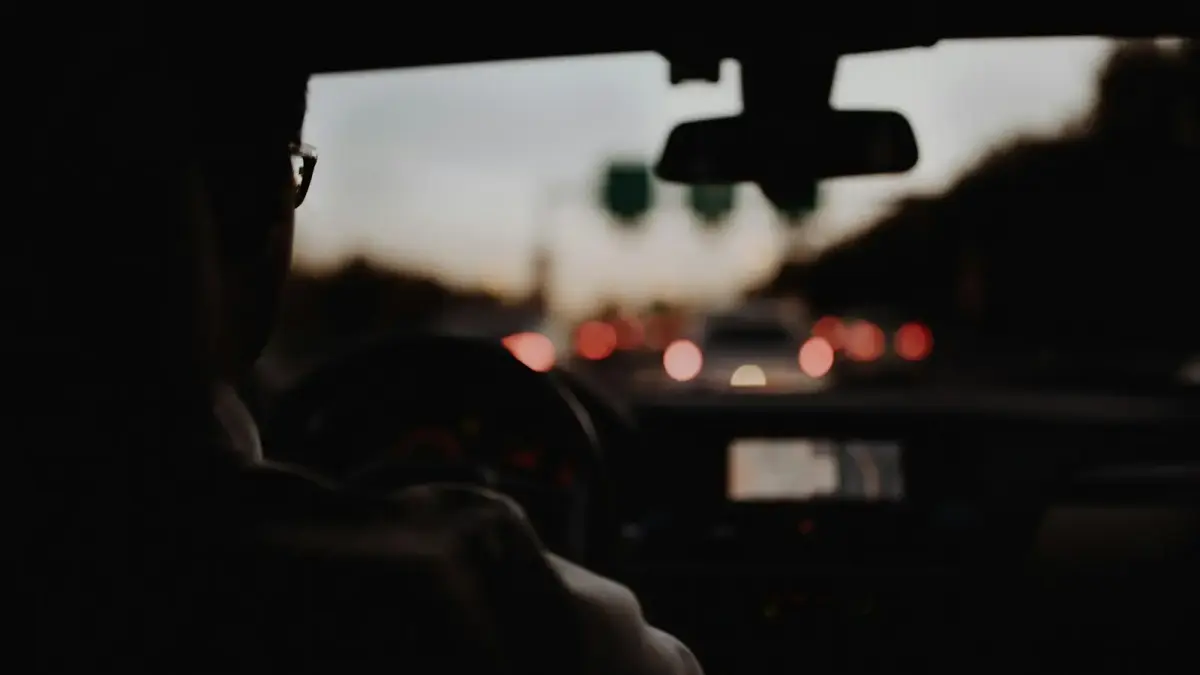
I signal before turning into my own driveway. Every single time. It’s eleven at night, nobody’s on the street, the porch light is the only witness, and my left hand still reaches for the stalk like it’s keeping a promise I made to someone a long time ago.
I used to think it was just habit. Muscle memory from driver’s ed that never wore off. But last winter I caught myself doing it in an empty parking garage - not a soul on any level, my car the only one left - and the click of the blinker echoed off the concrete walls, and I realized I wasn’t signaling for anyone else. I was signaling for me.
There’s a version of this that people laugh about online. The “good citizen” jokes, the gold-star-student memes. But if you’re someone who does this - who follows rules that have no audience - you know it doesn’t feel like being a good citizen. It feels like something you can’t stop doing. Something your body chose for you before your brain had a say.
And according to psychology, that instinct has roots far deeper than most people realize.
1. You use your turn signal in an empty parking lot
This is the one that gives you away. Not the highway signal, not the intersection signal - those have practical reasons. The empty parking lot signal is pure. Nobody will see it. Nobody will benefit from it. And you do it anyway, every single time, because something in your chest would feel wrong if you didn’t.
A 2019 study published in the Journal of Personality and Social Psychology found that people who consistently follow rules in the absence of external enforcement tend to have internalized moral frameworks that operate independently of social reward. The researchers called it “autonomous regulation” - behavior that isn’t driven by fear of punishment or desire for approval but by an internal code that feels as real as gravity.
What they didn’t say, but what you already know, is that this kind of code doesn’t come from nowhere. It comes from growing up in a place where the rules kept changing. Where a thing that was fine on Tuesday could get you screamed at on Thursday. A child in that house learns very quickly that she can’t control the rules outside her - so she builds ones inside her that never shift.
2. You follow the speed limit on empty roads at three in the morning
The highway is yours. No headlights behind you, no taillights ahead. Just pavement and darkness and the kind of quiet that makes the engine hum feel like a heartbeat. And you’re going exactly sixty-five.
Not because you’re afraid of a speed trap. Not because you’re a cautious driver. Because breaking the rule - even this one, even now, even with no possible consequence - would create a tiny fracture in the structure you’ve spent your whole life building.
People who grew up with unpredictable consequences don’t experience rule-breaking as freedom. They experience it as freefall. The rules aren’t constraints to you. They’re the floor. And you don’t test floors. Not when you spent your childhood never knowing which boards would hold.
3. You hold the door for people who are too far away to need it held
You’ve done this. You’ve committed to holding a door for someone who’s still twenty feet away, and now you’re both trapped in that awkward moment where they feel obligated to speed up and you feel obligated to keep standing there smiling like a cheerful doorstop.
It’s not about manners, though it looks like it is. It’s about the cost of getting it wrong. What if you let go and they were closer than you thought? What if they noticed? What if they felt dismissed?
Psychologist Gabor Mate has written extensively about how children who grow up in emotionally volatile environments develop hyper-awareness of other people’s comfort. They become experts at scanning for displeasure. Holding the door too long isn’t generosity - it’s insurance. You’d rather feel silly for over-helping than risk the micro-devastation of someone thinking you didn’t care enough.
4. You say “thank you” to automated phone systems and self-checkout machines
You’ve thanked a robot. You’ve said “please” to a screen that doesn’t have ears. And the wildest part isn’t that you do it - it’s that you can’t stop doing it. Even when you notice. Even when you laugh at yourself. The next time you check out at the self-serve register, you’ll say “thanks” to the beep.
This isn’t quirkiness. This is a nervous system that trained itself to be polite before it could afford not to be. In a house where a wrong tone could set off an avalanche, politeness wasn’t etiquette. It was armor. And your body never got the memo that the war ended.
A 2021 study in Frontiers in Psychology found that individuals with heightened rejection sensitivity - often rooted in early attachment disruption - tend to extend social behaviors even to non-social objects. The researchers framed it as a kind of emotional overgeneralization. Your system can’t tell the difference between a person and a machine because the protocol is the same: be pleasant, be safe, be small enough that nothing comes for you.
5. You never jaywalk even when there are no cars for blocks
The crosswalk button has been pressed. The street is deserted. A tumbleweed could cross without incident. And you’re standing there, waiting for the little white walk signal, because that’s the rule and you don’t break rules, not even the ones that exist only as a suggestion.
People watch you do this and think you’re either very patient or very rigid. They don’t understand that the street isn’t the point. The waiting is the point. The waiting is the thing you can control. And for someone who spent formative years in a house where nothing was controllable - not the mood, not the volume, not the reason you were suddenly in trouble - controlling this one small thing feels like breathing.
Daniel Goleman’s work on emotional self-regulation describes how children in chaotic environments often develop what he calls “compensatory control behaviors” - rituals and rules they impose on themselves to create the predictability their environment refused to offer. Jaywalking isn’t a crime to you. It’s a crack in the dam.
6. You alphabetize things nobody else will ever look at
Your spice rack is in order. Your bookshelf follows a system. The files on your computer are nested in folders that have sub-folders that have their own quiet logic, and nobody has ever opened them but you, and nobody ever will, and you maintain them anyway.
This one tends to embarrass people. It feels excessive. It feels like something you should have outgrown. But the woman who alphabetizes her junk drawer at forty-seven isn’t performing neatness. She’s maintaining a world she can predict. Every label facing forward, every container in its place - that’s not organization. That’s architecture. She’s building the house she didn’t get to grow up in.
A 2017 study in the Journal of Research in Personality found a strong correlation between childhood environmental instability and adult need for personal order. The researchers noted that this wasn’t the same as clinical perfectionism. It was closer to a form of self-soothing - creating micro-environments of certainty in a world that once offered none.
7. You arrive exactly on time even when “whenever you get here” was the actual instruction
Someone tells you the party starts “around seven-ish” and you’re in their driveway at 6:58, engine off, checking your phone until 7:01 because showing up at exactly seven felt too precise and you didn’t want to seem intense.
You’ve never been late. Not to anything that matters. Not to most things that don’t. And the effort required to maintain this record is something you rarely talk about, because people would find it strange - the way you reverse-engineer drive times, account for traffic, leave buffers inside of buffers.
But you’re not doing this because you value punctuality. You’re doing this because somewhere in your history, being late meant something terrible. Maybe it was a parent who interpreted tardiness as disrespect. Maybe it was a household where any deviation from expectation was treated as defiance. Susan Cain has written about how the quiet children - the ones who watched and adjusted and tried to disappear into compliance - often carry those reflexes into adulthood as a kind of invisible choreography. You arrive on time because the alternative still feels dangerous, even when the only thing at stake is a backyard barbecue.
8. You correct small errors that nobody but you would ever notice
The picture frame is crooked by two degrees. The receipt is off by a penny. The volume on the TV is set to an odd number. And you fix it. Quietly, without mentioning it, without expecting anyone to notice or care. You just reach over and straighten the thing because leaving it wrong would sit in your chest like a splinter.
This is the behavior that reveals the whole pattern. You’re not fixing the frame. You’re fixing the feeling. The crooked frame isn’t a problem - it’s a signal. It’s your nervous system whispering that something is off, that disorder leads to danger, that the only person who’s ever reliably kept things from falling apart is you.
And the penny on the receipt? That’s not about money. That’s about a child who learned that small things could become big things without warning. Who learned that an unwashed dish could become a lecture, a lost sock could become a punishment, a wrong look could become an evening you’d rather forget. You correct the penny because your body still believes that if you let small errors go, large consequences follow.
I want to be careful here, because I know how this reads. It reads like damage. Like something that needs to be fixed.
But I don’t think it does.
The woman who signals in an empty parking lot built something extraordinary. She took a childhood that offered no reliable structure and constructed one from scratch - not from fear, but from a need for something she could trust. Her own code. Her own floor. Her own quiet promise that at least this one thing would be consistent.
Brene Brown once wrote that the people who build the most rigid systems of personal integrity are often the ones who had the least of it modeled for them. They didn’t inherit their values. They invented them. And they carry them in their bodies like a second skeleton.
If you’re someone who follows rules nobody else can see, I want you to know something. You’re not rigid. You’re not strange. You’re not performing goodness for an audience that isn’t there.
You’re running the operating system you built to survive. And it worked. It got you here. The blinker clicks in the dark, and nobody hears it, and it still matters - because it was never for them.
It was always for you.