8 things that quietly happen to people who became the family photographer - the one always behind the camera at every holiday, every birthday, every graduation - because a child who learned that the safest way to belong in a room was to make themselves useful to it grew up with proof that everyone else was present and almost no evidence they were ever there, according to psychology
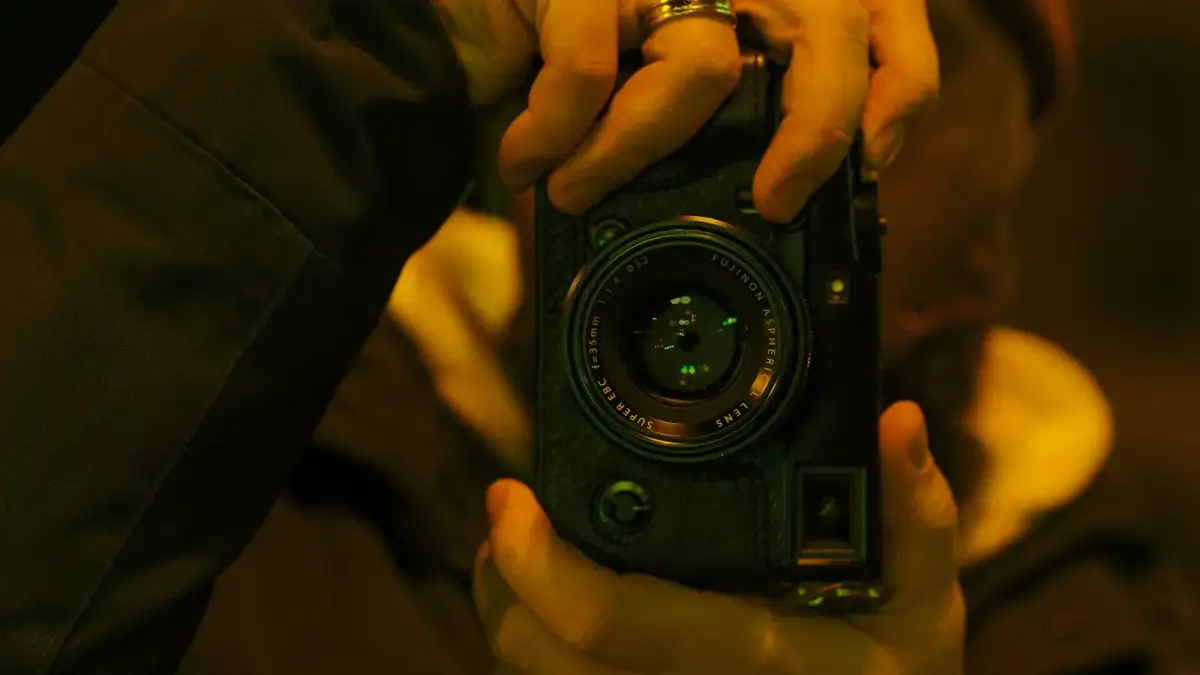
I found a box of photographs in my mother’s closet last year. Hundreds of them. Christmases, beach vacations, first days of school, backyard birthdays with crooked cakes and paper streamers. Everyone was in those pictures - my brother blowing out candles, my parents slow-dancing at a cousin’s wedding, my grandmother holding a baby on Easter morning.
I wasn’t in a single one.
Not because I wasn’t there. I was at every single event. I was the one holding the camera. I was the person who said “get closer, everyone” and “one more, just in case.” I documented twenty years of family life with extraordinary care, and the proof of my presence is a shadow in the corner of a few frames where the afternoon light caught me at the wrong angle.
It took me a long time to understand what that meant. Not just logistically - of course the photographer isn’t in the photo - but emotionally. Because I didn’t just happen to pick up the camera. I reached for it. Every time. Before anyone asked. I reached for it because holding it gave me something I desperately needed: a reason to be in the room that nobody could question.
If you were that person in your family, you already know exactly what I’m talking about.
1. You learned early that being useful was safer than being seen
There’s a difference between a child who picks up a camera out of curiosity and one who picks it up out of survival. You weren’t drawn to photography as an art form. You were drawn to the role it gave you.
When you were behind the camera, nobody questioned why you were there. You had a job. You were contributing. You were the one making sure the moment got saved, and that made you essential without requiring you to be vulnerable.
A 2019 study published in the Journal of Personality and Social Psychology found that children who grow up in emotionally unpredictable households often develop what researchers call “functional belonging” - they secure their place in the family system not through emotional connection but through usefulness. The camera was your version of that. It made you necessary.
And the thing about being necessary is that it feels almost like being wanted. Almost.
2. You instinctively offer to take the group photo - even with strangers
It happens without thinking. A family at a restaurant asks a waiter to take their picture and you’re already standing up, already reaching out your hand, already saying “I can do it.” Friends gather for a selfie and you step back to get a wider shot instead of squeezing in.
You don’t even register it as a choice. It’s muscle memory. The moment a camera appears, your body knows its assignment: step behind it.
What looks like generosity is actually a deeply rehearsed exit strategy. You’ve spent your whole life practicing how to remove yourself from the frame while still being present in the room. You’ve gotten so good at it that people think you’re just being nice.
You are being nice. But you’re also disappearing. And you’ve been doing it so long that the two feel like the same thing.
3. Being photographed makes you physically uncomfortable
When someone points a camera at you, something tightens in your chest. Your smile goes stiff. You angle your body away, or you make a joke, or you duck behind someone taller. “I’m not photogenic,” you say. “Take one of them instead.”
But it’s not really about how you look. It’s about what it means to be looked at. To be the subject instead of the observer. To stand in the center of a frame and say, by your presence alone, “I was here. I mattered enough to be captured.”
That feels like a claim you were never taught you were allowed to make.
Dr. Brene Brown’s research on vulnerability speaks directly to this - the idea that being truly seen requires a willingness to be exposed, and that for people who grew up equating visibility with risk, something as simple as a photograph can feel like an act of terrifying exposure. You’re not camera-shy. You’re visibility-shy. There’s a difference.
4. You create the memory but never appear in it
You know exactly what the light looked like at your daughter’s sixth birthday. You remember the angle of your father’s smile at Thanksgiving in 2014. You can describe the color of the sky behind your best friend on the day she got engaged, because you framed it, focused it, and pressed the shutter.
But if someone asked for proof that you were there, you’d have nothing.
This is the strange math of your life: you are the architect of everyone else’s memories and a ghost in your own. You have given the people you love an extraordinary gift - a visual record of their lives, organized and preserved with genuine tenderness. And in return, you have almost no evidence that you existed alongside them.
A 2021 study in Frontiers in Psychology found that people who habitually document experiences for others rather than participating in them often report a diminished sense of what researchers called “experiential ownership” - the feeling that their own life is real and fully lived. You were there for all of it. But the proof says otherwise.
5. You have a hard time being the center of attention - even when it’s your turn
Your birthday. Your graduation. Your retirement dinner. The moments that are supposed to be about you make you want to crawl out of your skin. You deflect compliments. You redirect conversations. You make sure the spotlight lands on anyone else as quickly as possible.
This isn’t modesty. This is a practiced disappearance.
When you spent your childhood making yourself useful instead of visible, being the center of attention doesn’t feel like celebration. It feels like exposure. Like standing in an open field with no role to play and no task to hide behind. The camera was your shield, and without it, you feel naked.
People call you humble. People say you’re so selfless. And you smile and accept it, because it’s easier than explaining that you never learned how to receive attention without feeling like you’re taking up space that doesn’t belong to you.
6. You notice everything about other people but struggle to describe yourself
Ask you about your sister’s laugh and you can write three paragraphs. Ask you about the way your father’s hands looked when he was tired and you’ll give details so precise they sound like poetry. You are an extraordinary observer of other people’s lives.
Ask you to describe yourself and you go blank.
This is what happens when you spend decades looking outward through a viewfinder. You develop an exquisite sensitivity to other people’s expressions, moods, and moments - and almost no practice turning that attention inward. You know what everyone else looks like in their most honest moments because you’ve been watching. You have no idea what you look like in yours because nobody was watching you.
Susan Cain’s work on introversion touches on this pattern - the way that quiet observers often develop deep perceptual skills at the cost of self-knowledge. You became fluent in everyone else’s story. Your own remains largely unwritten.
7. You preserve things for other people that you’d never preserve for yourself
Your phone has thousands of photos - of your kids, your partner, your friends, your parents, sunsets you wanted someone else to see. You organize them into albums. You print the good ones. You make sure the people you love have a record of their lives.
Your own phone has maybe three photos of you from the last five years, all taken by someone else, all slightly awkward, all making you think “I should delete that.”
You are meticulous about preserving other people’s existence and careless about preserving your own. Not because you don’t matter to yourself, but because somewhere deep down, you absorbed the idea that your value lies in what you create for others, not in your own presence. The album of your life is filled with everyone but you.
And the heartbreaking part is that someday, the people who love you will look for photos of you - at holidays, at graduations, at ordinary Tuesday dinners - and they’ll find almost nothing. Not because you weren’t loved. Because you never let yourself be captured.
8. You’re only now starting to realize that being in the picture was never really about the picture
This is the one that takes the longest to land.
The camera was never really a camera. It was a coping mechanism. It was the tool you used to solve an impossible childhood equation: how do I belong in this room without anyone having to make space for me?
And you solved it beautifully. You found a role that made you essential, invisible, and safe all at the same time. You became the person who holds the memory, who frames the moment, who makes sure nothing important gets lost - except yourself.
A 2020 paper in the Journal of Research in Personality found that adults who developed “service-based identity” patterns in childhood - where their sense of self was built around what they provided rather than who they were - often struggle in midlife with what the researchers called “presence anxiety.” The fear of simply being in a room with no function. No task. No camera. Just you.
But here’s what I want you to hear: the fact that you documented everyone else’s life with such care is not a flaw. It’s evidence of an enormous capacity for love. You just forgot to include yourself in it.
You were there for all of it. Every holiday. Every birthday. Every graduation. The fact that the photos don’t show it doesn’t mean it didn’t happen.
It just means that someone needs to turn the camera around now. And that someone might have to be you.
It won’t feel natural at first. It might feel vain or unnecessary or uncomfortable in a way you can’t quite name. But the people who love you don’t need another beautiful photo of themselves. They need proof that you were there too. They need to open a box in thirty years and find your face in the frame - not behind it.
You spent a lifetime making sure everyone else was remembered. You deserve to be remembered too. Not for what you did for the room, but for the simple, irreplaceable fact that you were in it.