Boys who grew up in working-class homes where their fathers came home too exhausted to speak often become men who can only show love through what they can fix, build, or carry to the car, because the only version of devotion they ever witnessed was a man quietly using his body until it gave out
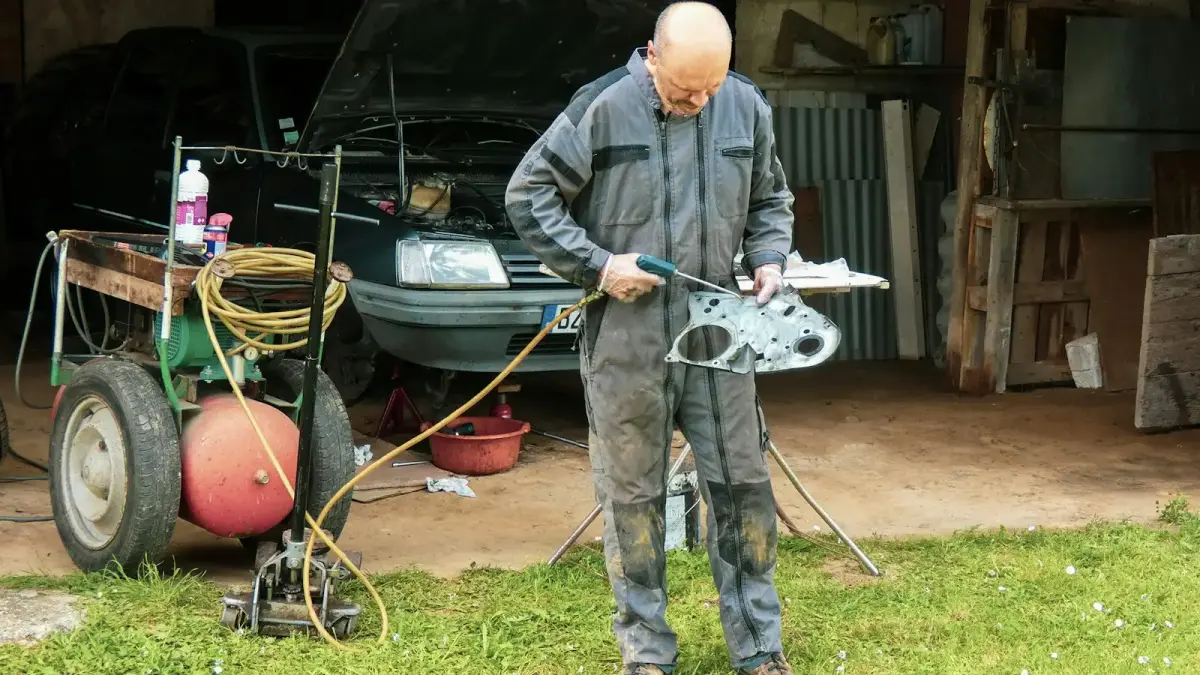
My father smelled like joint compound and coffee every single night of my childhood. He came through the side door - never the front, because his boots were too dirty - set his thermos on the counter, and sat in the brown recliner without saying a word.
I used to think he was angry. I’d scan his face for clues. My mother would set a plate in front of him, and he’d eat it slowly, staring at a spot on the wall just above the television. Forty-five minutes. Sometimes an hour. Then he’d get up, wash his plate, and go check whether the back gate was still sticking.
He wasn’t angry. He was empty. Not emotionally empty - physically depleted in a way that left no room for language. He’d given everything he had to a construction site that didn’t know his name, and what walked through our door each evening was whatever was left.
I didn’t realize until I was well into my forties that I had been taking notes the entire time.
The Lunch Pail on the Counter
There’s a very specific image that men like me carry around without ever naming it. A metal lunch pail, dented, with a clasp that doesn’t quite close anymore. A pair of work boots by the door, laces still tied because he just stepped out of them. A jacket hung on the same hook for twenty years, the shape of his shoulders pressed permanently into the fabric.
These are not nostalgic details. They are the artifacts of a curriculum.
What we learned, watching our fathers come home like that, was a complete philosophy of love. It was never spoken because it didn’t need to be. Love was the act of leaving the house before anyone else woke up. Love was a body that ached in places a fifty-year-old man shouldn’t ache. Love was a paycheck signed over entirely, keeping nothing for yourself.
A 2015 study published in the Journal of Family Issues found that working-class fathers were significantly more likely than their middle-class counterparts to define good fathering through provision and physical labor rather than emotional engagement - not because they valued emotional connection less, but because their own upbringing and work environments offered no framework for it.
My father didn’t sit me down and explain his theory of love. He didn’t have one, at least not in words. But every morning he laced up those boots and walked out into the dark, and every evening he came back with his body a little more used up than the day before. That was the lesson. That was the entire curriculum.
The Language We Learned Instead
I can fix almost anything in a house. I can re-grout tile, replace a garbage disposal, patch drywall so clean you’d never know there was a hole. I taught myself all of it, and I taught myself early, because in our house, calling someone to fix something was an admission of defeat.
My father could fix anything too. It was the one time I saw him fully alive after work - on a Saturday morning, with a problem to solve. A running toilet. A fence post that had shifted. The car making a sound it shouldn’t make. He’d disappear into the garage and come back hours later, hands black with grease, and there would be something quiet on his face that I now recognize as satisfaction.
He was speaking. That was the thing I didn’t understand for decades. He was speaking the entire time.
The men I grew up with all learned this same dialect. We carry every grocery bag from the car in one trip - not because it’s efficient, but because somewhere deep in our operating system, providing through physical effort is the most fluent thing we know. We insist on paying the check. We show up when you’re moving apartments. We drive four hours to fix your mother’s porch railing and drive four hours back the same day.
Dr. Gary Chapman’s framework of love languages gave us the phrase “acts of service,” and it’s useful enough. But it doesn’t quite capture what’s happening here. This isn’t a preference on a quiz. This is a mother tongue. It’s the only language some of us were ever taught, and we speak it with a fluency that would be recognized as eloquence if anyone were still listening.
What the Factory Floor Didn’t Teach
Here’s what the loading dock and the job site and the warehouse floor had in common: none of them asked how you were feeling.
You showed up. You did the work. If you were hurt, you decided whether you could keep going. If you were sad, you didn’t mention it. If you were scared about money or your marriage or the weird pain in your chest, you worked through it - literally. You put the feeling into your hands and you moved something heavy from one place to another, and by the end of the shift, the feeling had been converted into exhaustion, which was at least familiar.
A 2019 study in Psychology of Men and Masculinities found that men in manual labor occupations reported significantly higher levels of alexithymia - difficulty identifying and expressing emotions - than men in other fields. The researchers didn’t frame this as a personal failing. They framed it as an adaptation. These men had learned to regulate emotion through physical exertion in environments where verbal emotional expression was not just unsupported but actively penalized.
Our fathers brought that adaptation home with them every night. And we absorbed it the way children absorb everything - completely, uncritically, and permanently.
I didn’t learn that feelings had names until I was in my thirties. I’m not exaggerating. I knew “fine” and “tired” and “frustrated,” and that was the entire vocabulary. When my wife asked me how I felt about something, I would feel a sensation in my chest that I now know was emotion, and I would immediately start thinking about what I could do. What could I fix. What task could I complete that would make this feeling go away and make her feel taken care of at the same time.
The Request They Cannot Parse
Something happens to these men in their fifties. Their wives - patient, loving women who have spent twenty or thirty years receiving love in the form of fixed appliances and snow-cleared driveways - finally say the thing they’ve been holding.
“I just want you to talk to me.”
And the man hears it the way you’d hear someone suddenly speaking a language you’ve never studied. The words are clear enough individually. But the sentence doesn’t compile. Talk about what? He’s right here. He’s been right here for thirty years. He re-stained the deck last weekend. He drove her mother to three doctor’s appointments last month. What does she think all of that was?
This is the cruel part of the pattern. The men feel accused of something they can’t name. The women feel unseen by the person standing right in front of them. And both of them are telling the truth.
Research by Dr. John Gottman at the University of Washington has shown that emotional bids - small attempts to connect through conversation, touch, or shared attention - are the single strongest predictor of relationship longevity. Couples who consistently turn toward each other’s bids stay together. Couples who turn away dissolve.
But here’s what the research doesn’t always acknowledge: a man who gets up at five in the morning to scrape ice off his wife’s windshield before she leaves for work is making an emotional bid. It just doesn’t look like one if you’ve been taught that emotional bids only come in the form of words.
The Body as a Love Letter
I want to talk about what it costs.
My father’s knees were gone by sixty. His back had been a problem since his forties. His hands - the hands that fixed everything, that built our deck, that replaced the engine in a 1987 Chevy in our driveway over the course of a single weekend - were swollen at the knuckles and stiff every morning.
He never complained about any of it. Not once. Because the pain was part of the contract. The body was the instrument of love, and if the instrument wore out, that was just the price of the music.
I watched him lower himself into a chair at family dinners with a carefulness that broke my heart even before I understood why. He was sixty-five years old and he moved like a man who had been in a slow-motion collision for forty years. Because he had been. Every day on that job site was an impact. Every evening he came home was a small survival.
And yet he’d still get up if he heard a drip somewhere in the house. Still grab his toolbox if someone mentioned that their car was making a noise. The body was failing and the man was still trying to speak through it, because it was the only microphone he’d ever been given.
A Fluency the World Stopped Honoring
Here is what I want you to hear, if you are the son of one of these men, or if you are one of these men yourself.
You are not emotionally unavailable. You are not broken. You are not deficient in some fundamental human capacity that other people seem to possess naturally.
You are fluent in a language of devotion that the world has largely stopped speaking. The vocabulary is physical. The grammar is sacrifice. The punctuation is showing up, again and again, with your hands and your time and your body, even when it costs you, especially when it costs you.
The problem is not that your love is insufficient. The problem is that the culture shifted, and now the people you love most need something you were never taught to give. That’s not a character flaw. That’s a gap in your education, and gaps can be filled.
You can learn the new words without abandoning the old ones. You can sit on the couch and tell your wife about the hard day without believing it makes you less of a man. You can say “I’m scared” or “I’m sad” or “I don’t know what I’m feeling but I want to figure it out with you” - and the deck you built, the tires you changed, the thirty years of showing up with your body will still count. All of it still counts.
Your father gave you everything he had. It just happened to be a language built for a world that was already disappearing. And the fact that you learned it so well - that you still carry every bag in one trip, that you still lie awake thinking about the sound the furnace is making, that you still believe love is something you prove with your hands - that tells me exactly how much you were paying attention.
That tells me you loved him back in the only language you shared.
And that is not a small thing. That has never been a small thing.