There are men who still keep their father's tools in the garage - the handsaw with the worn grip, the level that does not quite sit true anymore, the wrenches organized by size on a pegboard that has not been rearranged since 1987 - not because the tools are useful but because holding them is the closest thing to a conversation they will ever have with a man who died without finishing the sentence he started the night he almost said I am proud of you
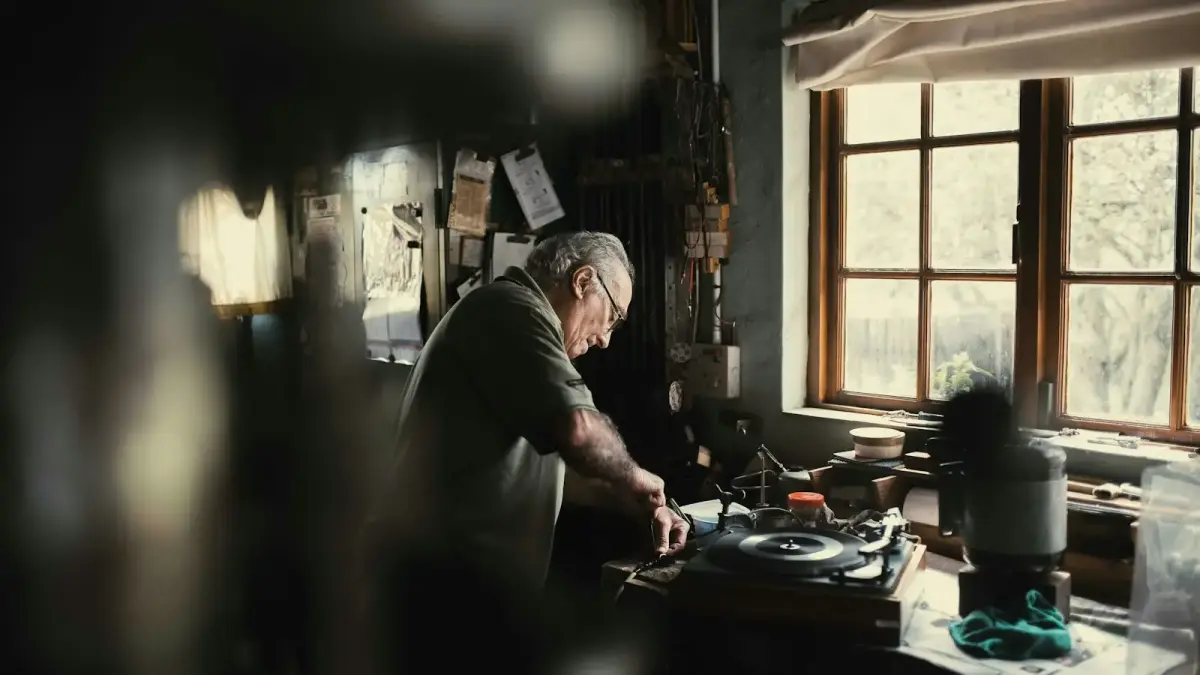
My father’s handsaw is hanging on the wall in my garage right now.
The grip is worn smooth on the right side where his thumb sat. The blade has a slight bow to it from years of cutting through things that probably didn’t need cutting - scrap lumber, old fence boards, branches he could have snapped by hand. There’s a nick near the handle that I’ve never been able to explain, and I’ve stopped trying. Some damage just belongs to the person who made it.
I don’t use the saw. I haven’t used it in years. But I know exactly where it is, the same way I know where my own hands are in the dark.
If you asked me why I keep it, I’d say something practical. Something about how they don’t make them like that anymore. And that would be a lie dressed up in flannel, because the truth is harder to hold than any tool on that wall.
The pegboard hasn’t moved
There’s a specific kind of man I’m talking about, and if you’re one of them, you already know.
You’re the one who inherited a garage full of tools you didn’t ask for, organized in a system you didn’t design, and you’ve kept every single piece exactly where it was. The wrenches still go by size, smallest on the left. The screwdrivers still hang from the same hooks, Phillips on top, flathead below. There’s a coffee can on the workbench full of nails and screws and washers that have been mixed together since before you had a mortgage.
You tell yourself you’ll sort through it someday. You won’t. And you know you won’t.
Because sorting through it would mean deciding what matters and what doesn’t, and you’re not ready to make that call about any of it. Every bolt, every washer, every stripped screw he never threw away - they all carry the same weight now. The weight of a man who was here, and then wasn’t.
A 2015 study published in the Journal of Consumer Research found that people assign significantly more value to objects that have been physically touched by someone they love, particularly after that person has died. The researchers called it “contagion” - the belief that something essential about a person transfers into the things they held. It’s not rational. It doesn’t have to be. Grief has never once asked for your permission to be irrational.
What the workshop really is
I started spending time in my garage about six months after my father died.
I didn’t have a project. I didn’t have a plan. I just started going out there after dinner, turning on the overhead light - the same fluorescent tube he installed, still buzzing the same way - and standing at the workbench. Sometimes I’d pick something up. A clamp. A plane. The level that pulls slightly to the left and hasn’t been true since maybe 1994.
I’d hold it. Turn it over. Set it back down.
My wife asked me once what I was building out there, and I said “nothing” in a tone that made her stop asking. That’s its own kind of inheritance - the way men learn to close a door with a single word.
But the truth is I was building something. I was building the closest thing I could get to a room where my father still existed. Where his hands had touched every surface. Where the sawdust in the cracks of the concrete was partly his sawdust - cells from his skin mixed into it, particles of him ground into the floor by boots he wore through at the heel.
The workshop is not a hobby. For men like us, it is a chapel.
You go there not to make things but to be in the presence of someone who can’t be present anymore. You pick up his tools the way a person picks up a hymnal - not because you know all the words, but because holding it connects you to something larger than what you can say.
The sentence he never finished
Here is the part that sits in your chest like a stone.
There was a night. Maybe more than one, but there’s always one you remember. He was standing at the kitchen counter, or sitting in his chair, or leaning against the truck in the driveway. And he started to say something. You could see it gathering behind his face the way weather gathers. His jaw moved slightly. His eyes went somewhere you couldn’t follow.
And then he didn’t say it.
He said something else instead. Something about the oil in the car, or the gutters, or whether you’d eaten. Something so ordinary it was almost violent, because you could feel the other sentence - the real one - retreating back into whatever room inside him where real things went to die unsaid.
Dr. Terrence Real, a therapist who has spent decades working with men and emotional inheritance, has written extensively about what he calls “covert depression” in men - the way an entire generation of fathers learned to convert tenderness into silence, and silence into distance. They didn’t withhold love because they didn’t feel it. They withheld it because no one ever showed them the door out of themselves.
Your father wasn’t cold. He was trapped. And the tools in your garage are the only language he had fluency in. When he handed you the wrench and said “hold this,” that was the sentence. That was the whole sentence.
Holding things for men who couldn’t hold anything
There’s a reason you organize the wrenches the same way he did.
It’s not efficiency. It’s not habit. It’s that the order itself is a kind of conversation. When you put the half-inch next to the nine-sixteenths, you’re agreeing with him. You’re saying yes, this is how it should go. You’re finishing a thought he started on a Saturday in 1983 when you were standing next to him learning that love between fathers and sons sometimes looks like two people staring at an engine block and saying nothing for forty-five minutes.
A 2020 study in Frontiers in Psychology examined how bereaved individuals use physical objects as “continuing bonds” with the deceased. The researchers found that men, in particular, were more likely to maintain connection through functional objects - tools, watches, jackets - rather than photographs or letters. The objects had to do something. They had to have a purpose, even if that purpose had long since expired.
Because that’s the template, isn’t it? Men were taught that you earn your space by being useful. Your father believed it. You believe it. And the tools believe it too, hanging there on the wall, pretending they still have jobs to do.
But you know what they’re really doing. They’re holding the shape of his hands. They’re keeping the impression warm.
The garage at sixty
I’m going to tell you something about getting older that no one prepares you for.
At some point - maybe fifty-five, maybe sixty, maybe the Tuesday after a routine physical where the doctor says something about your cholesterol with a tone you don’t love - you walk into the garage and you realize you’ve become the age your father was when he started to disappear.
Not dying. Disappearing. Getting quieter. Spending more time out in the shop. Answering questions with fewer words. Standing at the window for a long time without explaining why.
And you look down at your hands and they look like his hands. The same knuckles. The same veins rising under skin that’s gotten thinner than you expected. You pick up the handsaw and your thumb fits perfectly into the groove he wore into the grip, and for one second - just one - the boundary between you and him dissolves entirely.
You are him. He is you. The saw doesn’t know the difference.
This is the moment the garage becomes something sacred. Not in any religious way, but in the way that a place becomes holy when enough longing has been pressed into its walls. You’ve been coming here for years, holding his tools, breathing air that still smells faintly of motor oil and pine, and all of that accumulated presence has turned the space into something a church only wishes it could be - a place where the dead are actually, physically present. In the grain of the wood. In the rust on the blade. In the sawdust that you will never, ever sweep up.
What you’re really building
A 2019 study published in the Journal of Personality and Social Psychology found that unresolved conversations with deceased parents remain psychologically active for decades - that the brain continues to “rehearse” what it wanted to say, and what it wanted to hear, long after the possibility of either has passed.
You know this without the study. You’ve been rehearsing for years.
Every time you pick up a tool, you’re picking up the conversation. Every time you tighten a bolt or square a joint or measure twice before you cut, you’re saying something back to a man who can’t hear you. You’re saying I learned this from you. You’re saying I was watching even when you thought I wasn’t. You’re saying the thing he couldn’t say, because maybe if one of you says it, it counts for both.
I keep my father’s handsaw on the wall because it is the last place on earth where his hand and mine can occupy the same space.
I keep the level that doesn’t sit true because nothing about grief sits true, and it would be dishonest to pretend otherwise.
I keep the wrenches organized by size because he organized them by size, and agreeing with a dead man about the order of wrenches is the gentlest form of love I know how to practice.
If you’re reading this in a garage right now, with sawdust under your feet and your father’s tools on the wall - I want you to know something.
The sentence he started that night? He finished it. He finished it every time he handed you a tool and trusted you to hold it. He finished it every time he let you stand next to him while he worked, which was his way of saying there is no place I would rather you be.
You heard it. You just didn’t know you were listening.
You’re not broken for keeping all of this. You’re not stuck. You’re not sentimental in some way that needs fixing.
You’re a man standing in a room your father built, holding the things your father held, and that is its own kind of prayer. The most honest kind. The kind that doesn’t need any words at all.