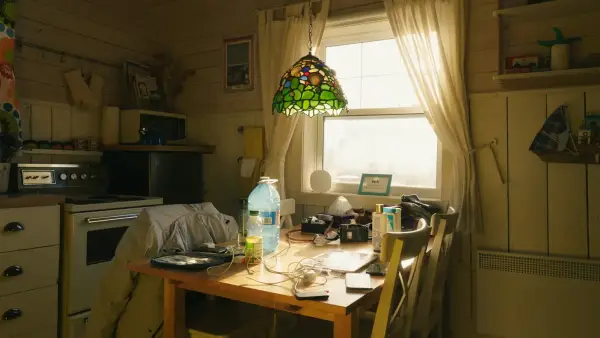
Boys who grew up in homes where nobody ever raised their voice but nothing was ever actually said out loud often become the men who are the easiest to be around and the hardest to truly know, and most of them do not discover until their forties that the peace they protected as children was never peace at all - it was a silence somebody had to hold together, and they were the one who had been quietly assigned the job

A man I know - sixty-three, retired engineer, the kind of guy who fixes your sink before you finish asking - sat at his kitchen table last spring trying to write a birthday card for his wife of thirty-eight years.
He sat there for almost an hour. He told me later he kept writing the same line. “Happy birthday. I hope you have a wonderful day. Love, David.”
He said he stared at it and felt something close to grief, because he could not, for the life of him, find a single sentence that wasn’t polite.
He wasn’t cold. He wasn’t checked out. He loved her in the heavy, quiet way that some men love - the kind you only see when you watch them fix the garage door without being asked, or warm up the car before she leaves for work. He just couldn’t find words that felt like his.
And when he finally put the pen down, he said something I have not stopped thinking about since.
He said, “I don’t think I ever learned how to say a real thing out loud. I think somebody told me a long time ago that real things were the ones that made the room get worse.”
I want to talk about that somebody. And I want to talk about that room.
The childhood curriculum nobody put in writing
There is a particular kind of childhood home that almost never gets written about, because from the outside it looks completely fine. There is no shouting. There are no slammed doors. Nobody is throwing dishes. Nobody is drunk on a Tuesday. Dinner happens at six. The lawn is mowed.
But inside that home, nothing is ever actually said.
There is a thing sitting in the room - a parent’s loneliness, a marriage that ended emotionally years ago, a grief nobody named, a financial fear, a quiet resentment - and everybody can feel it, and nobody is allowed to point at it.
The unspoken rule in those houses is simple. We do not make things worse.
And the children who grow up in those houses absorb that rule the way other children absorb the alphabet. They don’t learn it. They become it.
Boys, especially, get a second layer of the same lesson. Because in addition to “don’t make things worse,” they get told - not in words, almost never in words - that a man manages the room. A man notices when the temperature drops. A man steps in early, before the thing in the corner stands up and starts walking around.
By the time he is seven, he has a job. He just doesn’t know it has a name.
Learning to read a face the way other kids learned to read books
Ask a man who grew up in one of these homes what his mother’s face looked like when something was wrong, and he will tell you. He will tell you in extraordinary detail.
He will tell you about the small tightening at the corner of her mouth. The way her shoulders did a thing that was not quite a sigh. The pause before she answered the phone. The way she’d say “I’m fine, honey” in a register half a step lower than her normal voice.
He learned to read that face the way other kids learned to read picture books. With total focus. With his whole nervous system.
A 2019 study in the Journal of Family Psychology described what researchers called “emotion-avoidant” family systems - homes where strong feelings were treated as dangerous events to be managed rather than experiences to be shared. The kids in those homes, especially the sons, developed an unusual skill. They became hyperattuned to micro-shifts in their parents’ moods, often more so than the parents themselves.
The researchers used the word “attuned.” But if you ask the men who grew up that way, they don’t use that word. They use the word “watchful.”
They will tell you they spent their childhoods watching.
The peace that was actually a job
Here is the part nobody warned them about.
The peace they were protecting was not peace. It was a silence that somebody had to hold together with both hands, and they were the one who had been quietly assigned the job.
When you are seven years old and you keep the room calm by being quiet, by being good, by being easy, by not asking the question you were going to ask, by laughing at the joke that wasn’t funny, by going to your room before you were asked - you do not experience that as work. You experience it as who you are.
You grow up thinking you are simply a calm person. A low-maintenance person. A reasonable person. The kind of person who doesn’t need much.
But there is a difference between not needing much and not being allowed to need much. And it is a difference most of these men do not discover until they are well past forty.
Hypervigilance dressed up as a personality
In the meantime, the world rewards them.
Their friends call them the steady one. Their bosses call them dependable. Their wives, in the early years, call them safe. They become the man you want at a hospital bedside, at a difficult meeting, at a funeral. They do not flinch. They do not escalate. They do not need anything from the room they are in.
What nobody around them realizes - including, most of the time, the man himself - is that this isn’t temperament.
It’s a survival skill in a tuxedo.
The psychologist Terrence Real has spent decades writing about what he calls covert depression in men - the kind that doesn’t look like depression at all, because it shows up as competence, as politeness, as relentless capability. The men who have it don’t collapse. They function. They function so beautifully that nobody, including themselves, notices that something underneath has been quietly running on empty since they were children.
The boys from the quiet homes are often the textbook case. They learned at five years old that the way to be loved was to be no trouble. So they spend the next forty years being no trouble, and they call it their personality.
The friends who think he has no needs
He is the friend who never cancels. The friend who shows up early to help you move. The friend who listens to your divorce for two hours and then says, when you ask how he’s doing, “Oh, you know. Same as always. Can’t complain.”
And he can’t. Not because nothing is wrong. But because complaining was, in his original house, the thing that made the room get worse.
His friends think he is low-maintenance because he has no needs anyone can see.
The truth is more painful. He has needs. He just packed them in a box at seven years old and put the box somewhere he can no longer find.
Niobe Way, the developmental psychologist who spent years interviewing boys about their friendships, found something that stopped a lot of people in their tracks. Boys at eleven and twelve talk about their friendships in language that sounds almost like love letters. They use the word “love.” They talk about their best friends being people they would die for. They talk about secrets, about telling each other everything.
By fifteen or sixteen, that language is mostly gone. The same boys, two or three years later, are saying things like “I don’t know, we just hang out.” “I don’t really do that deep stuff.” “It’s whatever.”
Way called it a loss. She wasn’t being dramatic. Something real disappears in those years - and for the boys from the quiet homes, who already knew at seven not to say the real thing, the loss happens earlier and goes deeper, and almost nobody notices.
The sentence he cannot finish
Years later, he is forty-five or fifty-three or sixty-one, and he is in a kitchen with a woman who loves him, and she is asking him a question.
She is asking him what he feels.
Not what he thinks. Not what they should do. Not what the plan is. What he feels.
And he opens his mouth, and a sentence starts to form, and then somewhere between his chest and his throat the sentence stops. It does not get angry. It does not get defensive. It just stops, the way a car stops when it runs out of road.
He is not refusing to answer. He is genuinely looking for the words. And the words are not there, because the words were never given to him, because the words were the thing that, in his first house, made the room get worse.
So he says, “I don’t know.” And he means it more honestly than she will ever realize.
The moment everything quietly comes apart
For a lot of these men, there is a single moment in their forties or fifties when a partner, usually after years of patience, finally puts down whatever she is holding and says something like:
“I have been with you for twenty-two years. And I don’t know what you actually feel about anything. Anything at all.”
And the terrible part - the part that ends marriages, the part that breaks his heart in a way nothing else has ever broken it - is that there is nothing in him that wants to argue with her.
Because she is right.
He doesn’t know what he feels about anything either. He has been managing the room since he was seven years old. He has been so busy keeping the temperature stable that he never learned what his own temperature was.
This is the moment a lot of these men finally cry. Not in front of her. Usually in a car, or in a hardware store parking lot, or in a doctor’s office a few months later when somebody asks a kind question.
It is not a breakdown. It is the first time in a half-century that he has been allowed to be the thing in the room instead of the one managing it.
You were doing a job you were given at seven
If any part of this is landing in your chest right now - if you are recognizing your father, or your husband, or a friend, or yourself - I want to say something carefully.
The quiet man you are, or the quiet man you love, is not broken.
He is not emotionally stunted. He is not avoidant. He is not incapable of intimacy. He is somebody who, a very long time ago, was handed a job by a house that needed somebody to hold it together, and he was small, and he picked the job up because somebody had to, and he has been carrying it ever since.
The job was real. The cost was real. The reason he cannot find the words is not a flaw in him. It is a wound in the shape of a child being asked to do something no child should ever be asked to do.
And the only thing he needs now - the only thing - is permission to put the job down. Slowly. Without anybody being angry at him for being slow. With somebody sitting next to him while he learns, at fifty or sixty or seventy, the language he was told never to need.
It will be clumsy when it comes. It will sound, at first, like a man trying to write a birthday card and only being able to say polite things.
But underneath the polite things, there is a whole person who has been waiting a very long time to be heard.
He was always there. He was just doing the job. And the job is finally, finally, allowed to end.