Children who always checked the back door one more time before bed - who got up after the lights were out to make sure the stove was off, the front door was locked, the windows were closed - often become adults who circle back to check the car is locked, who reread sent emails three times, who cannot leave the house without touching the doorknob twice, because a child who discovered that the adults were not actually keeping watch learned that safety was something she would have to build herself, and the building never stops because the blueprint was drawn by a seven-year-old
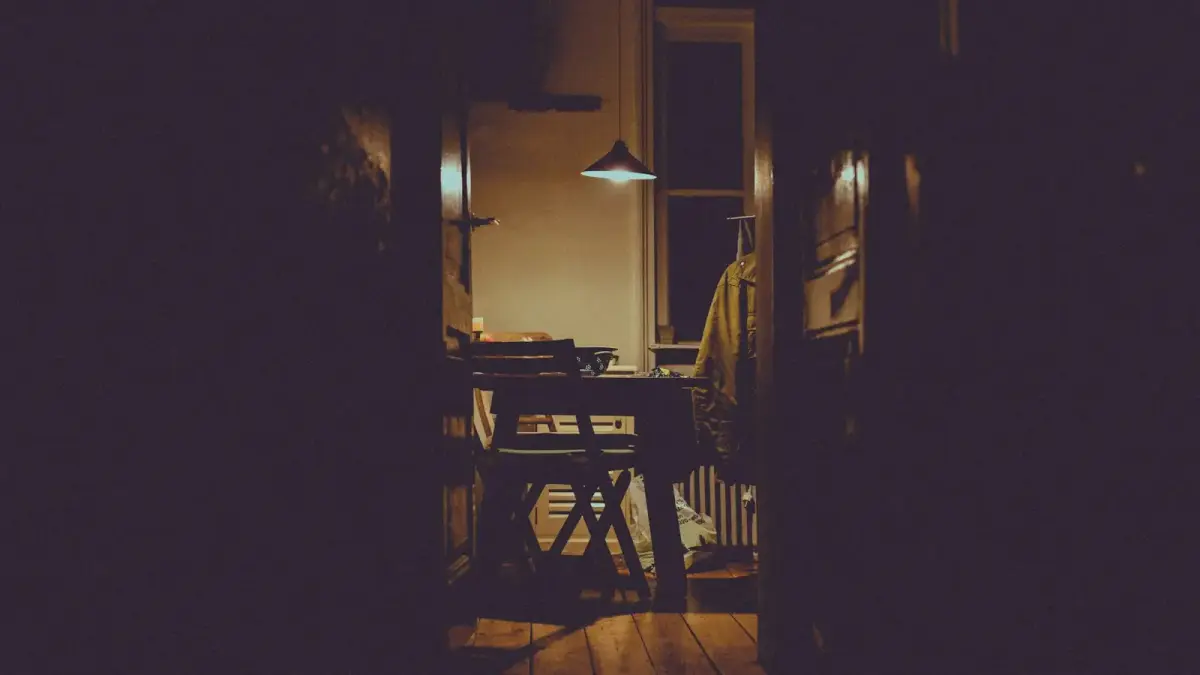
I was seven the first time I got out of bed to check the front door.
Everyone else was asleep. The house was dark and the hallway floor was cold and I remember standing on my toes to reach the deadbolt, pressing my palm flat against it to feel whether it was turned all the way. It was. It had been locked for hours. But I needed to feel it under my hand before I could let myself close my eyes.
That was the first night. It was not the last.
By the time I was nine, I had a whole route. Back door. Front door. Kitchen stove - every knob, one by one. The latch on the sliding glass door. The basement window that never quite sealed right. I would make the circuit in bare feet, moving as quietly as I could so nobody would wake up and ask me what I was doing, because I did not have words for what I was doing. I just knew that if I skipped even one step, something terrible would happen. Not to me. To everyone.
If you recognize that child, it is probably because you were her. Or him. Or some version of a kid who figured out far too early that the adults in the house were not actually keeping watch - and quietly, without anyone noticing, took over.
The circuit that never ends
1. You learned that checking was the price of safety
Most children absorb a sense of security without thinking about it. The doors are locked because a parent locked them. The stove is off because a parent turned it off. The house is safe because someone older and steadier has made it safe.
But some children do not absorb that message. Maybe the adults in the house were distracted, overwhelmed, unreliable, or simply not paying the kind of attention that makes a child feel held. Maybe the door was left unlocked one night and something happened. Maybe nothing dramatic happened at all - maybe it was just an atmosphere, a low hum of disorder that told a perceptive kid: nobody is steering this ship.
A 2019 study published in the Journal of Anxiety Disorders found that children who perceived their home environments as unpredictable - even without overt neglect or abuse - were significantly more likely to develop checking and monitoring behaviors by middle childhood. The instability did not have to be severe. It just had to be felt.
So the child begins to check. And the checking works, in the sense that nothing bad happens. Which means the child learns exactly the wrong lesson: the reason nothing bad happened is because I checked.
2. The route becomes a ritual becomes a reflex
At first, you checked because you were scared. Then you checked because it was habit. Then you checked because not checking felt physically wrong - like leaving the house without shoes, like forgetting something essential whose name you could not quite remember.
By the time you were a teenager, you probably did not even think of it as checking. You thought of it as being responsible. Being thorough. Being the kind of person who catches things other people miss.
And that is the quiet tragedy of it. The behavior that started as a child’s desperate attempt to impose order on a world that felt unsafe gets absorbed into your identity. It stops being something you do and becomes something you are.
3. You reread sent emails because mistakes feel existential
You know the email is fine. You proofread it before you sent it. You checked the attachment, verified the recipient, read the whole thing out loud in your head.
And then you open your sent folder and read it again. Just once. Maybe twice. Looking for the error you somehow missed, the tone that might be taken wrong, the sentence that could unravel everything.
This is not perfectionism. This is a nervous system that learned, very young, that small oversights lead to large consequences. A child who grew up monitoring the adults around her for signs of instability does not get to turn that monitoring off just because she grew up and got a desk job. The surveillance just shifts targets.
4. You cannot leave the house without going back
The keys are in your hand. The door is locked. You watched yourself lock it. You heard the click.
You are halfway to the car when you turn around and try the handle one more time.
Research on checking behaviors by psychologist Stanley Rachman suggests that the issue is not memory failure - people who check repeatedly have perfectly functional memories. The problem is a lack of confidence in their own memory. They remember locking the door. They simply do not trust the memory. Their brain flags it as unverified, unconfirmed, possibly wrong.
And if you spent your childhood in a house where things that should have been handled were not handled, your brain has very good reasons for refusing to trust that something is done just because you remember doing it. You grew up in a world where the obvious was not guaranteed.
5. You run worst-case scenarios like background software
While other people fall asleep thinking about tomorrow’s lunch or the show they are watching, you are running simulations. What if the stove is on. What if you forgot to lock the car. What if the email you sent at 4pm had a typo in the client’s name and they noticed and they are offended and they will not say anything but they will remember.
This is not anxiety in the clinical sense - or at least, it did not start that way. It started as competence. A child who could not rely on the adults around her built her own early warning system, and that system still runs decades later because nobody ever told it the emergency was over.
A 2021 study in Frontiers in Psychology found that individuals who reported high levels of childhood parentification - taking on adult responsibilities before they were developmentally ready - showed elevated vigilance and threat-monitoring well into adulthood, even in objectively safe environments. The alarm system does not care that you are forty-three and the doors have good locks. It was installed by a seven-year-old, and seven-year-olds do not build off switches.
6. You are the person everyone calls reliable
Here is the part that does not get talked about enough: the checking works. Not in the anxious, magical-thinking way it worked when you were small. It works because you actually are the person who catches the mistake in the contract, who notices the smoke detector battery is low, who remembers to bring the extra house key.
You are competent. Thoroughly, exhaustingly competent. And people rely on that competence without ever asking where it came from or what it costs you.
Because it does cost you. Every double-check is a small withdrawal from a finite account of energy. Every mental loop of did I, was it, what if takes up space that could have been rest or ease or the simple pleasure of trusting that things are fine.
7. Trusting that things are fine feels like the most dangerous thing you could do
This is the core of it. The deepest layer.
You do not check because you are broken. You check because, once, checking was the smartest thing a small person could do. You were right to check. The adults were not keeping watch. The doors were not always locked. The stove was sometimes left on. Your vigilance was not a disorder - it was an adaptation, and a brilliant one.
The problem is that adaptations do not expire on their own. Gabor Mate has written extensively about how the coping mechanisms we develop in childhood persist long after the original threat has passed - not because we are damaged, but because the body keeps doing what once kept it safe until something convinces it to stop.
And letting go of checking feels, to your nervous system, exactly like letting go of safety. Like choosing to be reckless. Like becoming the kind of careless person whose negligence once made you afraid.
8. The blueprint was drawn by a child, and children do not know when enough is enough
A seven-year-old who decides she is responsible for the safety of the household does not have the developmental capacity to set reasonable boundaries on that responsibility. She does not know that checking the door once is sufficient. She does not know that some things are not her job. She does not know that a certain amount of uncertainty is normal and survivable.
She only knows that checking makes the fear go quiet for a little while. So she checks again. And again. And the adult she becomes inherits that same logic - not because the adult is irrational, but because the template was set before rationality was fully online.
A 2018 study in the Journal of Personality and Social Psychology found that behavioral patterns established before age ten are among the most resistant to change in adulthood - not because they are hardwired, but because they become so deeply integrated into a person’s sense of self that changing them feels like losing part of who they are.
You are not checking the door because you are anxious. You are checking the door because checking the door is part of being you. And being you is the thing that kept everyone safe.
The building never stops
If you are reading this and seeing yourself in every paragraph, I want you to hear something clearly.
You were not a worried child. You were a child who was paying attention. You were not overreacting. You were responding accurately to an environment that required more vigilance than any child should have had to provide.
The checking, the circling back, the rereading, the quiet mental inventory you run before you can fall asleep - these are not flaws. They are the fingerprints of a person who learned to care for the whole house before she learned to ride a bike.
You do not have to stop being that person. But you might, slowly, let yourself wonder what it would feel like to trust - not the door, not the stove, not the email - but yourself. To trust that you already checked because you always check. To trust that the thing you built with all that vigilance is strong enough to hold, even if you close your eyes.
The seven-year-old who drew the blueprint did the best she could. She kept everyone safe. She deserves to rest now - and so do you.