She is 61 and just realized she has never once answered the phone without bracing herself - not the quick intake of breath when an unknown number appears, not the way her hand tightens around the phone when it rings after nine at night, not the split second where she calculates who might be calling and what might be wrong before she says hello - because a girl who grew up in a house where the phone ringing always meant bad news learned that sound is never neutral and has spent fifty years answering a device that is no longer attached to a wall with the same posture she learned at eleven
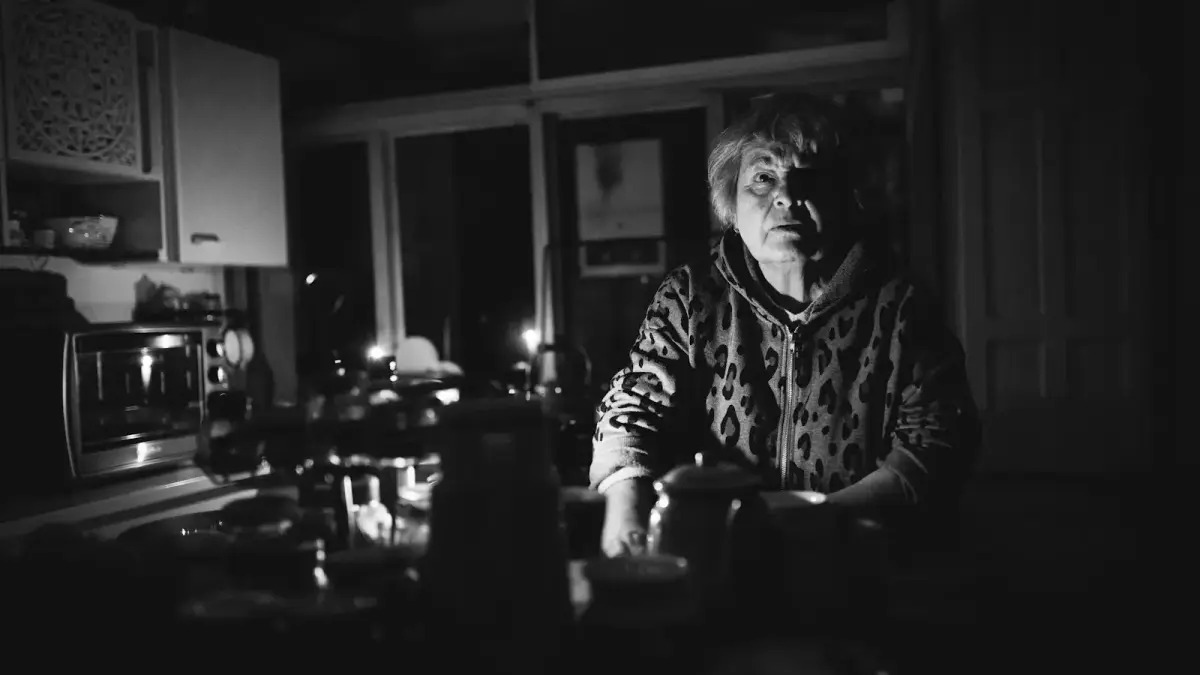
I was sitting in my kitchen last Tuesday when my phone buzzed against the counter, and I watched my own hand reach for it the way you’d reach for something hot. Fingers curled, shoulders drawn up, a tiny breath held somewhere behind my sternum before I even looked at the screen.
It was a text from my daughter asking if I wanted to meet for lunch on Saturday.
And I stood there in my own kitchen, sixty-one years old, realizing that my body had just prepared for an emergency over a lunch invitation. That I have been doing this - this bracing, this full-body flinch dressed up as answering the phone - for as long as I can remember. Not dramatically. Not in a way anyone would notice. Just a quiet tightening that happens so fast it feels like breathing.
I have never once in my life answered a phone in a state of calm.
The sound that was never just a sound
In our house growing up, the phone was mounted on the kitchen wall. Avocado green, long spiral cord that stretched around the corner if you needed privacy, which you always did. And when it rang after dinner, my mother’s face changed before she picked it up.
Not fear, exactly. Something more practiced than fear. A kind of gathering - the way you’d pull your coat tighter before stepping into wind.
She had good reason. Her brother drank. Her mother was sick more years than she was well. Her sister married a man who left bruises and sometimes left town. The phone at nine o’clock meant someone needed something that would cost my mother sleep, or money, or a long drive in the dark.
I learned to read that gathering on her face the way other children learned to read clocks. When the phone rang, I watched her first. If her shoulders dropped after hello, we were safe. If they didn’t, I knew to take my little brother upstairs and close the door.
A 2019 study published in Psychological Science found that children raised in unpredictable environments develop what researchers call “vigilance to threat cues” - an enhanced ability to detect signs of danger that persists long after the danger has passed. The researchers noted that this heightened detection system doesn’t switch off when the environment becomes safe. It simply finds new things to monitor.
I didn’t know the word hypervigilance until I was fifty-four. But I could have described the feeling at eleven.
Fifty years of bracing
Here is what answering the phone looks like when your nervous system learned early that ringing means trouble.
You hear it, and something contracts. Not your muscles, exactly - something behind your muscles. Something in the architecture of your attention. Your mind runs a calculation so fast it feels like instinct: Who would be calling? What time is it? Is everyone accounted for? Is my mother okay? Are my kids okay? Is someone in the hospital, is someone crying, is someone about to need me to be steady?
All of that happens before you say hello.
And when it’s just your friend asking about book club, or your dentist confirming Thursday, or your husband saying he’ll be ten minutes late, your body releases the tension so quietly that you don’t even register it was there. You just feel a faint wash of relief that you’ve learned to mistake for normalcy.
I did this through my twenties, when I was young and the calls were mostly good. I did this through my thirties, when my children were small and the calls were mostly logistical. I did this through my forties and fifties while carrying a cell phone that could ring anywhere, in any pocket, at any hour - which meant the bracing followed me out of the kitchen and into the rest of my life.
The phone is no longer attached to a wall. But I am still answering it from the same spot in that kitchen, watching my mother’s face, trying to calculate how bad it’s going to be before the first word lands.
The body remembers what the mind renames
I used to think I was just anxious. That I was a worrier, like my mother. That phone anxiety was a personality quirk, something to joke about at dinner parties - “Oh, I hate talking on the phone, doesn’t everyone?”
But it’s not that I hate talking on the phone. I hate the half-second before I know why someone is calling. That gap between the ring and the information is where my entire childhood lives.
Dr. Bessel van der Kolk, whose research on trauma and the body has shaped how we understand these patterns, describes it as the body keeping the score - the way our physical responses encode experiences that our conscious minds have long filed away as “over.” The original threat may be decades gone. The posture remains.
And the thing about a posture you’ve held for fifty years is that it stops feeling like a posture. It feels like the shape of you.
I didn’t know I was bracing because bracing was the only way I’d ever answered a phone. I had no unbraced version to compare it to. When something has been true since before you had language for it, it doesn’t register as a response to anything. It registers as the way things are.
What nobody told me about growing up in a house like that
Nobody told me that the phone would stay dangerous long after the people on the other end of the line got sober or moved away or passed on. Nobody told me that my nervous system had built an entire filing cabinet of threat responses indexed by sound, and that a ringtone in 2026 would open the same drawer as a wall phone in 1976.
Nobody told me that vigilance - real, bone-deep vigilance, the kind you learn before you learn long division - doesn’t retire when the situation improves. It just goes freelance.
A 2021 study in Frontiers in Psychology examined adults who grew up in high-conflict homes and found that they showed elevated stress responses to neutral social cues - a ringing phone, a knock at the door, a text notification - well into middle age. The researchers called it “anticipatory threat processing.” I call it answering the phone like something is always wrong.
And maybe the hardest part is that I was good at it. I was so good at bracing that nobody ever noticed I was doing it. I sounded calm. I sounded together. I picked up on the second ring, said hello with warmth, handled whatever came. Nobody saw the half-second before, the tiny muscular rehearsal for bad news that happened every single time.
Being good at bracing is one of the cruelest tricks a difficult childhood can play on you. It means you never get caught struggling. It means nobody ever says, “Hey, are you okay?” It means you carry it alone because you carry it well.
The woman and the girl
I am sixty-one years old and I have started doing something strange. When my phone rings now, I pause before I pick it up. Not to screen the call - to notice.
I notice the tightening. I notice the breath I hold without deciding to hold it. I notice the way my mind races through its catalog of emergencies before I’ve even seen the name on the screen.
And then I say - not out loud, but somewhere inside where the eleven-year-old version of me is still standing in that kitchen - it’s okay. We’re not there anymore. The phone is just a phone.
She doesn’t always believe me. That girl has fifty years of evidence that ringing means bracing, and one year of me whispering reassurances into the gap. But sometimes, lately, the grip loosens a fraction of a second earlier. Sometimes the breath comes back before hello instead of after.
I’m not trying to fix myself. I don’t think there’s anything broken about a child who learned to protect herself by staying ready. That readiness kept me functional through decades of real emergencies - my mother’s diagnosis, my father’s fall, the call from my son’s school that every parent dreads.
The bracing served me. It just never stopped serving me, even when I didn’t need it anymore.
What I want you to know
If you are someone who answers the phone the way I do - with that invisible flinch, that microsecond of preparation, that body-level assumption that connection might mean crisis - I want you to know something.
You are not anxious. You are experienced.
You are not overreacting. You are running a program that was written when you were too young to edit the code, and you have been running it so faithfully and so quietly that it became indistinguishable from who you are.
But it is not who you are. It is what you learned. And the fact that you can see it now, can name it, can feel the tightening and recognize it as a visitor from another time - that is the beginning of something your eleven-year-old self never had.
Choice.
Not the choice to stop bracing. That might take longer than I have, and honestly, I’ve made peace with that. But the choice to notice. To lay a gentle hand on the flinch instead of being swallowed by it. To answer the phone as a woman of sixty-one who knows - even if her body forgets - that most calls are just calls.
The phone is ringing. It might be my daughter about Saturday lunch. It might be nothing at all.
I’m going to take a breath first. A real one. And then I’m going to answer.