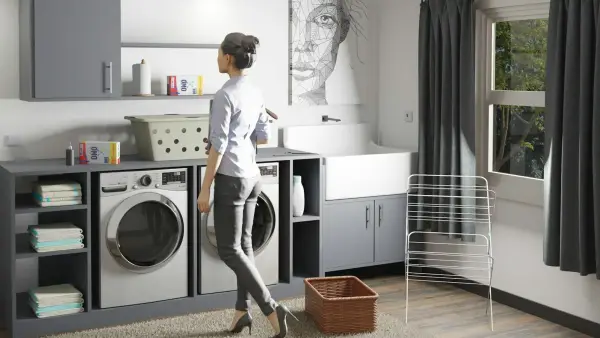
Children who always helped clean the entire house before company came over - who vacuumed the living room, hid the laundry basket in the closet, and were told not to open certain doors while guests were in the house - often become adults who cannot relax in their own home until every surface is clean enough to be judged, because a child who learned that visitors were not guests but inspectors discovered that home was not a place you lived in but a performance you maintained for everyone who might be watching
I was eleven years old, running a damp cloth across the coffee table, when my mother said the words that would quietly rearrange my entire nervous system: “The Hendersons will be here in forty minutes.” That was not a statement of fact. That was a countdown, and everyone in the house knew it.
My brother grabbed the vacuum. I started shoving magazines into the basket behind the couch. My mother disappeared into the bathroom with a can of Comet and a focus I only ever saw during these moments - a kind of controlled urgency that made the house feel like a stage thirty minutes before curtain.
The laundry basket went into the closet. The bedroom doors got closed. The dish towel with the stain got replaced with the one we never actually used. And somewhere in the middle of all of it, my mother’s voice changed - got lighter, got higher - as if she was already rehearsing the version of herself that would answer the door.
I didn’t know it then, but I was learning something that would follow me for the next thirty years. I was learning that home was not a place you lived in. It was a performance you maintained for everyone who might be watching.
The Ritual No One Talked About
Every family I knew growing up had some version of this. The Saturday morning scramble when someone was coming for dinner. The frantic sweep of the kitchen when a neighbor called to say they were dropping something off. The invisible line between “clean enough for us” and “clean enough for them.”
That line was everything. On our side of it, there were cereal bowls in the sink and shoes by the door and a pile of mail on the counter that had been there since Tuesday. On their side, there were folded throw blankets and a candle that only got lit when people were coming and a bathroom that smelled like pine instead of the shampoo we actually used.
A 2019 study published in the Journal of Personality and Social Psychology found that people from lower and middle-income backgrounds are significantly more likely to engage in “impression management” behaviors in their homes - adjusting their physical environment to meet perceived social expectations. The researchers called it environmental self-presentation. I call it the thing that taught me to see my own living room through a stranger’s eyes before I could see it through my own.
The ritual wasn’t about cleanliness. It was about control. If the house looked right, then we looked right. And if we looked right, then maybe nobody would notice the things we couldn’t fix - the carpet that was wearing thin, the couch that sagged on one side, the ceiling fan that made a clicking sound we’d all learned to stop hearing.
The Doors You Were Told Not to Open
There was always a room. Maybe it was the spare bedroom where the ironing board lived permanently, surrounded by laundry in various stages of being dealt with. Maybe it was the basement, or the back porch, or the master bedroom where the real mess of living collected because it had to go somewhere.
“Don’t open that door while the Hendersons are here.” My mother said it casually, like it was a small thing. But a child hears something very specific in that instruction. A child hears: there are parts of this family that are not for other people to see.
Not because those parts were shameful in any real sense. The ironing board wasn’t a secret. The laundry wasn’t evidence of failure. But the rule was clear - some rooms were for living, and some rooms were for showing, and the people who came through our front door were only allowed to see the showing rooms.
I internalized that division so completely that I still feel it in my chest when someone walks toward a closed door in my house. Not fear, exactly. Something closer to exposure. Like the door is a boundary between the version of me I’ve agreed to present and the version of me that actually exists, and someone is about to walk through it without permission.
The Mother Who Became Someone Else
The most confusing part was watching my mother transform. Five minutes before the doorbell rang, she was barking orders and wiping counters with the intensity of someone defusing a bomb. Then the bell rang, and she opened the door, and she was someone else entirely.
Her voice went up half an octave. Her posture shifted. She laughed in a way she never laughed with us - lighter, easier, as if nothing in the world could possibly be wrong. “Oh, come in, come in! The house is such a mess, I’m sorry.” The house was immaculate. She had just spent two hours making sure of it.
Sociologist Erving Goffman wrote about this decades ago - the concept of “front stage” and “back stage” behavior, the idea that we all perform different versions of ourselves depending on who is watching. But Goffman was describing adults making conscious social choices. What he didn’t fully explore was what happens to the child who watches that performance and learns, before they have words for it, that being yourself is something you only do when no one important is looking.
My mother wasn’t being fake. I understand that now, with the compassion that comes from being a mother myself. She was doing what her mother did, and what her mother’s mother did before that. She was protecting the family’s dignity with the only tools she had - a clean house, a warm smile, and the unspoken agreement that the real version of our life stayed behind the closed doors.
What This Looks Like at Forty-Three
I deep-clean before the plumber comes. I want you to sit with that sentence for a moment, because I know some of you just felt a flash of recognition so sharp it almost hurt.
The plumber. A person who is coming to fix a pipe under my sink. A person who will spend twenty minutes in my kitchen and never see my bedroom, my office, or the pile of unfolded towels on my bathroom floor. And yet I cannot let him into my house until I’ve wiped down every counter, swept the floor, and made sure there are no dishes in the sink.
I cannot have a friend stop by unannounced without a spike of panic that has nothing to do with whether I want to see them. The panic is about the laundry on the couch. The panic is about the breakfast plates still on the table at two in the afternoon. The panic is about being seen in the middle of actually living, which still feels - after all these years - like being caught.
A 2021 study in Frontiers in Psychology found that adults who grew up in households with high levels of “social monitoring” - where family behavior shifted significantly in the presence of outsiders - reported higher rates of perfectionism, social anxiety, and chronic self-surveillance. The researchers described it as learning to treat the self as an object to be evaluated rather than a subject to be experienced. That language is clinical but the feeling is not. The feeling is standing in your own kitchen and seeing it through the eyes of the person who might judge it.
The Class Truth Nobody Wants to Name
Here is the part that gets uncomfortable. This ritual - the pre-guest deep clean, the closed doors, the performed ease - was not evenly distributed. It mapped onto something, and that something was class.
Families with enough money didn’t do this. Or they did it differently - they had housekeepers, or their baseline was already close enough to “presentable” that the gap between real life and performance was small. The scramble, the urgency, the transformation - that belonged to families who were maintaining respectability with effort that was never supposed to show.
Brene Brown talks about the difference between guilt and shame - guilt says “I did something bad,” shame says “I am bad.” The pre-guest cleaning ritual lived in that second category. It wasn’t about the mess being wrong. It was about the mess revealing something about who we were. And who we were, apparently, was not quite enough - not without the vacuum lines on the carpet and the good towels in the bathroom.
The house was the family’s public face. And for families without the luxury of carelessness - without the money that makes mess look bohemian instead of poor, eclectic instead of chaotic - that public face required constant maintenance. A child who learned to polish that face learned something brutal and specific: being seen as you really are is something only people with nothing to hide can afford.
Learning to Live in the Mess
I am forty-three years old and I am still learning to let my house be lived in while someone else is in it. Still learning that the breakfast dishes are not an indictment. Still learning that a friend who loves me will not inventory my countertops.
It comes in small moments. Last month, my neighbor knocked on the door to return a baking dish, and I let her in without scanning the room first. The kitchen was not clean. There were shoes by the door and a half-finished puzzle on the dining table and a stack of mail that had been there since - yes - Tuesday. She didn’t notice any of it. She stayed for coffee. We talked for an hour. And when she left, I stood in my imperfect kitchen and felt something I can only describe as the absence of a weight I had forgotten I was carrying.
If you grew up in a house where company meant performance, where the doorbell triggered a transformation, where certain doors stayed closed and certain voices changed pitch - I want you to know something. The fact that you still feel that spike of panic when someone sees your real life is not a character flaw. It is the echo of a child who learned, with a vacuum in one hand and a damp cloth in the other, that love and judgment came through the same front door.
Your house does not have to be a stage. You are allowed to be seen in the middle of your actual life - dishes and all. The mess is not the thing you need to hide. The mess is the proof that you are finally, actually home.