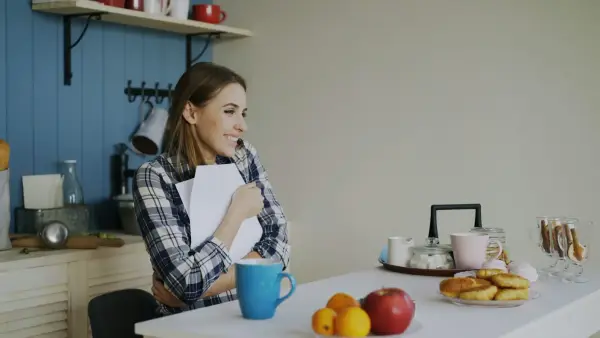
She is 59 and still writes directions down on a piece of paper before every trip even though the GPS on her phone has never once been wrong - not because she does not trust the technology but because a girl who grew up calling ahead and asking someone to describe every turn learned that the only reliable map was the one drawn in your own handwriting, and a woman who carries a folded piece of paper that says 'left at the church, right after the gas station' next to a phone that already knows the way is not old-fashioned but still loyal to a world where getting somewhere safely required another person's voice and a pencil
I watched my mother do it last Thanksgiving.
She was standing at the kitchen counter with a ballpoint pen and a piece of paper she’d torn from a legal pad, and she was writing directions to my cousin’s new house in Delaware. Her phone was right there next to her elbow. She’d already looked up the address. The blue line on the screen showed every turn, every highway merge, every estimated minute down to the decimal.
She copied it all onto the paper anyway.
Left on Route 9. Right after the Wawa. Stay in the middle lane for the overpass. She wrote it in her careful, slanted cursive, the same handwriting I grew up reading on permission slips and grocery lists and the notes she’d leave on the counter when she had to work late.
I almost said something. I almost asked why she was doing that when the phone would talk her through every turn. But I caught myself, because I already knew the answer. And the answer had nothing to do with technology.
The phone call before the trip
If you are old enough to remember, there was a time when getting somewhere new required a conversation.
You called ahead. You called the person whose house you were driving to, or you called a relative who’d been there before, and you asked them to walk you through the route. Turn by turn. Landmark by landmark. And they did it from memory, because they’d driven it enough times that the road lived inside them like a song they didn’t have to think about anymore.
“You’re going to get off at Exit 12, and it’s going to feel like you went too far, but you didn’t. There’s a big red barn on the left - don’t turn there. Go one more light.”
That was navigation. It was not a set of coordinates. It was a relationship between two people - one who knew the way and one who needed to get there. The directions came wrapped in someone’s voice, in their pauses and their little warnings and their “you can’t miss it” reassurances that were almost never true but always felt like enough.
A 2019 study published in Nature Communications found that regular GPS use actually reduces activity in the hippocampus - the part of the brain responsible for spatial memory and navigation. The researchers discovered that people who relied on GPS essentially stopped building mental maps of their surroundings. Their brains disengaged from the process of learning the route.
But for the generation that learned to navigate by listening, the route was never just information. It was a transfer of care.
Writing it down made it yours
There is something about copying directions in your own handwriting that changes your relationship to the journey.
When you write “left at the church,” your hand makes the turn before your steering wheel does. Your brain encodes the sequence differently than when a voice simply says “turn left in 400 feet.” You are not following instructions. You are rehearsing a path you have already traveled in your mind.
Psychologists call this the generation effect - the well-documented finding that information you actively produce is remembered far better than information you passively receive. A 1978 study by Slamecka and Graf in the Journal of Experimental Psychology demonstrated that the act of generating material yourself, even something as simple as completing a word fragment, creates deeper and more durable memory traces than simply reading the same material.
The women and men who wrote directions down before every trip were not being cautious. They were doing something cognitively sophisticated. They were turning someone else’s knowledge into their own. They were making the map personal.
And there was a ritual quality to it that mattered. The paper. The pen. The moment of preparation before you backed out of the driveway. You didn’t just leave. You got ready. You folded the paper into quarters and set it on the passenger seat or tucked it into the visor, and that piece of paper became a companion for the drive - something you glanced at, something you trusted, something that had your own handwriting on it and therefore felt like a version of yourself guiding you forward.
The landmarks that were never on any map
GPS gives you distances. It gives you street names and highway numbers and arrival times that update in real time. What it does not give you is the red barn, the Shell station, the church with the steeple you can see from two blocks away.
The old directions were built on landmarks, and landmarks are not just navigational tools. They are proof that a real person drove this road and noticed things. When your aunt told you to turn right after the gas station, she was telling you that she had been exactly where you were about to be. She had seen that gas station. She had made that turn. Her experience was now protecting yours.
There is a warmth in that kind of direction-giving that no algorithm can replicate. The GPS knows where the gas station is, but it does not know that your aunt once missed that turn and ended up on a dirt road for twenty minutes and laughed about it for years. It does not know that “the church on the left” is the one where your grandparents were married. The landmarks carried stories. They connected the route to a life.
And the landmarks were fallible in a way that made them human. “There used to be a Dairy Queen on that corner - I think it’s a tire shop now.” The world changed, and the directions had to change with it, and that meant calling again, asking again, updating the paper again. Navigation was a living thing. It required maintenance and memory and ongoing conversation with the people who knew the way.
She is not resisting the future
Here is what people get wrong about the woman with the folded piece of paper.
They think she is stubborn. They think she is afraid of her phone. They think she is clinging to the past because she cannot keep up with the present.
None of that is true.
She uses the GPS. She follows it. She knows it works. She has arrived at every destination it has ever pointed her toward. She is not confused about the technology.
But she also knows something the technology does not account for. She knows that preparation is a form of respect - for the journey, for the destination, for her own ability to understand where she is going rather than simply being taken there. She knows that writing the directions down is how she tells herself, “I am not just a passenger in this. I know the way.”
Research on the psychology of control supports this instinct. A 2021 study in the Journal of Personality and Social Psychology found that people experience greater well-being and lower anxiety when they feel a sense of personal agency over their actions - even when the outcome would be the same regardless. It is not about the result. It is about whether you feel like a participant or a passenger.
The woman with the paper directions feels like a participant. She has studied the route. She could do it without the phone if she had to. And that matters to her - not because she thinks the phone will fail, but because she was raised in a world where knowing the way was something you earned, not something handed to you by a satellite.
What the paper really carries
I think about my mother’s directions and I realize they are not really about navigation at all.
They are about a time when knowledge was personal. When you didn’t look things up - you asked someone. When information came through a voice you recognized, delivered with the specific texture of that person’s way of explaining things. Your father gave directions like a drill sergeant. Your mother gave them like she was telling a bedtime story. Your best friend gave them with three wrong turns built in because she always got the side streets confused.
The paper holds all of that. It holds the memory of a world where getting somewhere was a collaborative act. Where you could not simply punch in an address and be guided by a calm, disembodied voice that knew nothing about you and cared even less. Where the space between “Where are you starting from?” and “You can’t miss it” was filled with the sound of someone who wanted you to arrive safely.
That is what she is loyal to. Not the paper. Not the pen. Not the slow, deliberate act of writing each turn in her own hand, although she loves that too.
She is loyal to the understanding that once upon a time, finding your way somewhere was not a transaction between you and a machine. It was a conversation between you and a person who cared enough to walk you through it.
The folded paper on the passenger seat
My mother made it to Delaware without a single wrong turn.
She did not look at the paper once. She told me this later, almost sheepishly, like she was admitting to something. The GPS did its job. The blue line guided her perfectly. The folded piece of paper sat on the passenger seat the entire drive, untouched.
But she was glad she had it.
Not because she needed it. Because writing it had made her feel ready. Because the act of preparing - of sitting at the counter and thinking through each turn, of putting pen to paper and tracing the journey before she lived it - had made the drive feel like something she was doing, not something being done to her.
And maybe that is the simplest way to explain a woman who still writes directions down at 59. She is not old-fashioned. She is not resistant. She is someone who learned, long before any of us had a glowing screen in our pocket, that the safest way to get somewhere was to carry the route inside you - in your memory, in your handwriting, in the echo of a voice that once said, “Turn left at the church. You’ll see it.”
She still hears that voice. The paper is just how she keeps it close.