Children who always drew pictures for the adults around them - who brought a crayon drawing to a mother who had not smiled in days, who folded a piece of paper into a card for a father who came home quiet, who left small bright things on pillows and kitchen counters like offerings at an altar they did not understand - often become adults who still believe the right gift or the right gesture can reach a person who has gone somewhere words cannot follow, because a child who could not fix the sadness in a room discovered that a drawing slid across the table was the closest thing to a cure her small hands could build
I was seven when I made my first card that wasn’t for a birthday or a holiday. It was a Tuesday, maybe a Wednesday. My mother had been sitting at the kitchen table for what felt like hours, not eating the toast she’d made herself, not reading the newspaper she’d unfolded but never turned past the front page.
I didn’t know the word for what was happening to her. I didn’t have language for the way a person can be physically present but emotionally on the other side of a locked door. All I knew was that the air in the kitchen felt heavy and that my chest hurt in a way I couldn’t point to.
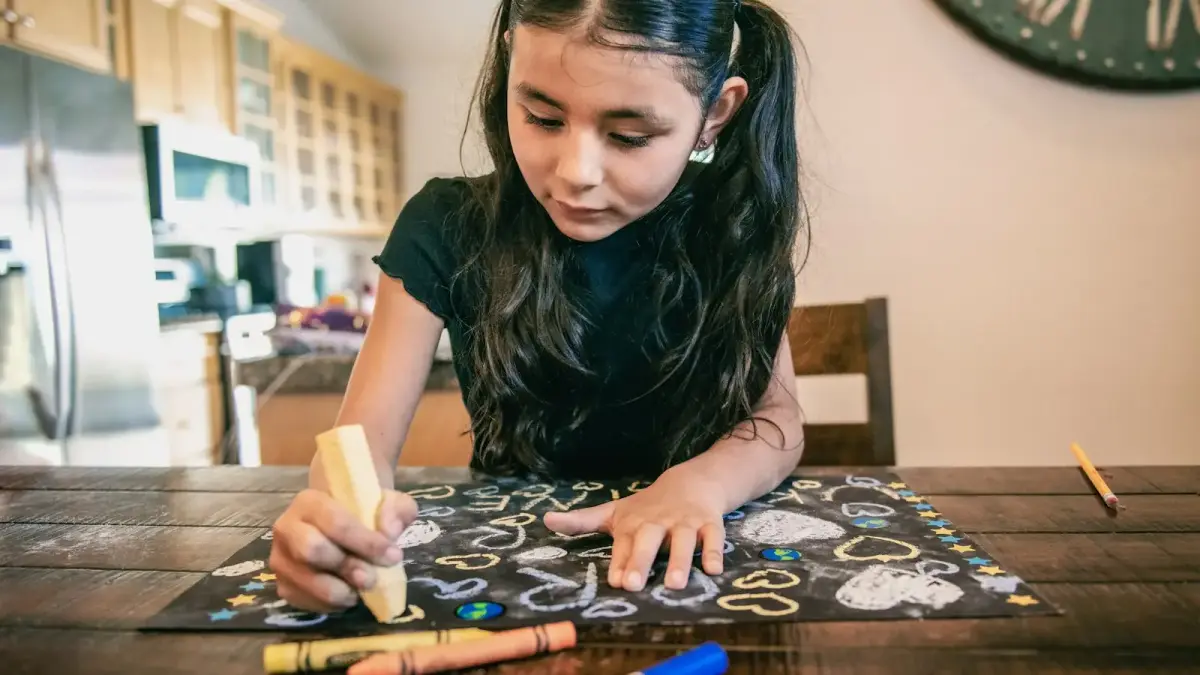
So I got the crayons. I folded a piece of printer paper in half and drew a sun with a face on it. I drew our house. I drew the two of us holding hands with fingers that looked like rakes. And I walked it over to her and put it next to the untouched toast like I was placing medicine on a nightstand.
She looked at it. She looked at me. And something in her face shifted - not all the way to happy, but away from wherever she had been. That was enough. That tiny shift was enough to teach me something I would carry for the next thirty years.
The first drawing was never about art
If you were one of those children - the ones who made things for the adults around you, who colored pictures nobody asked for, who left folded notes on pillows and slipped drawings under closed bedroom doors - you probably remember the specific feeling that drove you to do it.
It wasn’t inspiration. It wasn’t creativity. It was urgency.
Something was wrong in the house. Someone was sad or angry or far away, and the wrongness of it pressed against your skin like a weather system. You couldn’t name it, but you could feel it in the way conversation stopped at dinner, in the way a parent’s eyes went somewhere you couldn’t follow.
And you learned, probably before you learned to tie your shoes, that you could do something about it. Not with words - words were unreliable. You’d tried talking and the words either bounced off the sadness or made it worse. But a drawing. A card. A small bright thing made with your hands and offered across the distance.
That had a chance.
You watched for the micro-response. The softening around the eyes. The almost-smile. You became an expert at reading the faintest shift in a face, because that shift was your evidence that your offering had landed, that your small handmade thing had done what your presence alone could not.
What the child was really doing
Here’s what no one told you then, and what you may still not fully understand now. You were not making art. You were performing emotional triage.
A 2019 study published in Frontiers in Psychology found that children as young as four engage in what researchers call “creative emotional regulation” - using drawing, storytelling, and making as strategies to manage not just their own feelings, but the emotional climate of their environment. The children in the study who were most prolific in their creative output were often the ones living in households with the highest emotional unpredictability.
They weren’t the most artistic kids. They were the most vigilant ones.
John Bowlby’s attachment theory gives us the framework for this. When a child’s primary caregiver is emotionally unavailable - not cruel, not neglectful in any way that would show up on a checklist, but simply gone in the way that depression or grief or overwhelm takes a person away - the child’s attachment system goes into overdrive. The child needs the parent to be emotionally present. The parent cannot be. And so the child begins to work.
Gabor Mate writes about this with a tenderness that still catches me off guard. He describes the adaptations children make in emotionally stressed homes not as dysfunction but as intelligence. The child who draws pictures for a sad mother is solving a problem with the only tools available to her. She cannot drive her mother to a therapist. She cannot fix whatever is wrong in the marriage or the bank account or the neurochemistry. But she can make something beautiful and put it where the sadness is and hope.
That hope is the engine. That hope is the thing that keeps the crayons moving.
The adult inheritance
If you were that child, I want you to notice something about the adult you became.
You are the person who bakes when someone is grieving. Not because a casserole fixes death, but because you learned a long time ago that a warm thing placed in someone’s hands is a bridge when language fails. You show up at the door with food because you showed up at the kitchen table with a drawing, and the logic is the same.
You give gifts that are almost unsettlingly thoughtful. You remember the thing someone mentioned once in passing three months ago, and you find it or make it and wrap it and watch their face when they open it. You are reading their face the way you read your mother’s - searching for the shift, the evidence that you got through.
You write the longest cards. You don’t just sign your name - you fill the white space with words you chose carefully, words that say I see you, I know this is hard, I am here and I brought this because I could not bring anything bigger. Your cards are not cards. They are the same folded paper you handed across the kitchen table when you were seven.
A 2021 study in the Journal of Personality and Social Psychology found that adults who scored high on what researchers call “compulsive caregiving” - the tendency to prioritize others’ emotional needs through acts of service and gift-giving - were disproportionately likely to have grown up with a parent who experienced chronic emotional difficulty. The giving was not generosity in the way we typically understand it. It was a learned survival strategy that had been polished into a personality trait.
You don’t just show love through making and offering. You show love almost exclusively through making and offering. Because words didn’t work on the sadness in the house. Words never seemed to reach the place where the people you loved had gone. But a thing you made with your hands, a thing you carried across the room and placed gently in front of them - that had a chance.
And you are still, all these years later, playing the odds.
What the research tells us about these children
The clinical literature has a word for what you did, and it is not a particularly warm one. Parentification - the process by which a child takes on emotional responsibilities that belong to the adults in the household. Specifically, what you experienced is called emotional parentification, which differs from instrumental parentification in that you weren’t managing the household logistics. You were managing the feelings.
A 2020 study published in the Journal of Child and Family Studies found that emotionally parentified children develop what the researchers called “hyperattunement” - an extraordinary sensitivity to the emotional states of others that persists well into adulthood. These children become adults who can walk into a room and immediately sense the emotional temperature. They know who is struggling before that person has said a word.
This is your superpower and your wound living in the same body.
Brene Brown talks about the difference between empathy and over-functioning - the tendency to feel someone else’s pain and then immediately try to fix it, not because they asked, but because you cannot tolerate the helplessness of witnessing suffering without acting. If you were the child with the crayons, you know this pattern intimately. You feel someone’s sadness, and before you’ve even processed your own response to it, your hands are already moving. Already making. Already building the offering.
The creative expression piece matters too. Researchers at the University of Cambridge found that children who use art-making as emotional regulation develop neural pathways that link creative production directly to anxiety reduction. The act of making something literally calms the nervous system. So when you sit down to bake bread at eleven at night because your friend called crying, you are not just being kind. You are self-soothing and other-soothing simultaneously, running a program that was installed in your operating system before you were old enough to understand what the program was for.
The moment you realize the drawing was never going to be enough
There is a particular grief that belongs to the child who tried to fix something unfixable. And it usually doesn’t arrive until adulthood, until you are thirty or forty or fifty-five and something happens that brings it into focus.
Maybe a friend is going through a divorce and you make her favorite meal and bring it over and sit with her, and as you’re driving home you feel the familiar hollow ache - the sense that it wasn’t enough, that nothing you brought was enough, that the thing she is going through is bigger than any casserole or card or carefully chosen gift. And in that hollow you recognize something very old.
The drawing was never going to fix your mother’s depression. The card was never going to bring your father back from wherever he went when he sat in the living room and stared at the television without seeing it. The small bright things you made and left around the house like breadcrumbs were beautiful, and they were not medicine. They were a child’s best guess at medicine. And a child’s best guess, no matter how tender, cannot cure what ails an adult.
This is the grief. Not that you tried. But that you believed it was your job to try. That somewhere in the architecture of your childhood, you received the message that the emotional wellbeing of the adults around you was a problem you were responsible for solving. And you solved it the only way you knew how - by making things, by offering things, by sliding bright pieces of paper across the distance and praying they would land.
You were never supposed to carry that. You were so small. Your hands could barely hold the crayons.
The drawing was enough, just not in the way you thought
I want to tell you something, and I want you to hear it with the part of you that was seven years old and standing in a kitchen with a piece of folded paper and a pounding heart.
The drawing was enough. It was always enough. Just not in the way you thought.
It didn’t cure the sadness. That was never within your power, and the fact that you believed it was is the saddest and most beautiful thing about the child you were. But it did something else. Something the research supports and something that anyone who has ever received a handmade thing from a person who loves them already knows.
A 2022 study published in Psychological Science found that handmade gifts activate different neural reward pathways than purchased ones - both in the giver and the receiver. The researchers described it as “embodied care,” the sense that someone literally put their hands on this thing and shaped it with you in mind. The gift carries the maker’s attention in a way that a bought object cannot replicate.
Your drawing carried your attention. Your cards carried your attention. Every meal you’ve cooked for a grieving friend, every birthday gift you spent weeks thinking about, every note you left on a pillow - these things carry the shape of your hands and the quality of your focus and the depth of your care. They land. They have always landed.
The child who made things in the face of sadness she could not cure was practicing. She was practicing the only form of love available to her, and that practice made her into someone whose care is felt in everything she touches. The bread she bakes arrives warm. The card she writes makes people cry. The gift she gives is so precise it feels like being seen by someone who has been paying very close attention for a very long time.
Because she has. She has been paying attention since she was small enough to confuse a crayon drawing with a rescue.
You are not broken for being this way. You are not codependent for wanting your love to arrive in a form someone can hold in their hands. You are the natural result of a child who could not fix the biggest thing in her world and so fixed the only thing she could - the empty space between herself and a person she loved - by filling it with something she made.
That is not a wound. That is a practice. And the people who receive your offerings know exactly what they are holding, even if you sometimes forget.
They are holding the drawing. They have always been holding the drawing.