Children who always found the dog at every party - who walked into a house full of people and went straight to the floor where the family pet was lying, who spent the entire evening running their fingers through someone else's golden retriever's fur while the adult conversation happened above their head and nobody noticed they had gone quiet - often become adults who still scan every unfamiliar room for the animal before the people, because a child who discovered at seven that the only creature in any gathering who would never judge what she said, repeat it to someone else, or suddenly change the rules of the interaction was the one with four legs and no opinion learned that the safest form of company is the kind that asks nothing of you but your presence
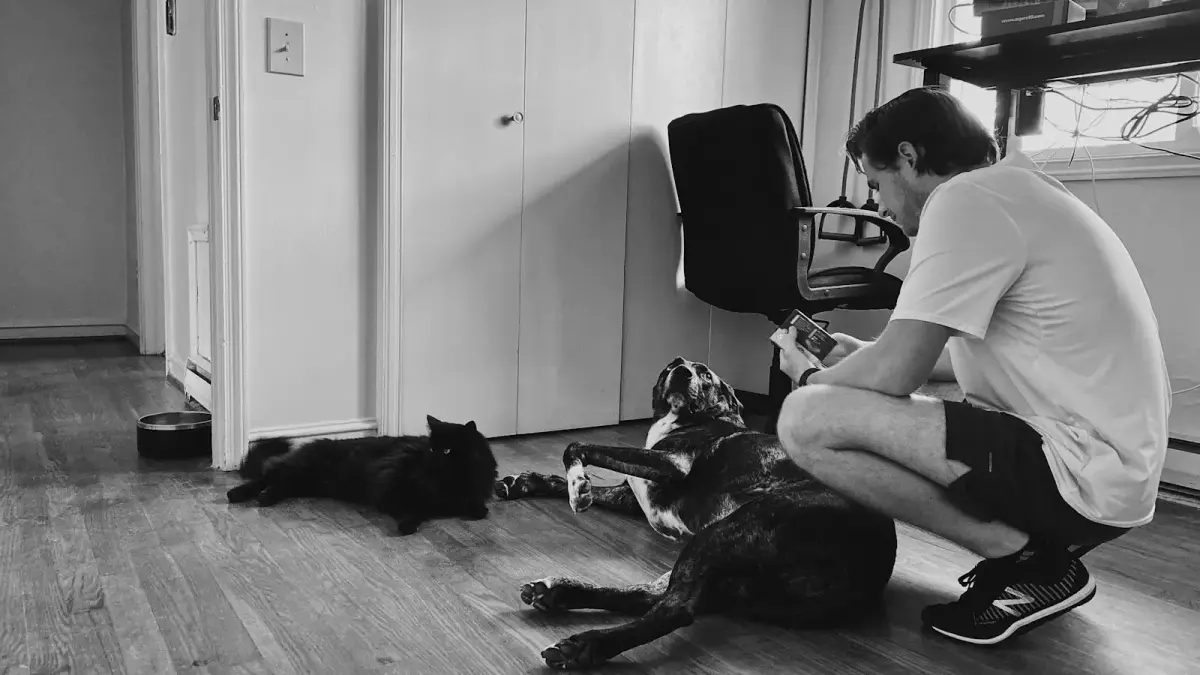
I was nine years old the first time I realized I’d been sitting under a dining room table for forty-five minutes, scratching behind the ears of a beagle named Chester while my parents’ dinner party carried on above me like weather I didn’t need to participate in.
Nobody came looking for me. Nobody noticed I’d disappeared from the circle of kids supposedly playing in the basement. I was on the kitchen floor with my back against the cabinet and Chester’s warm chin on my knee, and for the first time all evening I wasn’t calculating anything - not what to say, not how to laugh, not whether the other kids thought I was weird for not knowing the rules of the game they’d invented on the spot.
Chester didn’t need me to be interesting. He just needed me to keep doing exactly what I was doing.
I think about that beagle more than I think about a single person who was at that party. And if you’re someone who has ever walked into a crowded room and immediately located the cat, the dog, the aging Labrador sleeping in the corner - before you located a single human face you recognized - then I suspect you know exactly why.
This pattern didn’t come from nowhere. It started somewhere specific, and it grew into something that still shapes how you move through the world.
1. You learned early that animals have no subtext
Human conversation, even among children, runs on layers. There’s what someone says and what they mean. There’s the shift in tone that signals you’ve crossed a line nobody told you existed. There’s the sudden alliance between two kids that leaves a third standing alone at recess with no explanation.
Animals don’t operate in layers. A dog that wants to play brings you a ball. A cat that wants space walks away. The communication is direct, physical, and completely honest.
A 2015 study published in the Journal of Research in Personality found that individuals who scored higher in introversion and sensitivity showed significantly stronger emotional bonds with companion animals, suggesting that the preference isn’t random - it’s temperamental. You weren’t choosing animals over people because something was wrong with you. You were choosing the interaction that matched how your nervous system processed the world.
You were seven or eight or ten, and you’d already figured out that the golden retriever at your aunt’s house would never suddenly decide you weren’t invited to the game anymore.
2. The animal shelter became your version of hanging out
Other teenagers went to the mall, to each other’s houses, to parking lots where they sat on the hoods of cars and practiced being adults in ways that felt performative and exhausting.
You volunteered at the animal shelter. Or you walked the neighbor’s dog every afternoon. Or you spent hours at the barn where your friend kept horses, not because you particularly loved riding but because the barn smelled like hay and quiet and the horses acknowledged your presence without demanding a personality from you.
The shelter was social without being social. You had a role. You had a task. You didn’t have to fill silences with conversation or navigate the invisible hierarchy of who was cool and who was tolerated. The animals needed water, food, clean cages, and someone to sit with them. You could do all of that without ever once worrying whether you were doing it wrong.
It wasn’t shyness. It was clarity. You understood, even then, that the best relationships are the ones where both parties know exactly what they are.
3. You still scan every room for the animal before the people
You’re an adult now. You’ve learned small talk. You’ve learned to work a room when you have to, to smile at the right moments, to ask the follow-up question that makes someone feel heard.
But when you walk into a house party, a family gathering, a colleague’s barbecue - your eyes sweep the room for movement at floor level first. The cat on the windowsill. The dog asleep on the couch. The elderly spaniel who has stationed herself in the hallway where it’s quieter.
You go to the animal first. Every time.
It’s not rudeness. It’s not antisocial behavior. It’s that your body still remembers what your mind figured out decades ago - that the animal is the only being in the room whose attention comes without terms and conditions. You can sit with the dog for ten minutes, reset your nervous system, and then join the party with your social battery partially charged instead of running on empty from the moment you walked in.
4. Your phone is full of other people’s pets
Scroll through your camera roll and the pattern is obvious. Between the photos of meals and landscapes and the occasional selfie, there are dozens - maybe hundreds - of animals you don’t own.
Your coworker’s cat who sat on your laptop during a video call. The dog you met outside a coffee shop who leaned against your legs like he’d known you for years. Your neighbor’s rabbit. Your sister’s parakeet. The stray that showed up at the vacation rental and slept on the porch for three days while you named her and fed her scraps and quietly hoped nobody would claim her.
You photograph them because the encounters feel important. More important, sometimes, than they should. But that’s because each one is a tiny confirmation of something you’ve believed since childhood - that you are easy to be around when the criteria for “being around” is just warmth and presence.
A 2017 study published in the journal Anthrozoos found that people with higher levels of empathy reported more intense emotional connections to animals, and that these connections often served as emotional anchors during periods of social stress. You’re not being sentimental. You’re being accurate about where your emotional regulation actually comes from.
5. An animal’s attention feels different because it is different
When a person pays attention to you, there is always a frame around it. They’re evaluating something - your appearance, your energy, your usefulness, your social position. Even the kindest human attention carries a faint hum of assessment.
When a dog puts her head on your lap, there is no frame. There is no evaluation. There is a warm skull and two brown eyes and the simple message: you are here, I am here, this is good.
That difference - between attention that evaluates and attention that simply lands - is something you felt before you had words for it. As a child, you couldn’t have explained why the cat’s company felt safer than the other kids’ company. You just knew that when you were with the animal, the part of your brain that was always monitoring, always adjusting, always translating, went quiet.
That part still goes quiet. Every time.
6. You keep adopting strays - and not just the animal kind
The pattern extends beyond actual animals. You’re the person who befriends the lost cause. The colleague everyone has written off. The neighbor nobody talks to. The weird kid at the community event who’s standing alone by the snack table looking like they’re doing long division in their head to cope.
You gravitate toward anything that has been dismissed or overlooked, because you recognize the experience from the inside. You were the kid under the table with the beagle. You were the one who disappeared from the group and nobody noticed. You know what it feels like to be present but uncounted.
So you count them. The stray cat. The struggling coworker. The plant someone left on the curb. You bring them in, and you give them the thing you learned to value above all else - steady, uncomplicated company.
7. You talk to animals in a voice you never use with humans
There’s a voice you reserve for animals. It’s softer, higher, more honest than anything you’d let another adult hear. It’s the voice that says “oh, hello, look at you, aren’t you wonderful” to a stranger’s cat without a single molecule of self-consciousness.
That voice is the closest thing to your actual emotional interior that you let out in public. And you only let it out because the audience will never repeat it, never mock it, never use it as evidence of anything other than the fact that you are a person who is kind to small creatures.
A 2020 study published in Frontiers in Psychology found that people who engaged in “pet-directed speech” - the higher-pitched, emotionally expressive tone people naturally adopt with animals - showed measurable decreases in cortisol levels during the interaction. The voice isn’t silly. It’s medicine. Your body knows this even when your social conditioning tells you to be embarrassed about it.
8. The safest relationship is the one where both parties know exactly what they are
This is the thread that connects all of it - the child on the floor with the dog, the teenager at the shelter, the adult who scans every room for four legs before two.
You learned early that human relationships come with hidden architecture. Rules nobody explains. Expectations that shift without warning. Affection that is conditional on performance, on agreeableness, on being the right amount of interesting without ever being too much.
An animal’s rules are printed on the surface. A dog wants your presence, your touch, your calm. A cat wants your respect for her boundaries and the occasional chin scratch. A horse wants to know you’re not a threat and that you’ll be consistent. The contract is visible, mutual, and renegotiated in real time through body language both parties actually understand.
You didn’t reject human connection. You just discovered that the purest version of connection - the kind with no performance, no hidden scoring, no sudden withdrawal of warmth - was available at floor level, with creatures who had no interest in your resume, your small talk, or your ability to be charming on command.
And that discovery didn’t make you less capable of human relationships. It made you better at them. Because the person who knows what safe feels like - truly, physically, neurologically safe - is the person who can offer that safety to others.
You’re not antisocial. You’re not broken. You’re not stunted or avoidant or any of the labels that people use when they don’t understand why someone would rather sit with a dog than make conversation.
You’re someone who figured out, at an age when most kids were still learning to tie their shoes, that the most honest relationship in any room is the one between a person and an animal who are both just glad the other one showed up.
That’s not a flaw. That’s emotional intelligence that most people don’t develop until they’re forty, if they develop it at all.
You just happened to learn it on a kitchen floor, with a beagle named Chester, while nobody was watching.