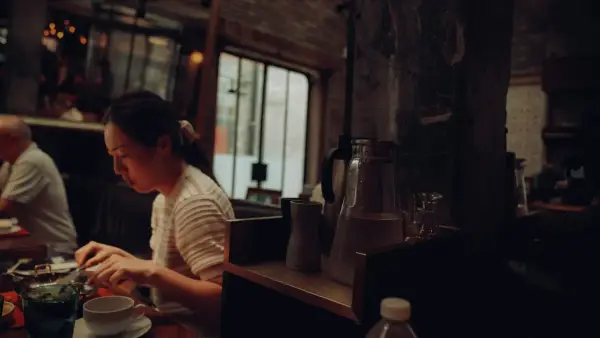
Children who always had a book with them - who brought a novel to every family gathering, every car ride, every waiting room, every dinner at a relative's house - often become adults who still carry something to read everywhere they go, not because they are antisocial or disinterested in people but because a child who grew up in a house that was too loud, too unpredictable, or too emotionally saturated discovered that a book was the only door in the room that opened to somewhere safe, and the woman at forty-nine who still slips a paperback into her bag even when she knows she won't have time to read it is not avoiding the world but carrying the one object that taught her she could survive it
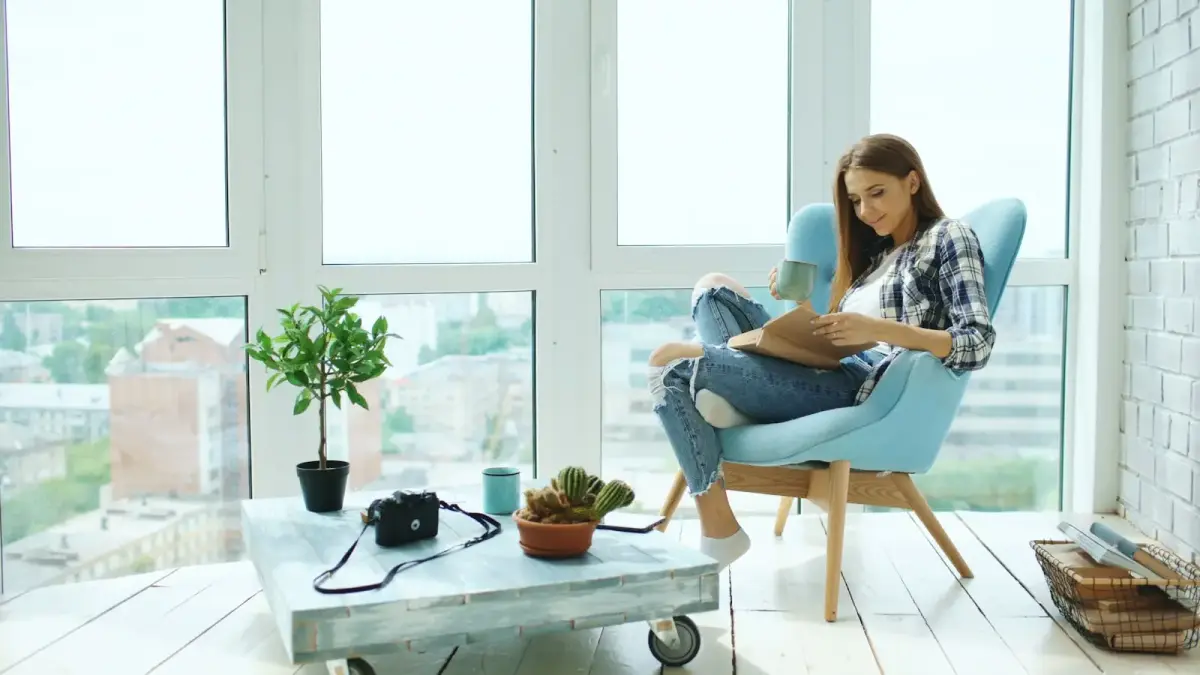
I was nine years old the first time someone told me I was “so good” for sitting quietly with a book while the adults talked.
It was Thanksgiving at my grandmother’s house. Fourteen people in a living room that comfortably fit eight. My uncle’s voice getting louder with each glass of wine. My mother’s jaw tightening the way it always did right before she stopped pretending everything was fine. Two cousins wrestling on the floor while someone’s baby screamed from the back bedroom.
And me, cross-legged on the carpet behind the couch with a copy of Island of the Blue Dolphins open in my lap, reading the same paragraph over and over because I wasn’t really reading. I was hiding. I was making myself so small and so quiet that the chaos couldn’t find me.
My aunt walked past, looked down, and said to no one in particular: “She’s so good. You never even know she’s here.”
I remember the warmth I felt hearing that. And I remember the thing I didn’t have words for yet - the understanding that I had just been praised for being invisible. That the highest compliment my family knew how to give a child was to forget she was in the room.
The book was never about loving to read
I want to be careful here, because I don’t want to take something beautiful - a child’s love of stories - and turn it into something clinical. Many children read because reading is wonderful. Full stop.
But there is a specific kind of child reader that I’m talking about, and if you were one, you already know the difference.
This child didn’t just enjoy reading. This child needed the book. She brought it to every car ride, every restaurant, every family event, every doctor’s office. She carried it the way another child might carry a stuffed animal - not for entertainment but for safety.
The book was a door. Not a door out of the room, because she couldn’t leave. But a door into a place where the noise couldn’t reach her. A place with rules that made sense, where people said what they meant and conflict resolved by the final chapter.
A 2013 study published in the journal Science found that reading literary fiction temporarily enhances what researchers call “theory of mind” - the ability to understand other people’s emotions and mental states. The children who read constantly weren’t escaping empathy. They were drowning in it. They could feel everything happening in the room - the tension, the unspoken anger, the grief nobody was naming - and the book was the only place where all that feeling had structure.
She wasn’t antisocial. She was overly social in the way that nobody recognizes - absorbing every mood in the room and needing somewhere to put it all down.
Invisibility as the highest praise
Here is the detail that matters most, and the one that will land differently depending on whether you lived it.
The quiet child with the book was praised. Constantly. She was “no trouble.” She was “so easy.” She was “the good one.” Teachers loved her. Relatives adored her. She never interrupted, never demanded, never made a scene.
And every single one of those compliments taught her the same lesson: you are most loved when you are least present.
Not absent - present but undetectable. Sitting in the room but taking up no emotional space. Having needs but never voicing them. Being there but never, ever being the reason anyone had to adjust their behavior.
Research on parentification and emotional neglect by clinical psychologist Dr. Jonice Webb has shown that children who are consistently praised for being “easy” or “low-maintenance” often grow into adults who struggle to identify their own needs. The praise wasn’t malicious. Most of the time, the adults genuinely believed they were raising a wonderful child. But what the child actually learned was that her worth was measured by how little she required.
The book made this possible. You can’t sit silently in a corner doing nothing - someone will eventually notice and ask what’s wrong. But you can sit silently in a corner reading, and people will call it a virtue.
The exit object
If you were this child, I want you to think about what you carry now.
Maybe it’s a book. Maybe you still put a paperback in your bag every morning even though you haven’t cracked it open in weeks. The weight of it is the point. Knowing it’s there. Knowing you have somewhere to go if the room becomes too much.
But maybe the book has evolved. Maybe now it’s your phone, open to an article you aren’t really reading. Maybe it’s a pair of headphones that signals to everyone around you that you are occupied, unavailable, politely elsewhere. Maybe it’s a notebook you carry to meetings so you can look down when the conversation gets uncomfortable.
Psychologists sometimes call these “transitional objects” - a term originally used by D.W. Winnicott to describe the blankets and stuffed animals that help toddlers manage the anxiety of separating from their caregivers. But the concept doesn’t expire at age five. The woman at forty-nine who still needs something in her hands before she can walk into a crowded room is doing the same thing she did at nine. She is carrying proof that she can leave without leaving. That there is a door in the room that only she can see.
This isn’t avoidance. This is a survival strategy that worked so well it became permanent.
The family reunion pattern on repeat
Here is where it gets specific, and I want you to notice if this feels familiar.
You go to a gathering. A party, a work event, a holiday dinner. You walk in and within minutes, you have already scanned the room for the quiet corner, the empty chair by the window, the kitchen where you can help with dishes and avoid the louder conversations in the living room.
You aren’t anxious, exactly. You aren’t panicking. You are doing something so practiced and automatic that it doesn’t even register as a strategy anymore. You are finding the place in the room where you can be present without being consumed.
And if someone asks you about it - “Why are you in here by yourself?” - you have a ready answer. “Oh, I just needed a break.” “I’m just checking something on my phone.” “I was just reading this thing.” Always casual. Always light. Never the real answer, which is something closer to: I learned very young that rooms full of people are rooms full of feelings, and I never figured out how to be in one without absorbing all of them.
A 2021 study in the Journal of Research in Personality found that people high in sensory processing sensitivity - what researcher Elaine Aron calls “highly sensitive people” - show greater activation in brain regions associated with empathy and emotional processing when exposed to social stimuli. The quiet child at the family reunion wasn’t tuning out. She was tuned in at a frequency that most people never reach, and the book was the only volume knob she had.
What the praise really cost
I want to go back to the aunt who said, “You never even know she’s here.”
She meant it kindly. She probably thought she was complimenting my parents on raising a well-behaved child. And in a certain light, she was right. I was well-behaved. I was polite, quiet, undemanding, and small.
But here is what that kind of praise costs over a lifetime.
You become an adult who doesn’t know how to take up space. You become someone who apologizes for having an opinion. Who feels guilty for being sad in front of other people. Who has never once in her life called a friend and said, “I need you to come over right now because I am not okay,” because the very idea of that - of making your pain someone else’s problem - feels like a violation of the contract you signed at nine years old.
The contract that said: you can stay in the room as long as you don’t make anyone deal with you.
You become the person who everyone calls “low-maintenance” and means it as a compliment, and you smile when they say it because you know that if you ever stopped being low-maintenance - if you ever became loud, needy, difficult, inconvenient - the love might go away.
Because it was never unconditional. It was always contingent on your silence.
The paperback in the bag
I’m forty-seven now, and I still put a book in my bag every morning.
I don’t always read it. Some days it stays zipped in the side pocket from morning until night, untouched. But I put it there, and there’s a specific kind of comfort in that ritual that I’ve stopped trying to explain to people who didn’t grow up needing it.
It’s not that I think I’ll have time to read. It’s not that I’m planning to be bored. It’s that somewhere deep in the architecture of who I am, the book means the same thing it meant when I was nine: you are safe. You have somewhere to go. If the room gets too loud or the feelings get too big or someone’s anger starts filling up the air, you have a door, and it fits in your bag, and nobody can take it from you.
I used to think this was a flaw. Something I should grow out of. Something that proved I was emotionally stunted or socially underdeveloped.
But I’ve come to understand it differently now.
The child who taught herself to disappear in plain sight wasn’t broken. She was resourceful. She found a way to survive a world that was too loud and too much and too unpredictable, and she did it without hurting anyone, without acting out, without making a single demand on anyone around her.
She did it with a book and a corner and the quiet faith that somewhere inside those pages was a version of the world that made sense.
You were never the problem
If you were this child - the one with the book, the one they called “easy,” the one whose invisibility was the thing everyone loved most about you - I want you to hear something that nobody said to you at nine.
You were not easy. You were careful. You were watching, feeling, absorbing, and managing an emotional environment that most adults in the room couldn’t handle themselves. You were doing the hardest work anyone in that family was doing, and you were doing it silently, and everyone thought you were just reading.
You weren’t just reading.
You were surviving. And you were doing it with more grace and intelligence than anyone around you understood.
The book in your bag today is not a weakness. It is not a sign that you never learned to be fully present with other people. It is the artifact of a child who figured out, all on her own, how to build a portable sanctuary in a world that didn’t offer her one.
You don’t have to put it down. You don’t have to stop carrying it. You don’t have to prove that you’ve outgrown the need.
You just have to know that the girl who sat behind the couch with a novel in her lap was never hiding from the world. She was building herself a place inside it where she was allowed to exist without apology. And she carried that place with her into adulthood because it was the first safe thing she ever made, and some things are too important to leave behind.