Children who always knew exactly how wide their parents' bedroom door was left open at night - who could read the emotional weather of the entire household from the width of that crack of light in the hallway - often become adults who read the distance between what people say and what they mean with an accuracy that everyone calls intuition but is actually a measurement system a seven-year-old built in the dark
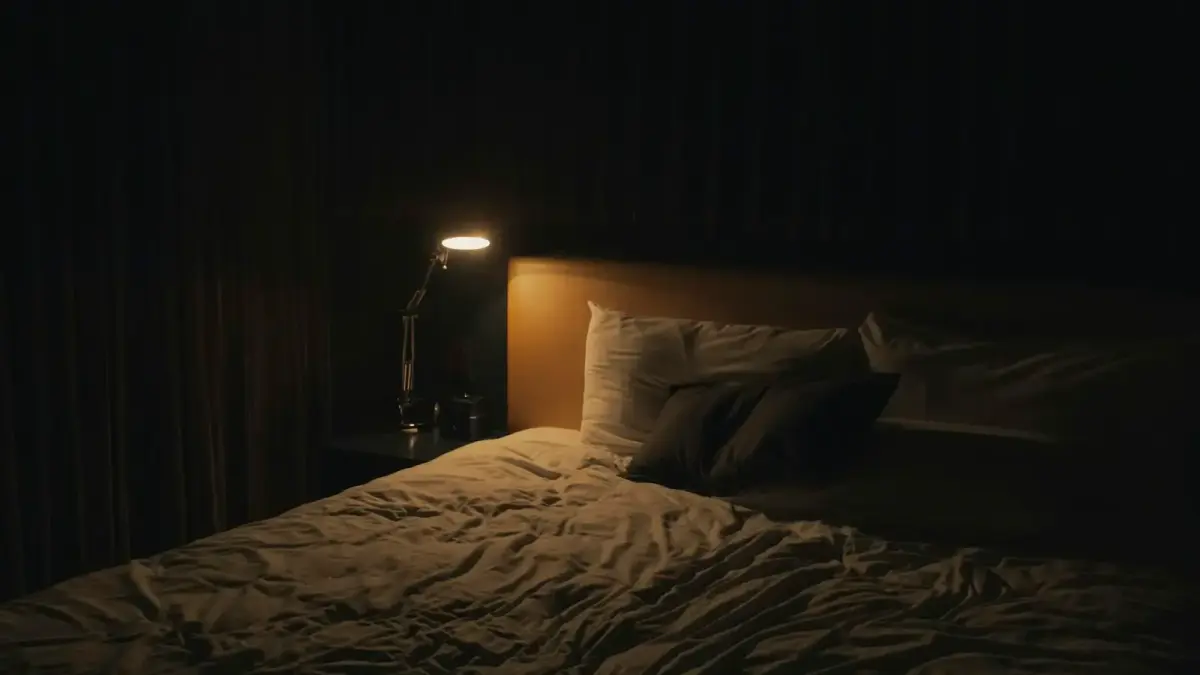
I knew, before my feet touched the hallway floor, what kind of morning it would be.
Not because anyone told me. Not because I heard yelling or crying or the sharp click of a suitcase latch. I knew because I could see - from my bed, through my own cracked door - exactly how wide my parents’ bedroom door was open. And that distance told me everything.
Six inches meant the night had been normal. My father had gone to bed first, left the door ajar the way he always did, and my mother had followed within an hour. Safe. Predictable. I could walk to the kitchen without scanning for wreckage.
Closed all the way meant someone had needed the barrier. A fight. A phone call that went too long. A conversation that required the architecture of a shut door to contain it. On those mornings, I moved through the house like a diplomat entering foreign territory - carefully, with my face arranged into something neutral.
And wide open - all the way open, the hallway flooded with lamplight at 2 AM - meant someone had already left.
I was seven years old, and I had built a measurement system more precise than anything I’d learn in a classroom. Except the thing I was measuring wasn’t inches. It was emotional safety. And the instrument I was using wasn’t a ruler. It was my nervous system.
The architecture of vigilance
Most children learn to read. Children like us learned to read rooms.
We didn’t study facial expressions from a textbook. We studied the distance between our mother’s body and the kitchen counter - whether she was leaning into the work or bracing against it. We studied the weight of our father’s footsteps on the stairs, cataloguing the difference between tired and angry, between distracted and gone.
Edward Tronick’s still face experiments in the 1970s demonstrated something that researchers found startling but that children like us already knew: infants as young as three months can detect when a caregiver’s emotional availability shifts. When the mother in the experiment goes blank - same face, same position, but emotionally absent - the baby doesn’t just notice. The baby panics. Then tries to fix it. Then shuts down.
What Tronick captured in a lab, we lived in a hallway.
The door was our still face experiment, running every night. And we never stopped collecting data.
We learned that physical distance is emotional language. That the gap between two people on a couch says more than the conversation they’re having. That a parent who sits in the car for four extra minutes before coming inside is carrying something they haven’t figured out how to set down yet.
This wasn’t curiosity. This was survival cartography. We were mapping the emotional landscape of our home the way a sailor maps coastline - not because the ocean is interesting, but because the rocks will kill you if you don’t know where they are.
And we mapped in silence. We never told anyone what we were doing. We never said, “I know you two fought last night because the bathroom light was on at 3 AM and the bedroom door was shut and this morning the coffee cups were in the wrong places.” We just knew. And we adjusted. We became smaller or louder or funnier or more invisible, depending on what the map told us the household needed that morning.
The spatial data came first. The emotional interpretation followed instantly. And by the time we were old enough to ride a bike, we had built a system more sophisticated than most adults will ever consciously develop.
What you were actually building
Developmental psychologists call it environmental monitoring - the heightened attentiveness to surroundings that children develop when their home environment is unpredictable. But that clinical phrase doesn’t capture what it felt like from the inside.
From the inside, it felt like a job.
Every morning before school, you ran a diagnostic. The volume of the radio in the kitchen. Whether the coffee was already made or whether the pot sat empty, which meant no one had come downstairs yet. The specific quality of silence - was it peaceful or pressurized? You could tell the difference before you were old enough to spell the word “tension.”
A 2017 study published in the journal Developmental Psychology found that children from emotionally unpredictable homes develop what researchers describe as “threat-related attentional biases” - their perceptual systems literally rewire to prioritize the detection of emotional shifts in their environment. These children don’t just notice more. They notice faster. Their brains allocate processing power to social-emotional cues the way a chess player’s brain allocates processing power to board positions.
You weren’t anxious. You were trained.
And the training was so effective, so early, and so constant that by the time you were eight or nine, you’d stopped noticing you were doing it. The scanning became automatic. The measurement became invisible. You walked into every room already knowing what you were walking into, and you assumed everyone else did too.
They didn’t.
The door becomes the room becomes the office becomes every relationship you’ll ever have
Here is what happens to the child who measured door widths in the dark: they grow up to measure everything.
The distance between a friend’s “I’m fine” and the way their voice flattened on the word “fine.” The half-second pause before a partner says “nothing’s wrong.” The way a colleague’s email sign-off shifted from “Best” to “Thanks” to nothing at all, and you clocked the trajectory before the third email arrived.
People call this intuition. They say you’re perceptive, empathic, a good reader of people. They say it like it’s a gift.
It’s not a gift. It’s a measurement system built by a child who needed advance warning.
John Bowlby’s attachment theory explains the mechanism. Children with insecure-anxious attachment - those whose caregivers were inconsistently available - develop what Bowlby called hyperactivated proximity-seeking behavior. In plain language: they become experts at tracking where safety is and how close they can get to it. They monitor the caregiver’s emotional position the way air traffic control monitors a radar screen. Not because they’re clingy. Because the signal keeps dropping.
When you grow up tracking the signal, you never stop.
At forty-five, you’re sitting in a meeting and you know - before anyone else in the room - that your manager is about to deliver bad news. Not because of what she said. Because of how she arranged her papers. Because of the angle of her shoulders. Because the distance between her body and the table increased by two inches, and that two inches is the exact same language as a bedroom door shifting from six inches to fully closed.
You learned this language in the dark, lying in your bed, watching a strip of hallway light. And now you speak it fluently in every room you enter.
Your friends think you’re psychic. Your partner marvels at how you always seem to know when something’s off. Your therapist, if you have one, has probably used the word “hypervigilant” and you nodded politely while thinking: no, I’m just paying attention. Doesn’t everyone pay attention?
No. They don’t. Most people walk into rooms and experience them. You walk into rooms and inventory them. The difference is invisible to everyone except the people who do it too - and when you meet one of those people, there’s a recognition that doesn’t need language. You both scanned the room at the same time. You both clocked the exit. You both know.
The cost of never being wrong
There’s a particular loneliness that comes with this kind of accuracy.
You see the fight coming before the first word is spoken. You sense the distance opening in a relationship weeks before the other person acknowledges it. You know when someone is lying - not from their words but from the spatial grammar of their body, the way they’ve rearranged the furniture of themselves to accommodate the lie.
And you can’t turn it off.
A 2021 study in Frontiers in Psychology found that adults who scored high on measures of childhood emotional parentification - those who served as emotional monitors in their families of origin - demonstrated significantly higher accuracy in nonverbal decoding tasks. They could read micro-expressions, detect incongruence between verbal and nonverbal cues, and identify masked emotions with a reliability that surprised the researchers.
But the same study found something else: these individuals also reported higher levels of emotional exhaustion, difficulty trusting positive social signals, and a persistent sense of waiting for the other shoe to drop.
Because when your measurement system was built for threat detection, you never fully trust the readings that say “safe.” The door is open six inches, yes. But it was open six inches last Tuesday too, and by Thursday it was shut. So you keep measuring. You keep checking. You lie in bed next to someone who loves you and you’re still - somewhere in the back of your skull - monitoring the width of the door.
You’re rarely wrong about other people. But you’re exhausted by the process of never being wrong. Because being wrong, for you, was never just an intellectual error. It was a physical danger. A child who misread the door walked into the wrong room at the wrong time and caught the shrapnel of whatever was happening behind it.
So you kept your readings precise. And you’ve never allowed yourself the luxury of being oblivious.
The reframe you might need to hear
What you have is not a superpower. It’s also not a disorder.
It’s a measurement system - sophisticated, accurate, built under conditions that no child should have to navigate alone. It was the best possible response to an environment that didn’t give you the one thing every child deserves: the ability to walk into any room in their own home without scanning it first.
You built something extraordinary. A seven-year-old, lying in the dark, constructed an instrument for reading human behavior that most adults never develop. You should be astonished by the intelligence of that child. By the creativity of it. By the sheer engineering of turning a crack of light into a weather report.
But you should also know that the instrument was built for a house you no longer live in.
The hallway is different now. The doors belong to you. And the person on the other side of them isn’t someone you need to predict - they’re someone you could, if you’re willing, simply ask.
That might feel terrifying. Asking means admitting you don’t already know. And not knowing was the one thing that child in the dark couldn’t afford.
But you’re not that child anymore.
You’re the adult who walks into rooms and reads them instantly, accurately, and completely. You carry a measurement system that has served you for decades. And the bravest thing you might ever do is set it down for a moment - not because it was wrong, but because you finally live in a house where you don’t need it to be right.
The door is open. Not because someone left. Because someone is inviting you in.
And you’re allowed to walk through it without checking the width first.