She is 57 and has finally understood why she always knows exactly how many drinks everyone at the table has had - not because she is counting, not because she is judging, but because a girl who grew up in a house where the third glass of wine changed the entire evening's weather learned before she was ten that the only way to predict what was coming was to watch what was being poured, and the arithmetic at fifty-seven is not suspicion but the last surviving reflex of a child who learned that safety was a number
The Sound That Starts It
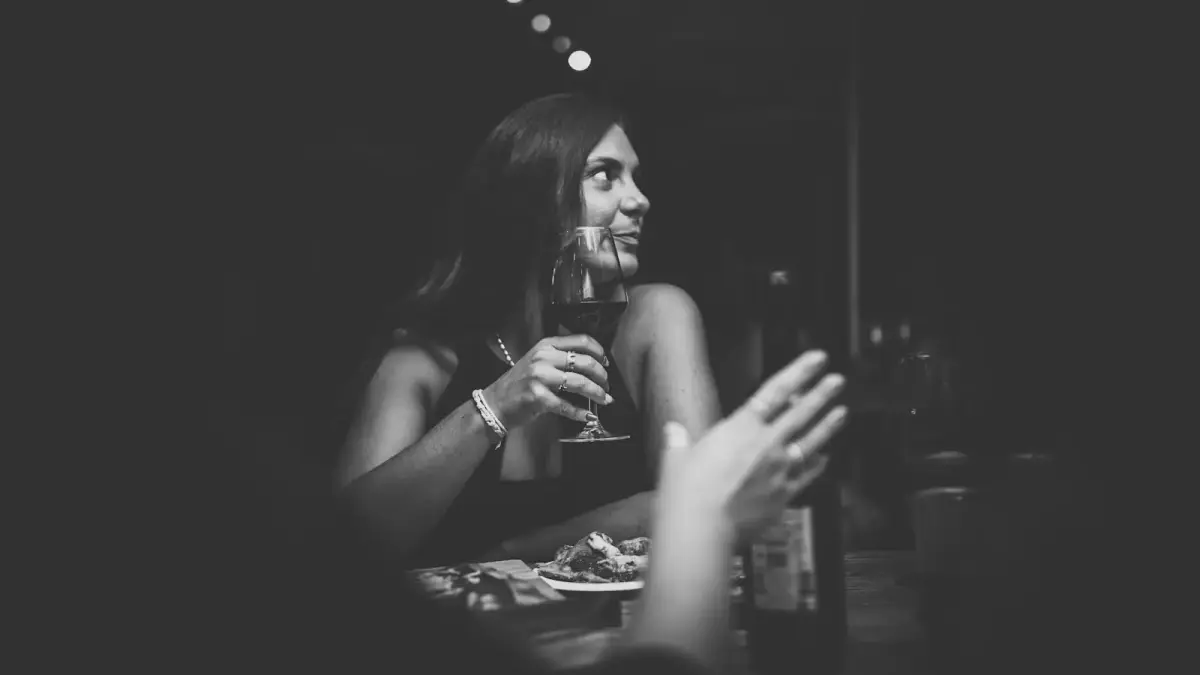
I was at a friend’s birthday dinner last month - one of those long, candlelit evenings with good food and easy conversation - and I noticed myself doing it again. Before the appetizers arrived, I already knew that the woman across from me was on her second glass of white, that the man beside her had switched from beer to whiskey, and that the host had refilled her glass twice without finishing the one before it.
No one asked me to keep track. No one needed me to.
I am fifty-seven years old and I have been doing this since I was eight.
Not judging. Not monitoring. Not even consciously choosing to notice. My eyes just go to the glass. The pour. The refill. The angle of the bottle. The way someone’s hand lingers on the stem a little longer than it did twenty minutes ago.
I used to think this made me uptight. Controlling. The kind of person who can’t relax at a dinner party because she’s too busy being the self-appointed alcohol police.
But that’s not what this is. It was never what this was.
The Third Glass
In my parents’ house, the first two glasses of wine meant my mother was still my mother.
She would laugh at normal volume. She would ask about homework. She would hum while she loaded the dishwasher and sometimes she would dance a little, just her hips swaying, and my sister and I would roll our eyes the way daughters do.
The third glass was the border crossing.
I didn’t have language for it then. I just knew that something shifted. The laugh got louder or disappeared entirely. The questions stopped being questions and became accusations. The humming stopped. The kitchen got quieter in a way that made the whole house hold its breath.
By the time I was nine, I could predict the evening’s emotional weather with the accuracy of a meteorologist. Two glasses: safe. Three glasses: uncertain. Four glasses: go to your room and close the door.
I didn’t learn this from a textbook. I learned it the way all children learn the dangerous things - by watching, by counting, by turning my nervous system into a calculator that ran equations no child should ever have to solve.
Arithmetic as Armor
A 1998 landmark study by Vincent Felitti and Robert Anda - the Adverse Childhood Experiences study, published in the American Journal of Preventive Medicine - found that children raised in households with substance misuse develop heightened sensory processing as a survival adaptation. Their brains learn to scan environments for threat cues with extraordinary precision. Not because they choose to. Because they have to.
I was one of those children. And the math I learned wasn’t the kind they taught at school.
My arithmetic was: how full is that glass? How fast was it poured? How long since the last one? Is the bottle still on the counter or has it been moved to the table, which means the pours will get more casual, which means the count gets harder to track, which means the evening is already slipping?
This was not anxiety. This was engineering.
I was building a prediction model with the only data I had, and the data was liquid. How much had been consumed. How much was left. How many minutes between refills.
I knew - the way you know the layout of your childhood bedroom in the dark - that the distance between a good evening and a terrible one was approximately eight ounces of Pinot Grigio.
The Surveillance System That Never Got Uninstalled
Here is what no one tells you about childhood hypervigilance: it doesn’t retire when the threat does.
My mother has been sober for nineteen years. I am proud of her. I love her. I have done the therapy, read the books, sat in the rooms where people share stories that sound like mine.
And I still count.
At restaurants, I know how many times the waiter has come by to refill someone’s wine. At holiday dinners, I track the bottles. At weddings, I can tell you who switched to water and who didn’t.
A 2019 study in Psychological Science found that threat-detection patterns formed in childhood become essentially automatic by adulthood - encoded so deeply in the nervous system that they operate below conscious awareness. The researchers described it as a form of “embodied memory,” where the body continues responding to environmental cues long after the original danger has passed.
My body still responds to the sound of a cork being pulled.
It’s not fear exactly. It’s more like a light coming on in a room I thought I’d locked. A quiet alertness that hums through my chest before my conscious mind even registers what happened.
Someone reaches for a bottle at dinner and my shoulders tighten by a fraction of a degree. Someone laughs a little too loudly after their third drink and something in my stomach turns over. Not panic. Just readiness. The old machinery spinning up, checking the gauges, running the numbers.
My husband noticed it before I did. He said, gently, one night after a dinner party: “You always know exactly what everyone’s drinking. You realize that, right?”
I didn’t realize it. Not in the way he meant.
I thought everyone did this.
The Girl in the Woman
Gabor Mate has written extensively about how children in unpredictable homes develop what he calls “automatic coping mechanisms” - behaviors that begin as survival strategies and harden into personality traits. The child who becomes exquisitely attuned to a parent’s mood doesn’t stop being attuned when she grows up. She just finds new rooms to read, new atmospheres to measure, new glasses to count.
I am fifty-seven and I am very good at dinner parties. I always know when the energy in the room is shifting. I can feel it when someone has crossed the line from relaxed to reckless. I notice the micro-expressions - the slight glaze in someone’s eyes, the way the volume of their voice climbs one notch.
People have called me perceptive. Intuitive. A great host. A careful friend.
They don’t know that what they’re admiring is scar tissue.
They don’t know that the woman who always notices when someone’s had enough learned that skill in a kitchen where noticing was the difference between safety and chaos.
Sometimes I catch myself mid-count at a perfectly normal dinner with perfectly normal people and I feel a wave of something that isn’t quite sadness. It’s more like tenderness. For the girl who sat at that kitchen table with her math, her vigilance, her desperate little system of prediction.
She was so young to be carrying that clipboard.
What the Body Remembers
The body keeps the score. Bessel van der Kolk wrote a whole book about it, and I lived it before I ever read a word.
My body remembers things my mind has forgiven. The particular sound of a wine bottle being set down on a granite countertop - that hollow, heavy thud. The way ice sounds different in a third drink than a first, because by the third the movements are less careful, more automatic. The smell of wine on someone’s breath when they lean in to say goodnight.
These aren’t traumatic memories in the way most people imagine trauma. There were no catastrophic events, no ambulances, no obvious breaking points. There was just a slow accumulation of evenings that started one way and ended another, and a child’s brain quietly cataloguing which sensory details predicted which outcomes.
A 2022 study in Frontiers in Psychology examined how children of parents with alcohol use disorders develop enhanced environmental monitoring - what the researchers called “predictive vigilance.” These children didn’t just react to threats. They learned to anticipate them. Their nervous systems became early warning systems, calibrated to detect the smallest shifts in atmosphere.
I was the early warning system in my house. I was the weather station. And the forecast was always based on the same metric: how many.
The Reframe She Needed
I spent years feeling embarrassed about this. Years thinking there was something wrong with me for being unable to simply relax and enjoy a meal without running inventory on everyone’s beverages.
A therapist finally said something that changed everything. She said: “You’re not controlling. You’re not anxious. You are a woman whose childhood installed a surveillance system, and you never learned how to turn it off because turning it off once meant danger.”
I sat with that for a long time.
Because the truth is, I don’t count out of suspicion. I count out of love. I count because a version of me - smaller, younger, more afraid - decided that counting was how she would keep herself and her sister safe. And she was right. In that house, at that time, with that mother, counting was safety.
The problem isn’t that the reflex exists. The problem is that it doesn’t know the war is over.
Fifty-Seven and Still Learning
I don’t think I will ever fully stop counting. The neural pathways are too deep, the conditioning too early. And honestly, I’m not sure I want to erase it completely. It’s part of how I move through the world - this quiet awareness, this ability to read a room at the molecular level.
What I’m learning, slowly, is to notice the counting without being owned by it.
To feel my shoulders tighten when someone opens a bottle and gently say to myself: that was then. This is here.
To let the old arithmetic run in the background without letting it hijack the evening.
To look at a table full of people I love, with their glasses and their laughter and their imperfect, beautiful humanness, and choose to stay in this room instead of traveling back to that kitchen.
I am fifty-seven years old. I have spent nearly five decades counting other people’s drinks. And I finally understand that what I was really counting, all along, was the distance between danger and safety.
The girl who learned that distance was measured in glasses of wine deserved better than that education.
But she used what she had. She kept herself alive with arithmetic. She turned a kitchen table into a control room and she ran the numbers every single night until the numbers kept her safe.
I don’t count because I’m broken.
I count because I survived.
And sometimes, at a dinner party, when the wine is flowing and the conversation is warm and everyone is fine - everyone is genuinely, beautifully fine - I catch myself counting anyway, and I let the tears come just for a second, just behind my eyes where no one can see them.
Not for me. For her.
For the girl who learned that safety was a number.