Children who always knew which grocery store aisle their parent was in - who tracked the sound of the cart wheels and could feel when a parent had drifted two aisles away - often become adults who cannot relax in any public space unless they know exactly where every person they arrived with is standing
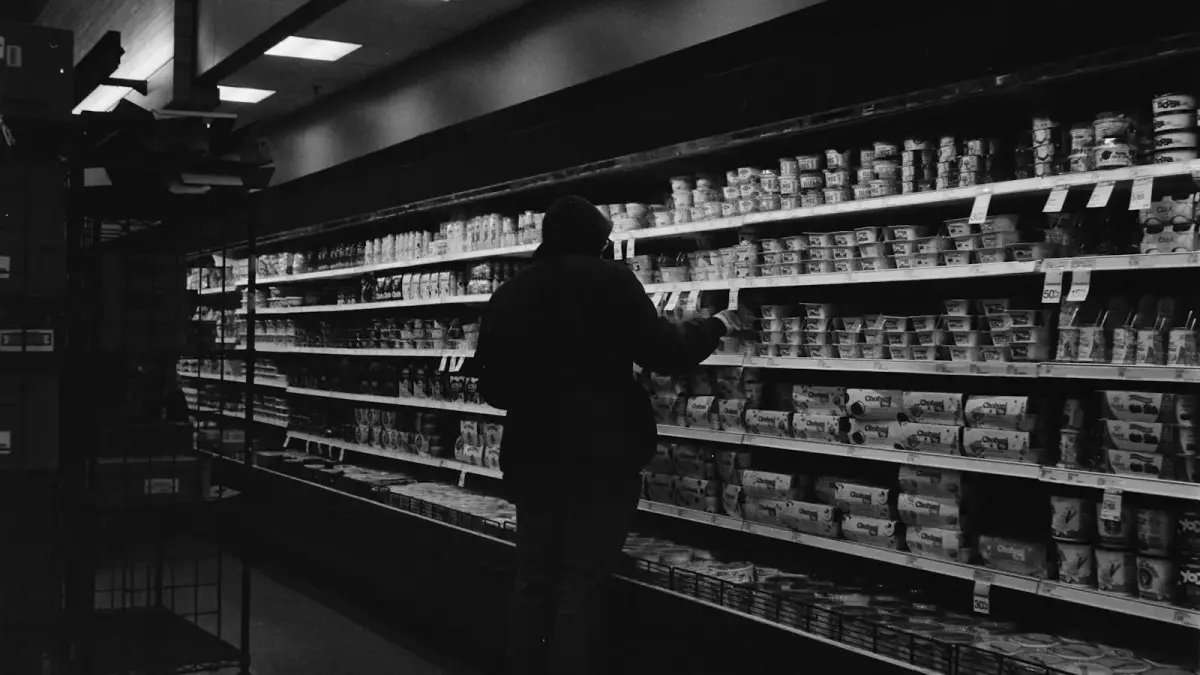
The sound of cart wheels on linoleum
I was eight years old, standing in aisle seven of our local grocery store, holding a box of cereal I had no intention of asking for. I was reading the back of it - some maze puzzle with a cartoon toucan - and the store was bright and cold and full of that particular fluorescent hum that grocery stores have.
And then I noticed the silence.
Not the store silence. The other silence. The one where the specific rattle of our cart - the one with the wobbly left wheel that clicked every half-rotation - had stopped registering in my ears. I looked up. The aisle was empty. Just polished linoleum stretching in both directions, endcaps of pasta sauce and paper towels, and no one.
My stomach dropped the way it does when you miss a step going downstairs. Not dramatic. Not a scream. Just a quiet, full-body lurch of something that felt a lot like the floor tilting beneath me.
I put the cereal box back and walked quickly toward aisle nine. Then eight. Then back to six. And there she was - my mother, comparing two cans of tomatoes, completely unaware I had been looking for her. The relief was enormous and instant. My breathing slowed. The floor leveled out. Everything was fine.
She never knew I was looking. She never knew there was a problem at all.
The tracking system you built without knowing it
If this sounds familiar to you - if you can still remember the specific sound your parent’s cart made, or the way their shoes sounded on a tile floor, or the exact pitch of their voice carrying over the frozen food section - then you already know what I am about to say.
You built a tracking system. You were a child, and you built a surveillance network inside your own nervous system, and it was so effective and so quiet that nobody - not your parent, not your teachers, not even you - realized it was running.
A 2019 study published in the Journal of Research in Personality found that children who experienced inconsistent caregiver availability developed what researchers call “proximity monitoring behaviors” - a heightened sensitivity to the physical location and emotional availability of attachment figures. These behaviors, the study noted, often persisted well into adulthood, long after the original threat had passed.
The original threat. That is a clinical way of putting it.
The original threat was just this: sometimes the person you needed most was there, and sometimes they were not, and there was no warning system for which one it would be. So you became the warning system.
It was never clinginess
Here is what I want you to understand, because I think you have probably been misunderstanding this about yourself for decades.
You were not clingy. You were not needy. You were not anxious in the way people mean when they say anxious - fluttering and irrational and making things up.
You were accurate. Your tracking system worked. It told you when a parent had moved, when the energy in a room shifted, when someone was about to leave. You were reading real data and responding to real patterns. The problem was never that your system was broken. The problem was that a child should never have needed to build one.
Dr. Gabor Mate has written extensively about how children in unpredictable environments develop what he calls “attunement to threat” - a finely tuned sensitivity to the moods, movements, and availability of caregivers. He emphasizes that this attunement is not a disorder. It is an adaptation. It is the developing brain doing exactly what it is supposed to do - keeping you safe in an environment where safety was not guaranteed.
You tracked cart wheels on linoleum because that sound meant “she’s still here.” You tracked footsteps because footsteps moving toward you meant “I am not forgotten.” You tracked the specific quality of silence because you had learned, at an age when you could not even articulate what you were learning, that silence sometimes meant gone.
The adult version looks different but feels exactly the same
You are fifty-three years old and you are at a farmer’s market with your husband on a Saturday morning, and you should be enjoying yourself. The tomatoes are beautiful. Someone is playing guitar near the flower stand. The sun is out.
But your husband wandered toward the cheese vendor four stalls back, and you have lost sight of him, and there it is. That feeling. Not panic exactly - you are a grown woman, you know he did not vanish - but a tightening in your chest that sits just below conscious thought. A pull. A quiet alarm that says: locate, locate, locate.
You stop looking at the tomatoes. You scan. You find him - there he is, sampling something, laughing with the vendor. The tightening releases. You go back to the tomatoes. But something has shifted. You are not fully here anymore. Forty percent of your attention is now allocated to tracking, and it will stay allocated for the rest of the morning.
This is the part that exhausts you, and this is the part nobody sees.
A 2021 study in Frontiers in Psychology found that adults with proximity monitoring patterns reported significantly higher levels of cognitive fatigue in social and public settings - not because the settings were inherently stressful, but because these individuals were running a continuous background process of location-tracking that consumed attentional resources other people did not have to spend.
You are tired at the farmer’s market not because you do not like farmer’s markets. You are tired because you are doing two things at once - enjoying the morning and running a tracking system - and you have been doing two things at once in every public space for your entire adult life.
The texts that confuse people
You have sent this text before. Or some version of it.
“Where are you?”
Three words. Sent from a museum lobby while your friend is somewhere on the second floor. Sent from a shopping mall while your sister tries on shoes. Sent from a parking lot at a concert venue because your partner went to find the restroom and has been gone for what feels like too long.
The person receiving this text does not feel the weight it carries. To them, it is a logistical question. They reply casually - “by the shoes” or “grabbing a coffee” or “be right there” - and they do not understand why you needed to know. They might even be mildly annoyed. They might think you are controlling, or impatient, or that you cannot entertain yourself for ten minutes.
They do not know that for you, the gap between “they’re here” and “where did they go” is not a gap. It is a canyon. And at the bottom of that canyon is an eight-year-old in aisle seven, holding a cereal box, looking up into an empty stretch of linoleum.
You are not asking where they are because you want to control them. You are asking because the tracking system needs a data point, and without it, the alarm keeps sounding, quiet and insistent, beneath everything else you are trying to feel.
The one who always says “let’s just stay together”
You know this person. Maybe you are this person.
At the mall: “Let’s just go to the same stores. I don’t need to split up.” At the museum: “Let’s start on this floor and work our way up together.” At the party: standing near the kitchen because that is where your person is, even though the interesting conversation is happening in the living room.
From the outside, this looks like preference. It looks like introversion, or social anxiety, or a personality that simply prefers togetherness. And maybe some of it is. But underneath it, there is often something more specific and more tired - a calculation that says: if we stay together, I do not have to track. If I do not have to track, I can actually be here. If I can actually be here, I might enjoy this.
The suggestion to “stay together” is not about closeness. It is about conservation. It is the tracking system negotiating a ceasefire with the part of you that just wants to look at the paintings without counting heads.
Why it feels like introversion but is not
This is the misunderstanding I see most often, and it is the one that breaks my heart a little.
So many people with this pattern have concluded that they are introverts. That they do not like crowds, do not like public spaces, do not like events. And maybe some of that is genuinely true - introversion is real and valid and has nothing to do with damage.
But for some of you, what you are calling introversion is actually exhaustion from a tracking system that will not turn off. You do not dislike the farmer’s market. You dislike the farmer’s market while running location surveillance on everyone you love. You are not overwhelmed by the museum. You are overwhelmed by the museum plus the constant background hum of “where is he, where is she, are they still here, have they moved.”
Susan Cain’s work on introversion has been transformative in helping people understand the value of quiet temperaments. But there is a difference between a nervous system that is genuinely overstimulated by noise and crowds, and a nervous system that is overstimulated because it is doing the work of air traffic control on top of trying to enjoy a Saturday afternoon.
If you have ever noticed that you can enjoy a place alone - truly alone, with nobody to track - more easily than you can enjoy it with people you love, this distinction might matter to you.
The message that never arrived
Here is what the tracking system is waiting for. It has been waiting for decades, and it does not know how to stop.
It is waiting for the message that says: you can stop watching now. I am not going to disappear. You do not have to know where I am every second because I am not going anywhere, and even if I move, I will come back, and even if you lose sight of me, I will find you.
That message never arrived in childhood, because the people who needed to send it did not know it was needed. They did not disappear on purpose. Most of them were not cruel or neglectful in any obvious way. They were just inconsistent in the particular way that teaches a child’s nervous system to stay alert. They were there and then not there and then there again, and the rhythm of it was just unpredictable enough that your body decided: I will handle this myself.
And you have been handling it yourself ever since.
You were never the problem
A 2020 study published in the Journal of Personality and Social Psychology found that adults who scored high on proximity monitoring measures also scored high on empathy, relational awareness, and emotional intelligence. The researchers noted that the same attentional system that tracked caregivers in childhood often became, in adulthood, a profound sensitivity to the emotional states of others.
Your tracking system made you someone who notices when a friend goes quiet. Who senses when a partner is upset before they say anything. Who reads a room the way other people read a book - quickly, accurately, and without being able to explain how.
You are not broken. You are not too much. You are not someone who needs to “learn to relax” or “stop being so anxious” or “just let people go to the bathroom without checking on them.”
You are someone whose nervous system learned, at a very young age, that love and proximity were the same thing - that if you could not see someone, you could not be sure they were still yours. And you have spent your whole adult life working with that equation, trying to enjoy the farmer’s market and the museum and the party while a quiet part of you counts heads and listens for cart wheels.
The tracking system was never the problem. It was the solution - the best one you had, built by a child who was doing her absolute best to stay safe in a world that did not yet feel stable.
If you are tired, it is not because something is wrong with you. It is because you have been running two lives in every public space - the one everyone sees, and the one underneath it, where a small version of you is still listening for the sound of a wobbly cart wheel, still checking to make sure no one has slipped away while you were not looking.
You are allowed to put the cereal box down. You are allowed to stand in the aisle and trust that the silence does not mean gone. You have been keeping watch for so long. It makes sense that you are tired. It makes sense that you want to rest.