Children who always preferred the company of one quiet adult to a room full of children their own age - who sat in the grandmother's kitchen while every cousin played in the yard, who found a corner at the birthday party and talked to someone's mother about her garden - often become adults who still scan every crowded room for the one calm person worth knowing, because a child who discovered at eight that the most interesting conversation in any house was the one nobody else wanted to attend never stopped choosing depth over volume
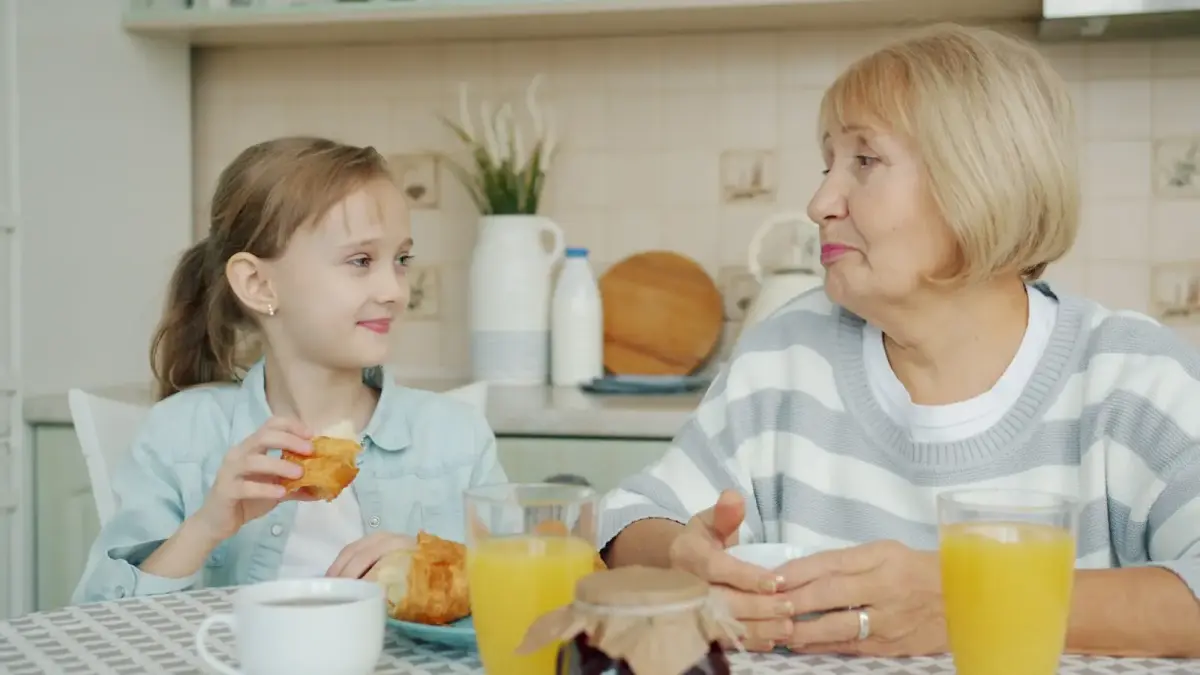
I was eight years old, sitting on a wooden stool in my grandmother’s kitchen while she peeled apples. Through the screen door, I could hear my cousins shrieking in the yard, chasing each other around the picnic table in some elaborate game I hadn’t bothered to learn the rules of.
My aunt leaned in the doorway and looked at me with that worried half-smile adults reserve for children who aren’t behaving like children. “Don’t you want to go play with the others?”
I didn’t. I wanted to stay right where I was, watching my grandmother’s hands move in slow circles around each apple, listening to her talk about the neighbor’s rose garden and the summer she drove across the country with her sister in 1962. I wanted to ask her what the desert looked like at night. I wanted the conversation to keep going in that unhurried way where nobody interrupted anyone and nobody was performing. I was exactly where I belonged - and I already knew, even then, that something about this preference would confuse every adult in my life for the next two decades.
If this sounds like your childhood, I want you to hear something clearly: nothing was wrong with you.
1. They seek out the calmest person at every gathering
You walk into a party and your eyes do a sweep of the room that has nothing to do with finding the bar or the bathroom. You’re scanning for the person who isn’t performing. The one leaning against the far wall with a drink they’ve been nursing for an hour. The one sitting slightly outside the main circle, watching the room with an expression that looks a lot like yours.
You find them every time. It’s almost involuntary - like a compass needle swinging north.
This isn’t antisocial behavior. A 2013 study published in the Journal of Research in Personality found that individuals who score high in what researchers call “preference for solitude” don’t actually dislike people. They’re drawn to environments where the signal-to-noise ratio favors depth. They want connection - they just want it without the static.
As a child, this looked like hovering near the quietest adult at every family function. As an adult, it looks like finding the one thoughtful person at every wedding, every work event, every neighborhood barbecue - and having a conversation you’ll remember for years while everyone else forgets the evening by Tuesday.
2. They form deep friendships with people much older - or younger - than them
Your closest friend in middle school was the librarian. In your twenties, you spent weekend mornings having coffee with a seventy-year-old neighbor. At work, you’re the person the new twenty-three-year-old intern somehow ends up confiding in during their first week.
Age has never been a relevant filter for you when it comes to connection.
This pattern makes sense when you stop thinking about friendship as a peer activity and start thinking about it as a resonance activity. You’re not drawn to people who share your demographic. You’re drawn to people who share your frequency - calm, reflective, genuinely curious about the person sitting across from them.
Daniel Goleman’s work on emotional intelligence describes this as a form of social attunement that isn’t tied to age or context. Some people are simply wired to recognize depth in others, regardless of the packaging it comes in. You were doing this at seven. You just didn’t know it had a name.
3. They find small talk physically exhausting
Not annoying. Not boring. Exhausting - in the body.
After thirty minutes of surface-level conversation at a networking event, you feel like you’ve been holding a weight above your head. Your jaw is tight. Your smile has become something you’re maintaining manually. You need to sit in your car for ten minutes before you can drive home.
This isn’t rudeness or social failure. A 2022 study published in Frontiers in Psychology found that people with high sensitivity to social stimulation show increased activation in brain regions associated with empathy and emotional processing during conversations - even casual ones. Your nervous system isn’t choosing to make small talk harder. It’s processing every interaction at a depth that most people reserve for their closest relationships.
As a child, this was the reason you drifted toward adults at family gatherings. Adult conversation - the real kind, the quiet kitchen kind - didn’t demand performance. Nobody was testing your social rank or evaluating whether you were fun enough. The grandmother peeling apples never asked you to be anything other than present.
4. They were called “old soul” as children - and still hear it
The phrase followed you everywhere. Teachers said it during parent conferences. Your mother’s friends said it when you asked them about their jobs instead of running off to play. Your grandmother probably said it most of all, with a softness in her voice that made it sound less like a label and more like recognition.
“Old soul” was the kindest version of what people meant. The less kind versions were “too serious,” “too quiet,” “not like other kids.”
But here’s what nobody told you then: the children who get called old souls are usually the ones whose nervous systems matured faster in the domain of social perception. They read rooms before they can read books. They sense tension before anyone raises a voice. They understand that the interesting conversation is happening in the kitchen, not the yard - because they can feel the difference in the quality of attention.
You weren’t too serious. You were paying attention at a frequency most people don’t reach until their forties.
5. They feel most relaxed in one-on-one conversations
Put you in a group of six people and watch what happens. You go quiet. Not because you have nothing to say, but because the conversational rhythm of a group requires a kind of competitive timing that feels fundamentally wrong to you. You have to interrupt to participate. You have to perform volume. You have to fight for the floor.
Put you across a table from one person and everything changes. Your shoulders drop. Your thoughts come out fully formed. You say things you didn’t know you were thinking until they left your mouth.
Susan Cain, in her research on introversion, describes this as the difference between stimulation and connection. Groups provide stimulation. One-on-one conversations provide connection. Your nervous system has known the difference since you were the child who pulled one cousin aside and said, “Let’s go sit on the porch and talk.”
You weren’t avoiding the group. You were choosing the format that let you actually show up.
6. They notice when someone is being talked over - and feel compelled to listen
You’re at a dinner party. Someone starts telling a story and gets interrupted halfway through. Everyone else moves on. You’re the one who leans over twenty minutes later and says, “You were saying something earlier about your trip. What happened?”
The look on their face when you do this - the brief flash of surprise followed by something that looks a lot like relief - you know it well. You’ve been collecting those looks your whole life.
This isn’t just politeness. This is a pattern that started when you were the child sitting quietly while adults talked, watching who got heard and who got ignored. You were cataloging the social dynamics of every room you entered, and you developed a reflex that most people never build: the instinct to return to the person who got lost in the noise.
A 2019 study in Psychological Science found that individuals who score high on trait empathy are significantly more likely to track conversational threads that others abandon. Your brain doesn’t let go of the unfinished sentence. It holds it, because you know how it feels to be the one nobody circled back to.
7. They remember conversations from decades ago with perfect clarity
You can tell me exactly what your grandfather said to you on his porch in 1987 about regret. You remember the inflection, the pause before the important part, the way the light was hitting the railing. You remember what your third-grade teacher told you about being brave the day you cried at school. You remember a conversation with a stranger on a train fifteen years ago - her name, the color of her scarf, the story she told you about her daughter.
Your memory for social interaction is almost photographic, while you can’t remember where you put your keys this morning.
This isn’t random. Gabor Mate’s work on the connection between emotional sensitivity and memory suggests that people who process social experiences deeply encode them more vividly. The conversations that mattered to you - the quiet, unhurried, real ones - got written into your long-term memory with a permanence that casual interactions never achieve.
This is why the grandmother’s kitchen mattered more than the yard. What happened in the kitchen was worth remembering. Your brain knew that before you did.
8. They have always preferred teaching and mentoring relationships over peer dynamics
There’s a reason you were the child who wanted to help the teacher clean the erasers after class instead of running to recess. A reason you volunteered to walk the kindergarteners to the bus. A reason, even now, that your most fulfilling relationships tend to have a mentoring quality - either you’re learning from someone or you’re guiding someone, and the exchange feels more natural than the lateral energy of pure peer friendship.
This isn’t about hierarchy or control. It’s about a kind of connection that has built-in permission to be sincere. In a mentoring relationship, you can ask real questions. You can admit what you don’t know. You can offer what you’ve learned without it feeling like competition. The performance pressure that poisons so many peer interactions simply doesn’t exist.
A 2020 study published in the Journal of Personality and Social Psychology found that individuals with a strong mentoring orientation reported higher relationship satisfaction across all domains of their lives - not just professional ones. The researchers suggested that mentoring relationships activate a deeper sense of purpose in connection, which tracks with everything you already know about yourself.
You were never failing at friendship. You were seeking a version of it that most social structures don’t make room for until adulthood.
If you recognized yourself in this list, I want to leave you with something I wish someone had said to me when I was eight years old, sitting on that kitchen stool, watching my grandmother peel apples while the other children played outside.
You were not failing to be a child correctly. You were not too serious, too quiet, or too strange. Your nervous system was doing something remarkably intelligent - it was filtering for quality. It was recognizing, years before you had language for it, that the most meaningful conversation in any house is usually the one happening away from the noise.
The adults who worried about you were seeing the surface. They saw a child who didn’t play enough, who was too comfortable with silence, who preferred the company of people three decades older. What they didn’t see was a child who was already practicing the kind of connection that most people spend their entire adult lives trying to learn.
You haven’t outgrown this. You’ve just gotten better at understanding it. And the next time you find yourself at a crowded event, drifting toward the quietest corner, sitting down next to someone who has stopped trying to impress anyone - know that you’re not hiding from the party. You’re finding the only part of it that was ever going to matter to you.
That kitchen never left you. You just keep finding new versions of it, everywhere you go.