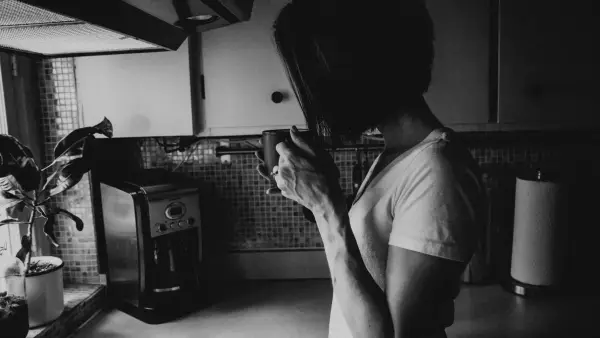
Children who always triple-checked that the front door was locked before bed - who would test the handle, walk away, come back, test it again, and sometimes lie awake wondering whether they had really checked or only imagined checking - often become adults who verify every stove knob by touch, set three alarms for a single morning, and cannot leave for vacation without a quiet departure ritual of confirmation, because the child was never anxious but was simply the one who took on the job of making sure, since nobody else in the house seemed to be doing it
The Handle Test
I was nine the first time I got out of bed to check the front door. It was a Thursday. I know it was a Thursday because my father worked late on Thursdays, and Thursday nights were the nights the house felt most like it was my job.
I padded down the hallway in socks, turned the deadbolt to make sure it was horizontal, pulled the handle twice, and went back to bed. Then I lay there for ten minutes wondering if I had actually turned it or only thought about turning it. So I got up and checked again.
The second check was always the problem. Because once you admit to yourself that your memory of the first check might not be reliable, you have opened a door that is very difficult to close. If you can’t trust the memory from two minutes ago, why would you trust the one from thirty seconds ago?
I checked the door three times that night. It became four by the following week. By the time I was eleven, I had a whole route - front door, back door, the sliding glass door in the den, and the window above the kitchen sink that never latched properly unless you pressed it with both hands.
Nobody asked me to do this. Nobody assigned me the role. I simply noticed that nobody else was doing it, and something in me decided that someone had to.
The Volunteer
There is a particular kind of child who takes on the job of keeping the house safe without ever being told it was their responsibility. They are not the oldest child, necessarily. They are not the most anxious child, necessarily. They are the child who noticed a gap - a place in the household where vigilance was needed and nobody seemed to be providing it - and stepped into that gap the way a person steps into a cold lake. Not eagerly. Not happily. But because someone had to, and they were the someone who was awake.
A 2015 study published in the Journal of Child Psychology and Psychiatry found that children who take on what researchers call “instrumental parentification” - assuming practical caretaking responsibilities that exceed their developmental stage - often develop heightened monitoring behaviors that persist well into adulthood. The checking is not pathological. It is adaptive. The child learned that vigilance had a function, and the function was keeping people safe.
This is not the same as a child who was told to check the doors. That child has a job description. This is the child who invented the position, wrote their own job description, and started showing up for shifts that nobody else knew existed.
They checked the stove before bed even though they had not cooked anything. They tested the faucets. They looked in on a sleeping sibling to make sure the blanket hadn’t crept over their face. They lay in the dark listening to the sounds of the house, cataloguing each creak and settling noise, sorting them into two categories: normal and not normal.
They were the night watchman of a household that never posted the job.
The Route
Every child who checks has a route. It is never random. It is never casual. It has an order, and the order matters, because if you do it out of sequence, the magic doesn’t work and you have to start over.
Mine went: front door, back door, sliding door, kitchen window, stove knobs (even though I had not touched the stove), and then - this is the part that embarrasses me to admit - I would stand very still in the center of the kitchen and listen. Just listen. For thirty seconds. For anything that sounded wrong.
I did not know the word for what I was doing. I would not learn the word “hypervigilance” until I was twenty-six and a therapist said it to me in a tone that was clearly meant to be clinical but landed like a name I had been waiting to hear.
You have your own route. Maybe you don’t call it a route. Maybe you call it “just being careful” or “I’m a worrier” or “I can’t relax until I know everything is locked up.” But it has an order. And if you skip a step, you can feel it - a low hum of incompleteness, like a song that ended one note too soon.
A 2019 study in Behaviour Research and Therapy found that checking behavior is strongly linked to what psychologists call “not just right experiences” - the sense that something is unfinished or incomplete that generates a compelling urge to repeat an action until the feeling resolves. But what the study did not explore is where that feeling of incompleteness was first installed. For many people, it was installed in a house where the feeling of completeness - of everything being handled, everything being locked, everyone being safe - was not reliably provided by the adults.
So the child provided it. And the child never clocked out.
What It Looks Like at Forty-Seven
You are forty-seven and you touch every stove knob before you leave the house. Not a glance. A touch. Your hand goes to each knob and presses it, feeling for the indent that means off. You do this even when you have not cooked. You do this even when you just watched yourself turn the stove off thirty seconds ago. The hand goes anyway, because the hand does not trust the eyes, and the eyes do not trust the memory, and the memory does not trust itself because it was trained in a house where things that were supposed to be taken care of were sometimes not taken care of.
You set three alarms. The phone alarm, the clock alarm, and the backup alarm on the second phone that you keep in the nightstand drawer for exactly this purpose. People laugh about this. You laugh too. But you also know that the reason you have never once overslept for anything important in your entire adult life is not luck. It is architecture. It is the scaffolding of a person who learned early that the safety net is the one you build yourself.
You cannot leave for vacation without a ritual. You check the doors. You unplug the coffee maker. You open the oven and look inside it, even though you have not used the oven in four days. You run your hand along the bathroom faucet. You take a photo of the stove knobs with your phone so that when you are sitting on the airplane two hours later and the question arrives - did I really check? - you have evidence. Proof. A timestamped photograph that says: you checked. You really checked. You can let go now.
Except you can’t, entirely. Because the job was never really about the stove.
The Distinction Nobody Makes
There is an important line between checking behavior as a clinical symptom and checking behavior as a developmental inheritance, and most people - including many clinicians - draw that line in the wrong place.
Clinical obsessive-compulsive checking is driven by intrusive, ego-dystonic thoughts. The person knows the thought is irrational. The thought terrorizes them anyway. The checking is an attempt to neutralize a fear that the person recognizes as disproportionate to any real danger.
But the checking that begins in childhood responsibility is different. It is not driven by irrational fear. It is driven by accurate observation. The child looked around the house and correctly identified that nobody was checking. The child accurately perceived a gap in the household’s safety infrastructure and filled it. The checking was not a symptom. It was a solution.
The problem is that the solution outlived the problem. The child grew up. The house changed. The circumstances that required a nine-year-old night watchman no longer exist. But the nine-year-old never received a formal discharge. Nobody ever sat them down and said: you can stop now. Someone else has this.
So they didn’t stop. They couldn’t stop. Because stopping meant trusting that someone else would do the job, and trusting that someone else would do the job was precisely the thing they learned not to do at an age when the lesson wrote itself into their bones.
Gabor Mate has written extensively about how the body stores unresolved childhood roles, arguing that many adult behaviors labeled as “anxiety” are actually the body continuing to perform a function that was necessary in childhood and never formally concluded. The anxious adult is not creating problems. They are solving ones that no longer exist, with tools they built when they were too young to build anything else.
The Weight of the Watch
What nobody tells you about being the child who checked is that it was lonely. Not in a dramatic, cinematic way. In the quiet way that all invisible labor is lonely - the way cleaning a house is lonely, the way staying awake while everyone else sleeps is lonely, the way carrying a responsibility that nobody acknowledges is lonely because the loneliness is the point. You are alone with the task because the task only exists because you are the only one doing it.
You would lie in bed after your route and feel something that you would not be able to name until decades later. It was not anxiety. It was not fear. It was the particular exhaustion of a child who has taken on a job that belongs to an adult and is performing it with the resources of a child - which is to say, with no resources at all except the willingness to get out of bed one more time and press your hand against one more door.
A 2021 study in the Journal of Family Psychology found that children who assume caretaking roles in the household report higher levels of what researchers call “compulsive self-reliance” in adulthood - the deep, structural belief that if something needs to be done, they must be the one to do it. Not because they want to. Not because they enjoy control. Because the alternative - trusting that someone else will handle it - feels physically unsafe.
You know this feeling. You feel it every time you ask someone else to lock up and then lie in bed fighting the urge to go check anyway. You feel it every time you delegate a task at work and then quietly verify it was done. You feel it when your partner says “I already checked” and you say “I know” and you check anyway, not because you don’t trust them but because you don’t know how to trust the gap between their checking and your certainty.
The Resignation That Never Came
Here is what I want you to hear, if you are the person who checks.
You were not born anxious. You were not wired wrong. You were not the nervous kid who couldn’t relax. You were the kid who noticed that the house needed someone on watch, and you volunteered before anyone asked. You built a system of safety out of sock-footed hallway walks and handle tests and whispered counts in the dark. You kept your post through childhood, through adolescence, through every apartment and house and hotel room you have ever slept in.
You are still on duty. That is not a disorder. That is devotion. It is the devotion of a child who loved the people sleeping in those rooms enough to get out of bed one more time, walk down one more hallway, and press one more hand against one more lock - just to be sure. Just to know. Just to carry the weight of “someone has to make sure” so that everyone else could sleep without carrying it.
The stove knobs. The alarm clocks. The photo of the deadbolt on your phone. These are not evidence that something is wrong with you. They are evidence that something was right with you, very early - a seriousness, a care, a willingness to hold the watch that most people would not develop until they had children of their own, if they developed it at all.
You were the child who kept everyone safe. And the reason you can’t stop checking is that nobody ever told you the shift was over.
It’s over. You can put it down now. But if you can’t - if your hand still reaches for the knob, if your feet still carry you down the hall, if you still need to hear the click of the lock one final time before you can close your eyes - that is okay too. The watch you are keeping is an old one. And old watches do not end because someone tells you they’re finished. They end when your body finally believes it.
You kept everyone safe. You are still keeping everyone safe. And the fact that you cannot stop is not your weakness. It is your longest act of love.