Children who crouched at tide pools and refused to leave - who spent hours watching sea anemones close around their fingers, tracking hermit crabs between rocks, cataloging every creature in a world the size of a bathtub while their parents called from the beach towels that it was time to go - often become adults who notice what other people walk past, because a child who learned to love what lives in the margins learned that the most extraordinary things are always hiding in plain sight, in the places nobody else bothers to look
I was seven the first time I put my finger into a sea anemone’s mouth.
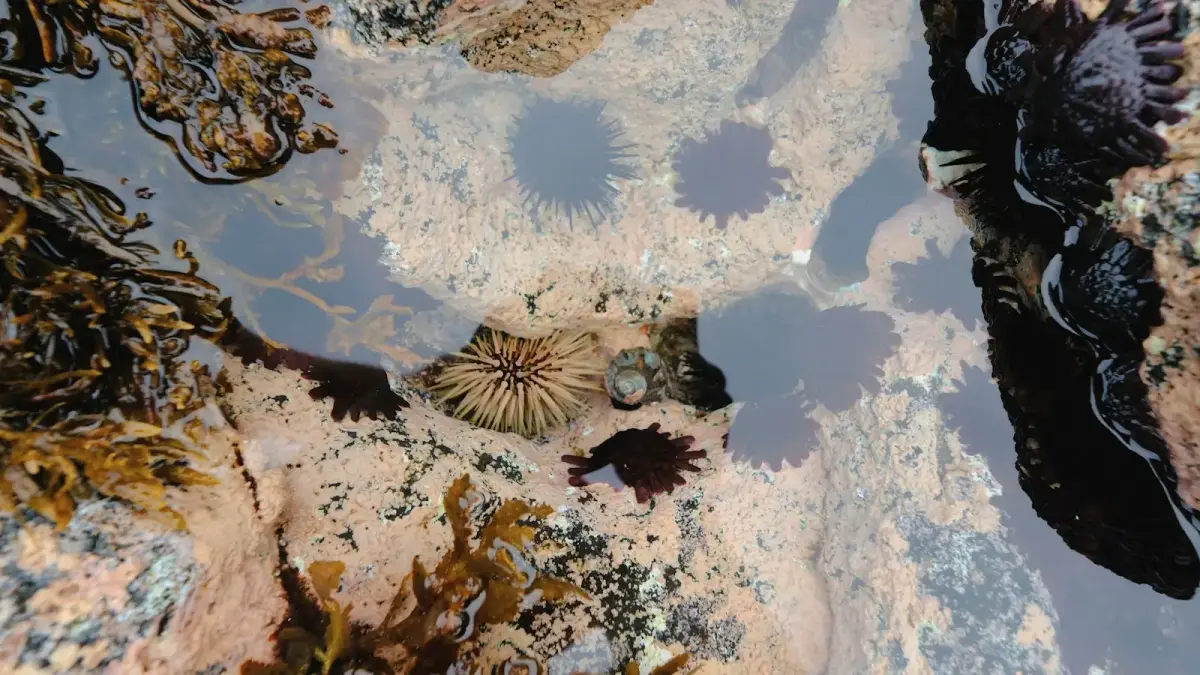
My family had driven three hours to the coast for a weekend trip, and while my older brother sprinted toward the waves and my parents set up the cooler and the umbrella, I wandered to the rocks. I found a shallow pool no bigger than a kitchen sink, warm from the sun, and I crouched there. The water was still enough that I could see everything - the purple spines of an urchin tucked into a crevice, a hermit crab dragging its borrowed shell across the bottom, a cluster of mussels breathing open and shut like tiny dark lungs.
And the anemone. Green-tipped, soft, alive in a way I didn’t have words for yet. When I touched it, it closed around my fingertip with a gentle pull, and I felt something shift inside me that has never fully shifted back.
My mother called my name four times before I heard her. I wasn’t ignoring her. I was simply somewhere else - a world the size of a bathtub that felt, to me, more vast and more important than anything happening on the towels behind me.
If that scene sounds familiar to you - if you were the child who crouched and refused to stand, who cataloged and memorized, who felt a kind of reverence for tiny things that the adults around you couldn’t quite understand - then I want to tell you something about who you became.
The child who wouldn’t leave the edge
Not every child is drawn to edges. Some children run toward the center of things - the loudest game, the biggest wave, the group already laughing. But some children drift toward the margins. The shallow water. The underside of a log. The patch of moss on the north side of a fence post.
These children aren’t antisocial. They aren’t strange. They are doing something that developmental psychologists have been studying for decades - they are practicing a form of deep, self-directed attention that most adults spend years trying to reclaim.
A 2015 study published in Psychological Science found that children who engage in sustained, voluntary attention to natural environments show measurably different patterns of cognitive flexibility later in life. The researchers called it “attentional absorption” - the capacity to become so engaged with a stimulus that external distractions functionally disappear. It’s not distraction. It’s the opposite of distraction. It’s focus so complete it looks, from the outside, like the child has gone somewhere else entirely.
And in a way, they have.
What the tide pool actually taught you
Here is what most people don’t understand about the child at the tide pool. They think the child is interested in marine biology. They think it’s about the animals.
It’s not about the animals. It’s about a way of seeing.
When you crouch at a tide pool, the first thirty seconds show you almost nothing. Water, rock, maybe a bit of seaweed moving. But if you stay - if you hold still and keep looking - the pool begins to reveal itself. A snail you didn’t see starts moving. A fish no longer than your thumbnail darts from one shadow to another. Something with legs you can’t count picks its way across the bottom like it has somewhere important to be.
The pool didn’t change. Your perception did.
That is the lesson the tide pool child absorbs without anyone teaching it to them. That patience transforms what you can see. That stillness is not the absence of something happening - it’s the prerequisite for noticing what was happening all along.
Rachel Carson, the marine biologist and writer who would go on to change the world with her book about pesticides, wrote about this exact experience in her essay “The Sense of Wonder.” She described taking her young nephew to the tide pools of Maine at night, in the rain, and watching his face as he discovered creatures glowing in the dark water. She argued that a child’s sense of wonder is more durable and more important than any fact they could memorize. The feeling comes first. The knowledge follows.
The neuroscience of noticing
Your brain, it turns out, was being shaped by all that crouching.
Neuroscientist Amir Amedi and his colleagues have published extensively on how sustained visual attention during childhood development strengthens what researchers call “perceptual sensitivity” - the ability to detect subtle changes in an environment that other people miss. A 2021 study in Frontiers in Psychology demonstrated that adults who reported high levels of nature-based exploratory play in childhood scored significantly higher on tasks requiring detection of visual anomalies. They noticed the thing that was slightly different. They caught the detail that everyone else’s eyes slid past.
This isn’t a party trick. This is a fundamentally different relationship with the world.
If you were a tide pool child, you probably grew into the adult who notices when a friend’s smile doesn’t reach their eyes. You’re the one who catches the first yellow leaf on the maple tree three weeks before anyone else mentions that fall is coming. You walk into a room and register the energy before a single word is spoken.
People may have told you that you’re “too sensitive” or “too observant” or that you “read too much into things.” But what they’re actually describing is a perceptual system that was trained, early and thoroughly, to treat the world as something worth looking at closely.
The quiet rebellion of paying attention
There is something countercultural about a child who refuses to leave a tide pool.
Think about what that child is doing. They are rejecting the schedule. They are ignoring the call to come eat lunch, to get in the car, to do the next thing. They are saying, without words, that this moment - this small, specific, unscheduled moment - matters more than whatever is supposed to come next.
That is a kind of rebellion. A quiet one. And it doesn’t go away.
Adults who were tide pool children tend to resist the pull of hurry in ways that confuse the people around them. They’re the ones who stop on a walk to watch a hawk circle. They’re the ones who arrive at a party and spend twenty minutes talking to one person instead of working the room. They linger. They look. They are chronically, beautifully unwilling to skim.
Psychologist Mihaly Csikszentmihalyi spent his career studying what he called “flow” - the state of being so absorbed in an activity that time seems to disappear. What he found was that people who experience flow regularly aren’t doing anything exotic. They are simply paying complete attention to whatever is in front of them. The activity matters less than the quality of engagement.
The tide pool child knew this before they could spell it.
Why the margins hold the most life
Here is a fact from marine ecology that has never stopped feeling like a metaphor to me.
Tide pools exist in what biologists call the intertidal zone - the strip of coastline between the highest reach of the tide and the lowest. It’s a margin. A border. Not quite land, not quite sea. It floods and drains twice a day. It bakes in the sun and then fills with cold salt water. It’s one of the harshest environments on earth.
And it is one of the most biodiverse.
The creatures that live in tide pools have adapted to conditions that would kill almost anything else. They are tough and strange and astonishingly varied. A single pool might contain thirty species. The margins, it turns out, are where the most interesting life is.
I think the child who was drawn to those margins understood something instinctive about where to look for what matters. Not in the center, where everything is obvious and already claimed. But at the edges. In the overlooked places. In the spaces between categories.
If you were that child, you probably still live this way. You find the most interesting people at the edges of a gathering. You read the footnotes. You notice the quiet colleague, the unfinished sentence, the thing someone almost said and then swallowed.
You learned, before you had language for it, that the margins are not empty. They are full. They are where everything extraordinary is hiding.
The gift of slow seeing
John Berger, the writer and art critic, once said that the relationship between what we see and what we know is never settled. I think about that line often, because it captures something true about the tide pool child’s adult life.
You don’t stop seeing once you’ve learned to look. The practice deepens. It changes what you know, and what you know changes what you see, and the loop never closes. It just widens.
A 2019 study in the Journal of Research in Personality found that the personality trait most strongly associated with sustained attention to natural environments was openness to experience - one of the Big Five personality traits. But the researchers noted something interesting. Openness in their subjects wasn’t just about seeking novelty. It was about depth of engagement. The high-openness individuals didn’t just notice more things. They noticed more about each thing. They saw layers where others saw surfaces.
This is what I mean by slow seeing. It’s not that you look longer, though you do. It’s that you look deeper. You are willing to stay with something until it reveals what it actually is, not just what it appears to be at first glance.
This is a rare and genuinely valuable way to move through the world.
What you carried home from the rocks
If you were a tide pool child, you carried something home that you didn’t put in a bucket.
You carried a way of being in the world that trusts patience over speed. That believes the small thing is worth your full attention. That knows - in your body, in your nervous system, in the quiet place behind your thoughts - that the most extraordinary things don’t announce themselves. They wait. They hide. They reveal themselves only to the person who is willing to crouch down, hold still, and look.
You are probably still that person.
You are the one who notices the shift in someone’s voice that means they’re not okay. You are the one who sees the first wildflower pushing through a crack in the sidewalk in March. You are the one who reads a paragraph three times because something in it is beautiful and you want to understand why.
The world moves fast and rewards the people who move with it. But the world also desperately needs the people who stop. Who crouch. Who refuse to leave until they’ve seen what’s actually there.
You were that child. You are still that person.
And the tide pool you loved - that tiny, teeming, overlooked world at the edge of everything - it taught you the truest thing anyone can learn: that the most extraordinary life is always in the place nobody else thinks to look.