Children Who Spent Entire Saturday Afternoons Drawing With Sidewalk Chalk on the Driveway - Suns With Long Rays, Houses With Every Window, Flowers Taller Than People - Then Watched the Rain Wash It All Away and Came Back the Next Day to Start Again, Often Become Adults Who Pour Themselves Into Things They Know Won't Last
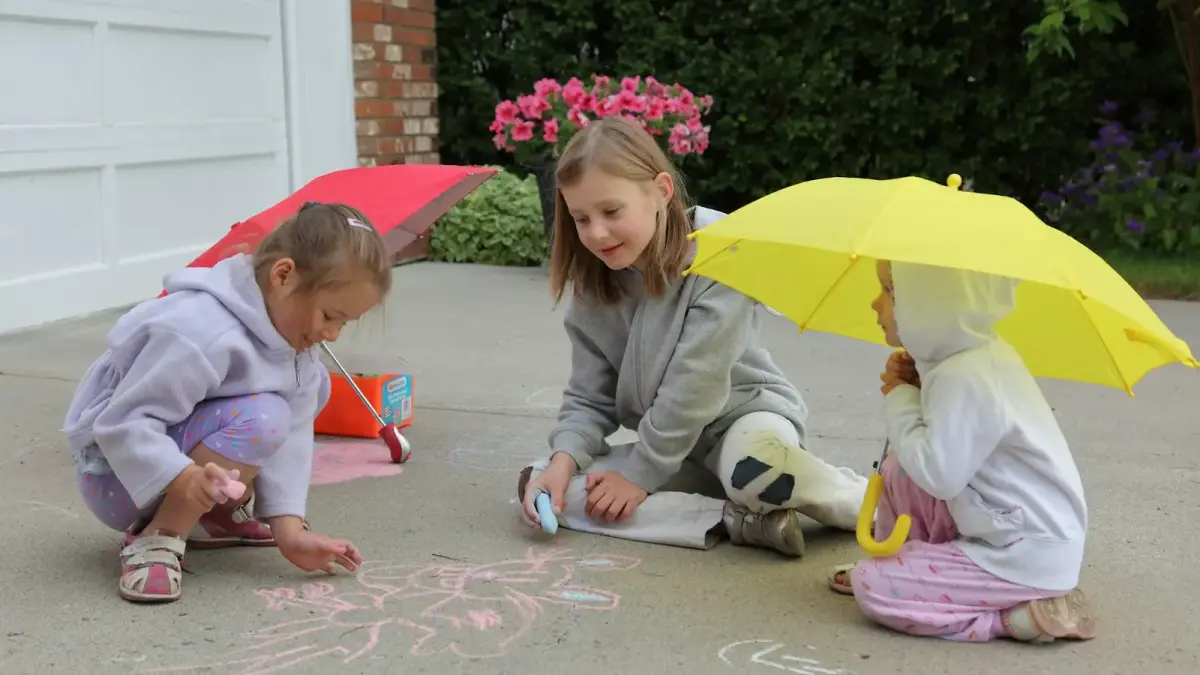
My daughter was five when she spent an entire July afternoon drawing a castle on our driveway. It had turrets and a moat and a garden with individual petals on every flower. She used seventeen different chalk colors. She narrated the story of who lived there while she drew - a queen who kept frogs as pets and a knight who was afraid of butterflies.
By the time she finished, the sky had already turned that heavy shade of grey that means business.
I remember standing at the kitchen window watching her add one last sun to the corner of the scene - a giant, radiant thing with rays that stretched across three concrete slabs. I wanted to take a photograph. I wanted to seal it somehow. She looked up at the clouds and said, “That’s okay. I’ll make a different one tomorrow.”
She was not sad. She was not resigned. She was already planning what came next. And I realized, standing there, that she understood something I had spent thirty years failing to learn.
The Driveway Was Never a Canvas - It Was a Teacher
There is a particular kind of child who gravitates toward sidewalk chalk. Not the child who draws one hopscotch grid and runs inside. The child who treats the entire driveway like a commission. Who maps out kingdoms and solar systems and portraits of the family dog. Who kneels on concrete until her knees are raw and her fingers are coated in a rainbow of dust.
This child knows the rules of the medium. Chalk on pavement is temporary. Sprinklers run on timers. Rain comes when it comes. The neighbor’s car will back over the corner of your masterpiece at 6 PM when he gets home from work.
And the child draws anyway.
A 2016 study published in the journal Thinking Skills and Creativity found that children who engage in what researchers call “process-oriented creativity” - making things for the sake of making them, without attachment to the finished product - develop stronger emotional regulation and greater tolerance for uncertainty than children whose creative efforts are always preserved and praised as objects.
The driveway chalk child is not learning art. She is learning how to love something without gripping it.
What Impermanence Actually Teaches a Developing Brain
Most of the environments we build for children are designed around permanence. We frame their drawings. We save their school projects in labeled bins. We tell them their work is so good it deserves to last forever.
There is nothing wrong with that. But the child on the driveway is getting a different education entirely.
She is learning that effort and outcome are not the same thing. That you can spend four hours making something extraordinary and then watch it dissolve, and the four hours still counted. They counted because you were absorbed. Because you solved the problem of how to make a dolphin’s tail curve right. Because the sun felt warm on the back of your neck and the chalk felt good in your hand and you were fully, completely present for every minute of it.
Dr. Teresa Amabile’s foundational research at Harvard on creativity distinguishes between intrinsic and extrinsic motivation. Children who create for the inherent satisfaction of the process - not for a grade, not for praise, not for a product that will be displayed - consistently produce more creative and emotionally authentic work. But more importantly, they develop a relationship with effort itself that is not contingent on what happens to the finished thing.
The chalk child internalizes this before she has language for it. The making is the point. The making was always the point.
The Adults They Become
You know this person. Maybe you are this person.
She is the one who spends three days planning a birthday party for a seven-year-old - handmade invitations, a scavenger hunt that winds through the entire yard, a cake decorated to look like a dragon’s lair. The party lasts from 2 to 5 PM. By 5:30, the streamers are in the trash and the yard is empty. She is not deflated. She is already thinking about next year.
He is the one who cooks a dinner that takes the entire afternoon. A risotto stirred in twenty-minute intervals. A salad with components that each required their own preparation. A dessert that involves tempering chocolate. The meal is consumed in forty minutes. The dishes take longer than the eating. And he feels no loss, because the afternoon of cooking was the thing. The eating was just the last movement.
She plants a garden every spring knowing that the first hard frost will take it. He builds a sandcastle with his grandchildren at the beach and does not flinch when the tide arrives. She writes a toast for her best friend’s wedding that will be heard once, by forty people, and then exist only in memory.
These are not people who don’t care about results. These are people who learned, on a driveway, that results are just the residue of attention. The real thing was the attention itself.
Process Over Product - And Why Most Adults Get This Backwards
Here is what happens to most of us: somewhere between childhood and adulthood, we start to believe that effort is only justified by permanence. That if you are going to pour yourself into something, it had better last. It had better produce a result you can point to, save, measure, display.
This is why so many people struggle with retirement. With empty nests. With any life transition that removes the tangible output they had been using to justify their daily investment of energy.
A 2019 study published in the Journal of Personality and Social Psychology found that adults who scored high on measures of “process focus” - who reported finding satisfaction in the act of doing rather than exclusively in the result - showed significantly lower rates of depression during major life transitions and reported higher overall life satisfaction across decades.
They had learned to decouple effort from permanence. And many of them, when asked to trace that orientation back to its origins, described childhood experiences that involved creating things that did not last.
Sandcastles. Snow forts. Chalk drawings on sidewalks that would not survive the weekend.
The Specific Beauty of Watching Something Disappear
There is a word in Japanese - mono no aware - that roughly translates to “the bittersweet awareness of impermanence.” It is the feeling you get watching cherry blossoms fall. The recognition that a thing is beautiful precisely because it will not stay.
You do not need to study Japanese aesthetics to understand this. You just need to have been six years old on a driveway, watching a garden hose wash a unicorn down the storm drain, and feeling something that was not quite sadness and not quite acceptance but something richer than both.
The chalk child learns mono no aware in her body before she learns it in her mind. She feels it in the moment she surveys a finished drawing - the sun is setting, the colors are vivid against the grey concrete, and she knows this is the only time it will look exactly like this. Tomorrow the edges will be blurred. The day after, it will be gone entirely.
And she does not reach for a fixative. She does not beg her parents to cover it with a tarp. She stands there, chalk dust on her shorts, and she looks at it.
That is a kind of bravery most adults never develop.
Why This Matters More Now Than It Used To
We live in an era obsessed with documentation. With preservation. With making sure every experience is captured, stored, backed up, and retrievable. We photograph our meals. We record our children’s concerts. We screenshot conversations so we can revisit them later.
None of this is inherently wrong. But it has quietly eroded our ability to be present for things that will not be preserved. To invest fully in an experience whose only record will be the change it makes inside us.
The chalk child never had that problem. She knew from the start that the driveway would not keep her work. She was making it for the making. For the feeling of a fat piece of yellow chalk dragging across warm concrete. For the satisfaction of standing back and seeing an entire world she pulled out of her own head.
Psychologist Mihaly Csikszentmihalyi spent decades studying the state of flow - complete absorption in an activity. His research, published across multiple works including his landmark book Flow, consistently found that the activities most likely to produce this state were those where the process itself was the reward. Not the product. Not the preservation. The doing.
The driveway was one of the purest flow states available to a child. No grade. No audience. No permanence. Just creation for the pure, temporary joy of it.
Coming Back the Next Day
This is the part of the story that matters most. Not that the rain came. Not that the drawing disappeared. But that the child returned.
She came back to a blank driveway - the same grey concrete, the same cracks, the same oil stain near the garage door. And she picked up a piece of chalk and started again. Not to recreate what was lost. To make something new.
This is what the chalk child carries into adulthood. Not resilience, exactly - that word has been stretched so thin it barely means anything anymore. Something more specific. The knowledge that a blank surface is not a tragedy. It is an invitation.
The woman who plans the elaborate party knows it will end. The man who tends the garden knows winter is coming. The grandmother who builds the sandcastle knows about tides. They are not ignoring impermanence. They are in a relationship with it. They learned, on their knees on a warm driveway, that the willingness to begin again is not a consolation prize for loss. It is the whole gift.
Your chalk drawing is gone. The concrete is clean and grey and waiting.
What are you going to make today?