Children who fell asleep to the sound of a transistor radio playing in another room - baseball scores and weather reports murmuring down the hallway like a light left on for someone too small to reach the switch - often become adults who cannot sleep in total silence, not because they fear the quiet but because a child who learned that safety has a sound never stopped listening for it
I don’t remember when I first noticed it, but at some point in my late twenties, I realized I couldn’t fall asleep without voices.
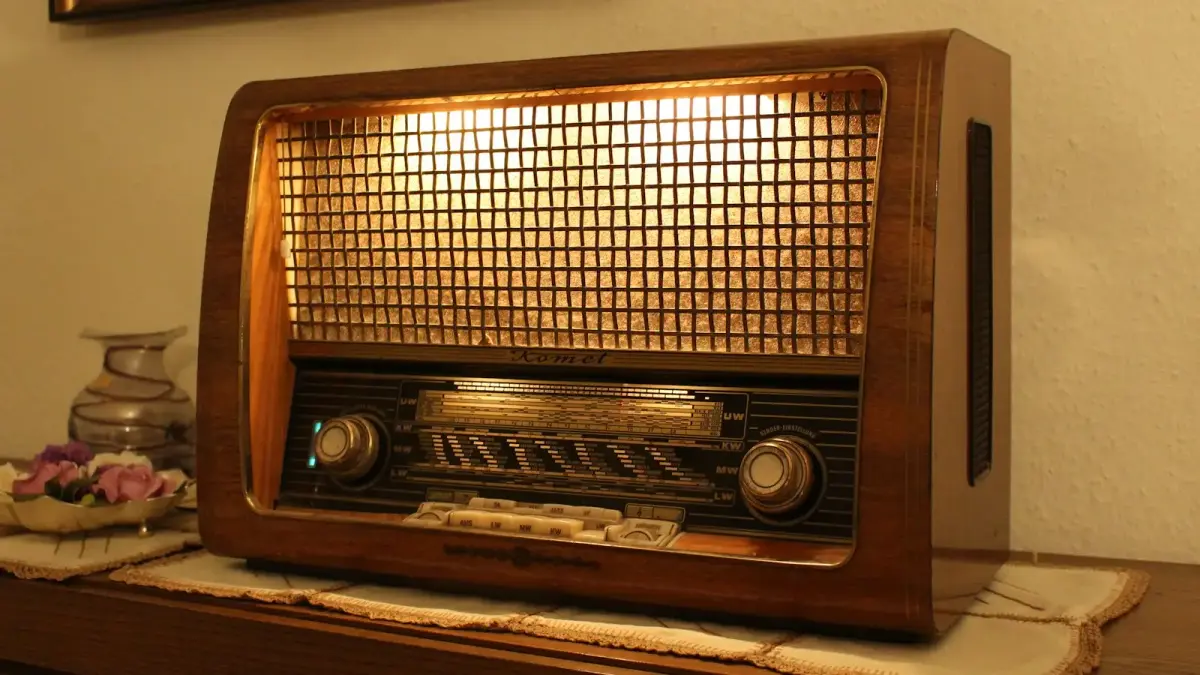
Not music. Not white noise machines with their mechanical hiss. Voices. Human ones. A podcast turned down to a murmur, a television set to a volume where the words blurred into cadence. Something that sounded, if I’m honest, exactly like the AM radio my grandfather kept on in his workshop every single evening of my childhood.
He never turned it off before I fell asleep. I don’t think he knew he was doing anything. He was just a man in his sixties who liked listening to the ballgame while he sanded something or sorted his tackle box. But down the hallway, in the dark of the guest bedroom where I slept on weekends, his radio was the last thing I heard before I drifted off. The low hum of a sportscaster calling balls and strikes. The static that crept in when the signal weakened. The occasional weather report interrupting something I was already too drowsy to follow.
I didn’t know I was memorizing what safe sounded like. But I was.
And decades later, I still reach for it.
If you grew up in a house where a radio played in another room - where a television murmured through the wall, where voices floated down the hallway from a kitchen or a garage or a den that smelled like pipe tobacco and old newspapers - you might recognize yourself in what comes next.
1. You cannot fall asleep in a completely silent room
This is the most obvious one, and probably the reason you paused on this headline.
Total silence doesn’t feel peaceful to you. It feels alert. Watchful. Like something is missing that should be there.
You’ve tried. You’ve turned off the phone, closed the laptop, let the house go dark and still. And you lie there in that silence and your body does something strange - it doesn’t relax. It listens harder. Your ears reach for something that isn’t there, the way your hand might reach across the bed for a person who used to sleep beside you.
A 2019 study published in the Journal of Sleep Research found that individuals who grew up in homes with consistent ambient sound showed measurably different arousal responses to silence compared to those raised in quieter environments. For some nervous systems, silence isn’t the absence of stimulation. It’s a signal that something has changed. And the body reads change, especially at night, as a reason to stay awake.
2. You play podcasts or television at a volume where you can’t quite make out the words
This is the detail that gives it away.
You don’t actually want to listen to what’s playing. If the volume were loud enough to follow, it would keep you awake. What you want is exactly what you had as a child - the shape of human speech without the content. The rise and fall. The rhythm that tells your nervous system someone is talking, someone is present, the house is not empty.
You’ve probably never articulated this to anyone because it sounds strange. But you know the exact volume. You’ve been calibrating it your entire adult life. Loud enough to hear that voices exist. Quiet enough that the words dissolve into texture.
That’s not a preference. That’s a memory your body is recreating.
3. You associate silence with something being wrong
Here’s where it gets deeper.
For a child lying in bed in a house where a radio always played, the sound wasn’t entertainment. It was information. The radio being on meant someone was awake. Someone was in the next room. The house was occupied, populated, alive.
And when the radio went off - when the station signed off for the night or the batteries died or your father finally went to bed - the silence that followed wasn’t neutral. It was the sound of being the last one awake. The sound of a house that had emptied out. The sound of being alone in the dark with no proof that anyone else was still there.
Psychologist Donald Winnicott wrote extensively about the child’s need to be “alone in the presence of another” - the developmental experience of playing independently while knowing a caregiver is nearby. That radio was Winnicott’s theory turned into sound. It was presence without intrusion. Companionship without demand.
When it stopped, so did the feeling of safety.
4. You feel most at ease in coffee shops, airports, and other spaces full of ambient human noise
Your friends think you like coffee shops because of the atmosphere. The truth is simpler and stranger.
A room full of strangers talking is the closest public equivalent to lying in bed as a child and hearing voices through the wall. You can’t make out the conversations. You don’t need to. The sound itself is the point. It tells your body the same thing the radio told it forty years ago - you are not alone here.
A 2012 study from the Journal of Consumer Research found that moderate ambient noise (around 70 decibels, roughly the level of a busy cafe) actually enhances creative thinking and feelings of comfort. The researchers attributed it to a mild disruption of focused processing that allows the mind to wander productively. But I think for people like us, there’s something else happening. That ambient hum doesn’t just help us think. It helps us feel held.
5. You’ve tried white noise machines and they don’t work the same way
People have suggested them. Partners have bought them. You’ve downloaded apps that play rain sounds, ocean waves, the interior of an airplane cabin.
And they’re fine. They help a little. But they don’t do the thing.
Because what your nervous system learned to associate with safety wasn’t just sound. It was human sound. The unpredictable rhythm of speech. The slight variations that tell your sleeping brain this is a person, not a machine. The way a voice rises at the end of a question or drops into a low chuckle.
White noise is consistent. It never changes pitch, never pauses, never surprises. And your body knows the difference between something that’s constant and something that’s alive. The radio wasn’t constant. It was alive. It stuttered and drifted and faded between stations and came back. It had the imperfection of a real presence.
That imperfection is what you’re still looking for.
6. You sometimes leave the television on when you leave the house
Not because you forgot. Because you want the house to sound occupied when you come back.
This is the one most people won’t admit to. But if you do it, you know exactly what I mean. Walking into a completely silent home after being out for hours can produce a feeling that’s difficult to name - something between loneliness and unease, as if the house itself has been holding its breath.
So you leave something on. A news channel on low. A streaming service playing to no one. And when you open the door and hear the murmur of voices, something in your chest loosens before you’ve even set your keys down.
You’re not being wasteful. You’re doing something your grandfather did with that radio every single evening. You’re making the house sound like someone is home.
7. Hearing actual AM radio can make you unexpectedly emotional
This is the one that catches you off guard.
You’re in someone’s garage and they have a transistor radio on. Or you’re in a car and someone tunes past the AM band and you hear it - that particular quality of sound. The slight tinny compression. The way AM signals carry differently than anything digital. The static that lives between stations like breath between words.
And something in you just - stops.
It’s not sadness exactly. It’s recognition. The feeling of hearing a sound your body remembers before your mind catches up. Neuroscientist Rachel Herz, whose research on sensory memory at Brown University has shown that auditory cues can trigger emotional memories with the same intensity as smell, calls this a form of “Proustian recall” - a sensory experience that bypasses cognition and lands directly in feeling.
You’re not remembering the radio. You’re remembering the person who had it on. You’re remembering the hallway. The dark. The specific feeling of being small and safe and drowsy and not alone.
8. What you were really listening for was never the radio
This is the part that matters most.
The radio was never the point. The ballgame wasn’t the point. The weather report crackling through at ten-fifteen wasn’t the point.
The point was that someone was still awake.
A child lying in bed in a dark house is performing an act of extraordinary trust. She is surrendering consciousness in a world she doesn’t control, and the only thing that makes that possible is the belief that someone is keeping watch. That the adults are still up. That the house is still held.
The radio was proof. It was evidence that on the other side of the wall, in the den or the garage or the kitchen, someone was present. Not hovering, not checking on you, not performing care in any visible way. Just being there. Existing in the next room with their radio and their quiet evening.
And that was enough.
That was everything.
If you still need voices to fall asleep, you’re not broken. You’re not dependent. You’re not failing at some imagined standard of sleeping in meditative silence.
You are a person whose body learned very early what safety sounds like. And it sounds like someone in the next room, doing nothing in particular, staying up just a little longer than you.
The podcasts, the television on low, the ambient sounds you queue up each night - they’re not a crutch. They’re a translation. You’re converting a childhood experience of being watched over into something you can give yourself, now that the person who kept the radio on is no longer down the hall.
That’s not weakness. That’s one of the most tender things a nervous system can do - keep reaching for a feeling it had once, in a house that no longer exists, with a person it still misses.
You’re not listening for the radio.
You never were.
You’re listening for the person who was still awake when you weren’t. And every night, in your own quiet way, you find them.