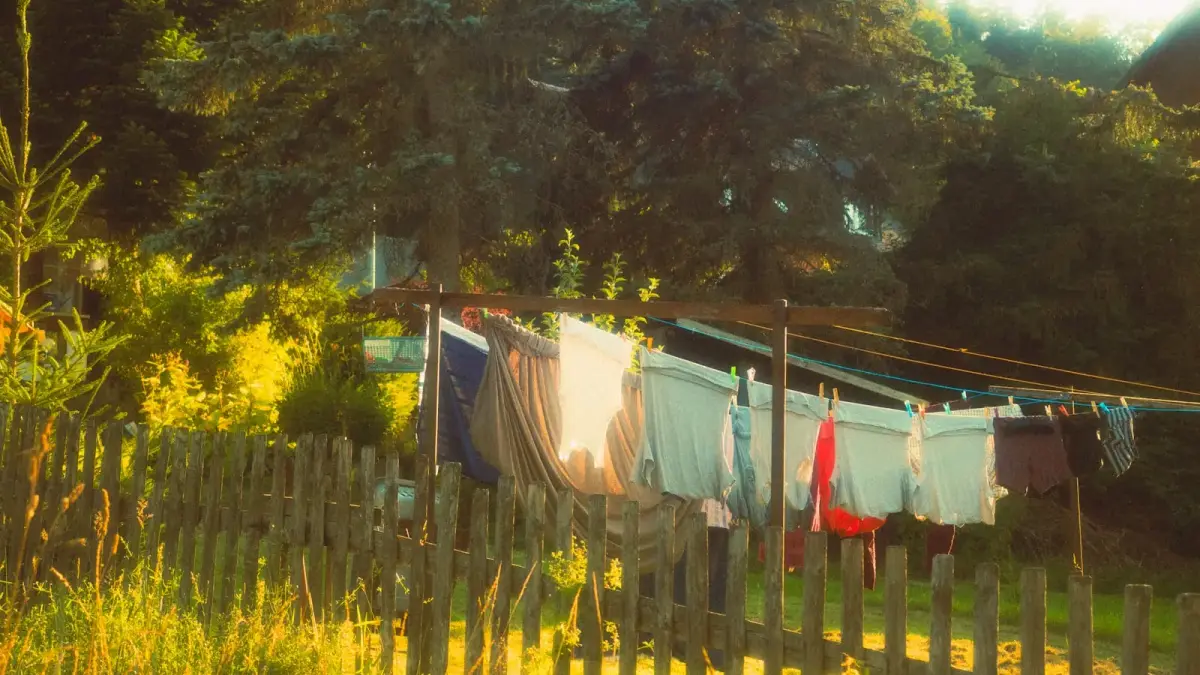
Children who helped their mothers hang laundry on the clothesline - who stood in the backyard handing up wooden clothespins one at a time and watched sheets billow like sails in the wind - often become adults who find an inexplicable peace in repetitive outdoor tasks, because a daughter who stood in the morning sun while her mother pinned wet shirts to a wire learned that the quietest hour of the day was the only one where that woman looked like she belonged entirely to herself
I can tell you the exact temperature of the air the last time I helped my mother hang laundry.
It was a Tuesday morning in late May. I was maybe nine. The grass was still damp. She carried the basket on her hip, and I walked behind her holding the bag of clothespins like it was something important. Because to me, it was.
She didn’t talk much during those mornings. That was the thing I noticed even then, before I had any language for it. My mother was a talker - she narrated the grocery list, she called her sister three times a week, she filled silence the way some people fill empty rooms with furniture. But at the clothesline, she went quiet. Her hands moved in a rhythm I couldn’t name. Pin, stretch, pin. Shake the wrinkles out. Let the sheet catch the wind.
I didn’t know I was watching something rare. I didn’t know I was memorizing it.
But here I am at fifty-three, and I still hang certain things on a line in my backyard. Not because I’m old-fashioned. Not because I read an article about reducing energy costs. Because something in my body remembers that the woman at the clothesline was the calmest version of my mother I ever knew - and I have been trying to stand inside that calm ever since.
If you grew up helping someone hang laundry outside, you probably carry more from those mornings than you realize.
1. You find a strange comfort in tasks that most people consider pointless
You sweep the porch when nobody’s coming over. You weed the garden bed by hand instead of spraying it. You wash the car in the driveway with a bucket when there’s a car wash two miles away.
People in your life have probably called you inefficient. They’ve offered faster solutions, better tools, modern alternatives. And you’ve smiled and kept doing it your way, because you know something they don’t.
The comfort isn’t in the result. It’s in the rhythm.
A 2019 study published in the Journal of Environmental Psychology found that repetitive outdoor activities - gardening, raking, hanging laundry - activate a parasympathetic response similar to meditation. The researchers called it “soft fascination,” a state where the mind quiets not through concentration but through gentle, patterned movement.
You didn’t learn this from a study. You learned it from a woman who hummed while she pinned towels to a wire, and for those twenty minutes, seemed to forget that anything in her life was hard.
2. The smell of line-dried fabric opens a door in your chest that nothing else reaches
You’ve tried the candles. You’ve tried the detergents that promise “outdoor freshness” in a plastic bottle. They don’t come close.
Because the smell of sheets dried on a line isn’t a fragrance. It’s a coordinates. It drops you into a specific backyard, a specific morning, a specific quality of light.
Scent memory is the most stubborn form of recall we have. The olfactory bulb connects directly to the amygdala and hippocampus - the brain’s emotional and memory centers - which is why a smell can return you to a moment faster than a photograph can. Dr. Rachel Herz, a neuroscientist at Brown University, has written extensively about how scent triggers what she calls “involuntary autobiographical memory” - vivid, emotionally loaded recall that arrives without effort or warning.
So when you bury your face in a pillowcase that dried in the sun, you’re not being sentimental. You’re being neurologically accurate. Your brain filed that smell under “safe,” and it has never reclassified it.
3. You stand outside sometimes for no reason at all - and it feels like the most productive thing you’ve done all day
You step onto the porch with your coffee and just stand there. You don’t check your phone. You don’t sit down. You just stand and look at whatever is in front of you - the yard, the sky, the neighbor’s fence - and something in your shoulders releases.
People who didn’t grow up outside don’t always understand this. Standing still outdoors, doing nothing, can look like avoidance. Like wasted time.
But you know it’s the opposite. You watched someone do this before every load of laundry. She’d step outside, set the basket down, and just breathe for a second. She’d look at the garden or the birds or nothing in particular. Then she’d start.
That pause wasn’t laziness. It was the only transition your mother gave herself between one demand and the next. And your body learned that standing outside for thirty seconds is not nothing. It is the thing that makes everything else possible.
4. You prefer doing things by hand, even when a machine could do it better
You knead bread instead of using the stand mixer. You write notes by hand. You fold clothes fresh from the line instead of pulling them from the dryer in a tangled heap.
There’s a word for this that psychologists use: embodied cognition. It means that thinking isn’t just something your brain does - it’s something your whole body participates in. When your hands are engaged in a physical task, your nervous system processes stress differently.
But you don’t need the terminology. You just know that when your hands are busy with something slow and tangible, the noise in your head gets quieter. You learned this before you were ten years old, standing in a backyard, handing clothespins up one at a time, watching your mother’s hands move in a pattern that never varied.
The machine might be faster. But the machine doesn’t make you feel like everything is going to be fine.
5. You have a complicated relationship with efficiency
The modern world runs on optimization. Faster delivery, faster results, faster everything. And you participate in it - you have to. But somewhere inside you, there’s a small, stubborn resistance.
You don’t always want the fastest version. Sometimes you want the version that takes forty-five minutes and happens outdoors and lets you think about nothing.
This isn’t a personality flaw. A 2021 study in Frontiers in Psychology explored what researchers called “savoring behaviors” - the deliberate choice to slow down and absorb a positive experience rather than rushing past it. People who regularly engage in savoring report higher life satisfaction and lower rates of depression.
Your mother at the clothesline was savoring. She probably didn’t call it that. She probably called it “getting the laundry done.” But the way she moved - unhurried, rhythmic, present - was a masterclass in resisting the cult of speed.
And you absorbed every lesson.
6. You understand that some kinds of peace can only be witnessed, not explained
Here’s what nobody tells you about watching a parent in a rare moment of calm: it teaches you what peace looks like before you have any idea what peace is.
You were a child. You didn’t understand why your mother seemed different at the clothesline. You didn’t understand the weight of her days - the meals, the cleaning, the managing of everyone else’s needs, the way a woman of that generation could go entire years without anyone asking her what she wanted.
But you saw her face change. You saw the tension leave her jaw. You saw her move at her own speed, answering to nothing but the wind and the weight of wet cotton.
That image became your internal template for calm. Not a spa. Not a vacation. Not silence in an empty room. But a woman standing outside, hands busy, mind quiet, belonging to herself for exactly the length of time it takes to hang one load of laundry.
You’ve been chasing that image your whole adult life. And the fact that you still haven’t fully found it doesn’t mean you’ve failed. It means you understand how rare it was.
7. The woman who still hangs laundry on the line at fifty-five is not being old-fashioned - she is reconstructing the one version of her mother that ever looked like freedom
This is the part that gets me every time.
When I hang a sheet on the line in my backyard, I am not performing nostalgia. I am not rejecting technology. I am not making a statement about simplicity or sustainability or any of the things people assume when they see a clothesline in a modern yard.
I am standing where my mother stood. I am doing what her hands did. And for a few minutes, I am inside the only version of her that ever seemed unreachable - not unreachable to me, but unreachable to everything that usually had a claim on her.
The bills. The arguments. The fatigue that lived behind her eyes most days. None of it could touch her at the clothesline.
Adam Grant once wrote about how we inherit not just our parents’ traits but their coping mechanisms - the specific ways they found relief, often without realizing they were teaching us anything. Your mother didn’t set out to teach you that outdoor work was a form of prayer. She was just getting through her Tuesday. But you were watching. And you learned.
8. You carry a kind of gratitude that has no obvious target
You’re grateful, but you’re not sure for what exactly.
Not for the laundry itself - that was just fabric and water and wooden pins. Not for the chore - you didn’t love chores any more than any other child. And not exactly for your mother, though she’s part of it.
You’re grateful for the accident of it. The fact that you happened to be standing in the right backyard on the right morning, watching the right woman do something ordinary, and your brain decided to file it as sacred.
Because not every child got that. Not every child had a moment where the world went quiet and a parent stood still and the sun hit the laundry just right and everything, for ten minutes, made complete sense.
You got that. You carry it.
And every time you step outside to do something slow and repetitive and unnecessary, you are not wasting time. You are returning to the only cathedral you have ever fully trusted - a backyard, a wire, a sheet catching the wind, and the memory of a woman who, for one hour a week, looked exactly like peace.
That’s not inefficiency. That’s inheritance.
And it’s worth every minute.