Children who learned to cook by standing next to a grandmother who never once opened a recipe book - who absorbed measurements by watching hands, who learned 'a pinch' and 'enough' and 'until it looks right' - become adults who cannot follow a written recipe without feeling like they are betraying someone, because the kitchen was never about food, it was the only room where a woman who did not know how to say I love you said it in the only language she trusted
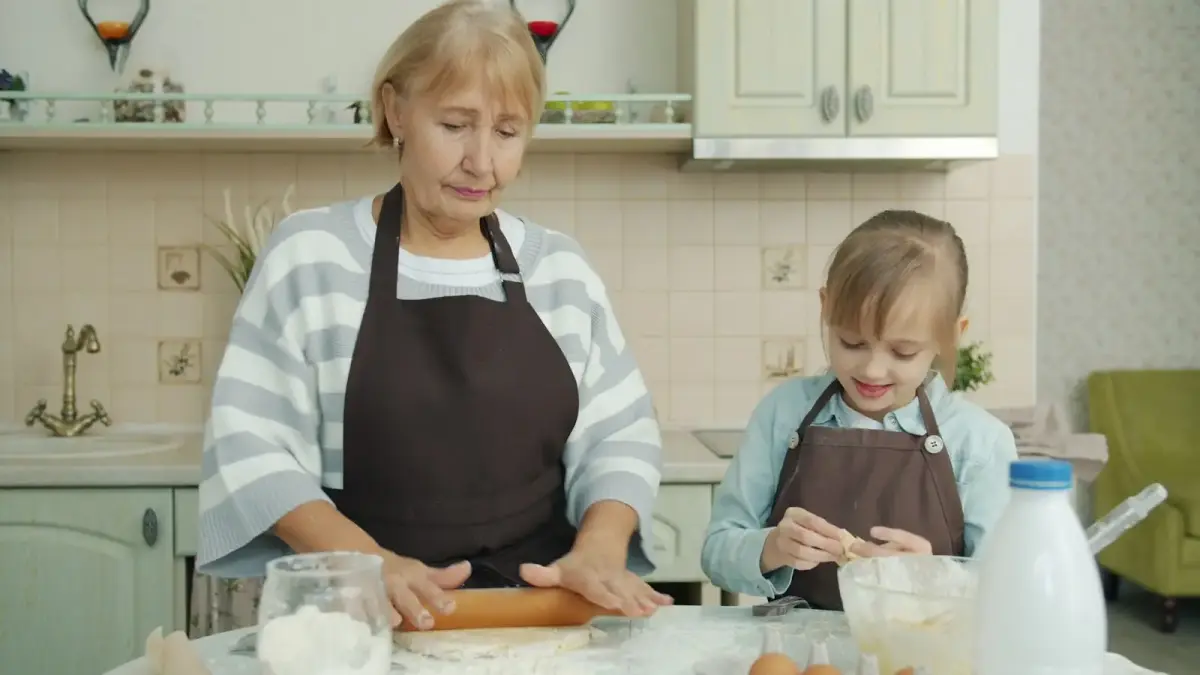
I was eleven years old, standing on a step stool in my grandmother’s kitchen, when she poured flour into a bowl without looking at it. I asked her how much that was. She said, “Enough.”
That was the entire lesson. Not a teaspoon, not a cup, not a measurement that could be written down and reproduced by a stranger. Just enough. And the thing is, I understood exactly what she meant - not because the word made sense, but because I had watched her hands do it forty times before.
I did not know then that I was being given something. There was no ceremony, no announcement that knowledge was being transferred. She didn’t sit me down and say, “I’m going to teach you how to cook.” She just let me stand next to her. She let me be in the room while she did what she had always done. And somewhere between the flour dust and the quiet, I absorbed a language that had no dictionary and no alphabet - only muscle memory and the particular way her wrist turned when she stirred.
I think about that kitchen almost every week now. Not because I’m sentimental. Because every time I open a cookbook, something inside me resists. Something feels wrong about the precision. And I have spent years trying to understand why.
The Measurements That Only Made Sense If You Were There
“A pinch” is not a real unit of measurement. Neither is “a handful” or “some” or “until it smells right.” These are instructions that only work if you watched the specific hand that first demonstrated them.
My grandmother’s pinch was not your grandmother’s pinch. Her “enough” was calibrated to a bowl I can still see if I close my eyes - white ceramic, a small chip on the rim, a faded blue stripe. The measurement was inseparable from the vessel, and the vessel was inseparable from the woman.
This is what researchers in cultural anthropology call “tacit knowledge” - information that cannot be fully articulated in words or symbols. A 2003 study published in the journal Cognition found that procedural knowledge acquired through observation and imitation activates different neural pathways than knowledge learned through explicit instruction. Your brain literally processes “watch and do” differently than “read and follow.”
Which means the cooking you learned beside your grandmother is stored in a part of you that a recipe card cannot reach. It lives in your hands, not your head. It lives in the rhythm of how you stir, not in the words that describe stirring.
And that is why a written recipe feels like a translation of something that was never meant to be translated.
The Recipe She Never Wrote Down
My grandmother had one dish that everyone in the family talked about. You probably had one too - that thing she made that nobody else could quite replicate, no matter how carefully they tried.
People asked her for the recipe. She would try to give it. She’d say things like, “You cook the onions until they’re done,” and everyone would laugh because that’s not a recipe, that’s a riddle. But she wasn’t being evasive. She genuinely did not know how to convert what she did into instructions for someone who wasn’t standing beside her.
Because the recipe was never information. It was a relationship.
The dish existed in the space between her body and the stove, in the particular way she tilted the pan, in the moment she decided - by smell, by color, by some instinct that had been refined across fifty years of repetition - that it was ready. You could not write that down any more than you could write down the exact feeling of being held by someone who loves you.
Psychologist Michael Polanyi described this phenomenon decades ago. We know more than we can tell. Your grandmother knew more than she could tell. And she told you anyway - not with words, but by letting you stand close enough to absorb it through proximity.
The Kitchen Where Silence Was a Language
Here is what I think most people miss about those kitchen memories. It was not the cooking that mattered. It was the standing next to.
Think about it. How many other rooms in your childhood home allowed you to simply exist beside an adult without being asked to perform something? In the living room, you were told to sit still. In the dining room, you were told to use your manners. At school, you were told to pay attention.
But in the kitchen, you were just there. You could watch. You could reach for something and be handed it without a word. You could stand in silence for twenty minutes and it wasn’t awkward - it was the whole point.
A 2018 study published in the Journal of Family Psychology found that shared routine activities - cooking, cleaning, gardening - create stronger attachment bonds between grandparents and grandchildren than planned recreational activities. The researchers called it “companionate presence.” Being together without agenda. Existing in the same space without the pressure to entertain or be entertained.
Your grandmother may not have been a woman who said “I love you.” Many women of her generation weren’t. Emotional vocabulary was not something they were raised to develop. But she let you into her kitchen. She let you stand at her elbow. She handed you a spoon and said, “Stir this.”
That was the declaration. You just didn’t have the language to recognize it until you were old enough to miss it.
Why Written Recipes Feel Like Betrayal
You are an adult now, and you can follow a recipe. You are perfectly capable of measuring a teaspoon of salt and preheating an oven to 375 degrees. The skill is not the issue.
The issue is the feeling. The strange, low-grade guilt that arrives when you pull out a measuring cup for something your grandmother did by feel. The sense that by quantifying what she left unmeasured, you are reducing something sacred to something mechanical.
This is not irrational. This is grief wearing the disguise of a cooking preference.
When you resist the recipe, you are not being stubborn or imprecise. You are protecting the last living connection to a woman who taught you something in the only way she knew how. To measure what she never measured feels like admitting she’s gone. To follow someone else’s instructions feels like replacing her.
Dr. Pauline Boss, a researcher at the University of Minnesota, has written extensively about what she calls “ambiguous loss” - grief that has no clear resolution because the loss is not fully acknowledged. The loss of a grandmother’s kitchen knowledge is rarely treated as a real loss. Nobody sends flowers when you realize you cannot remember the exact way she shaped the dough. But your body remembers that something is missing, even when your mind can’t name it.
And so you cook by feel. Not because you’re a natural, but because feeling is the only channel that still connects you to her.
The Moment Your Hands Become Hers
It happens without warning. You are standing at your own stove, in your own kitchen, years or decades later. You are making something simple. And your wrist turns.
Not the way you would turn it. The way she did.
You freeze. You look at your own hand as if it belongs to someone else. And for a half-second, the distance between you and that old kitchen collapses entirely. She is here. Not as a memory, but as a motion. Living in the tendons of your hand, the angle of your wrist, the way you tilt the pan without thinking about it.
Developmental psychologists call this “embodied inheritance” - the way physical behaviors, gestures, and motor patterns are transmitted across generations not through genetics but through observation and repetition. You watched her do this hundreds of times. Your mirror neurons fired every single time. And now, decades later, her movement lives inside your movement.
This is the part that recipe books will never capture. The knowledge isn’t “add two eggs and fold gently.” The knowledge is the fold itself - the specific pressure, the specific speed, the specific patience that your hands learned from her hands.
You are carrying her. Not in your memory. In your body.
Cooking Her Dish Alone for the First Time
There is a particular kind of silence that fills a kitchen when you are trying to make her food and she is not there to tell you if you’re doing it right.
You stand at the counter and you realize that “enough” only made sense when she was the one saying it. Without her, “enough” is just a word. Without her hand reaching into the flour, a pinch is just a guess. The whole system depended on her presence, and the system does not work without her.
And so you improvise. You add a little, taste it, add more. You try to remember not the recipe but the result - that particular flavor that existed nowhere else in the world but in her kitchen, on her stove, made by her hands.
Sometimes you get close. Sometimes you stand there stirring and the smell catches you off guard and your eyes burn and you have to set the spoon down for a minute. Not because you’re sad, exactly. Because the food remembered her before you did.
That dish will never taste exactly right. And that is not a failure. That is the proof that what she gave you was never just a recipe. It was an experience that required her in it. The gap you taste is not a missing ingredient. It is the shape of her absence.
Come Stand Here Next to Me
I watch parents now - at cooking classes, on social media, in kitchens with ring lights and measured ingredients - and I notice how many of them teach cooking as a skill. Step one. Step two. A quarter cup. Three hundred fifty degrees.
And I wonder if something is being lost in the precision.
Because my grandmother did not teach me to cook. She taught me that I was welcome in a room with her. She taught me that love can be transmitted through proximity, without words, without explanation, without anyone naming what is happening. She taught me that some knowledge is not meant to be efficient. It is meant to be inherited through standing close enough to someone that their rhythm becomes yours.
A 2019 study in Frontiers in Psychology found that intergenerational knowledge transmission - particularly through shared domestic activities - contributes significantly to a child’s sense of identity and belonging. The researchers noted that children who learned skills through “apprenticeship” rather than formal instruction reported stronger emotional connections to their family of origin well into adulthood.
You already knew that. You knew it the moment you smelled something that pulled you back thirty years in a single breath.
So if you find yourself unable to follow a written recipe without a strange ache in your chest, know that this is not a limitation. It is a loyalty. Your hands are keeping a promise that your mouth never made.
And if you have children, or grandchildren, or anyone small enough to need a step stool - consider skipping the recipe book. Just say what she said to you.
Come stand here next to me. I’ll show you how much is enough.