8 things children who memorized every stop on their school bus route - who knew exactly which house had the cracked mailbox, which corner the driver took too fast, which stretch of road meant they were seven minutes from home - quietly do as adults, according to psychology
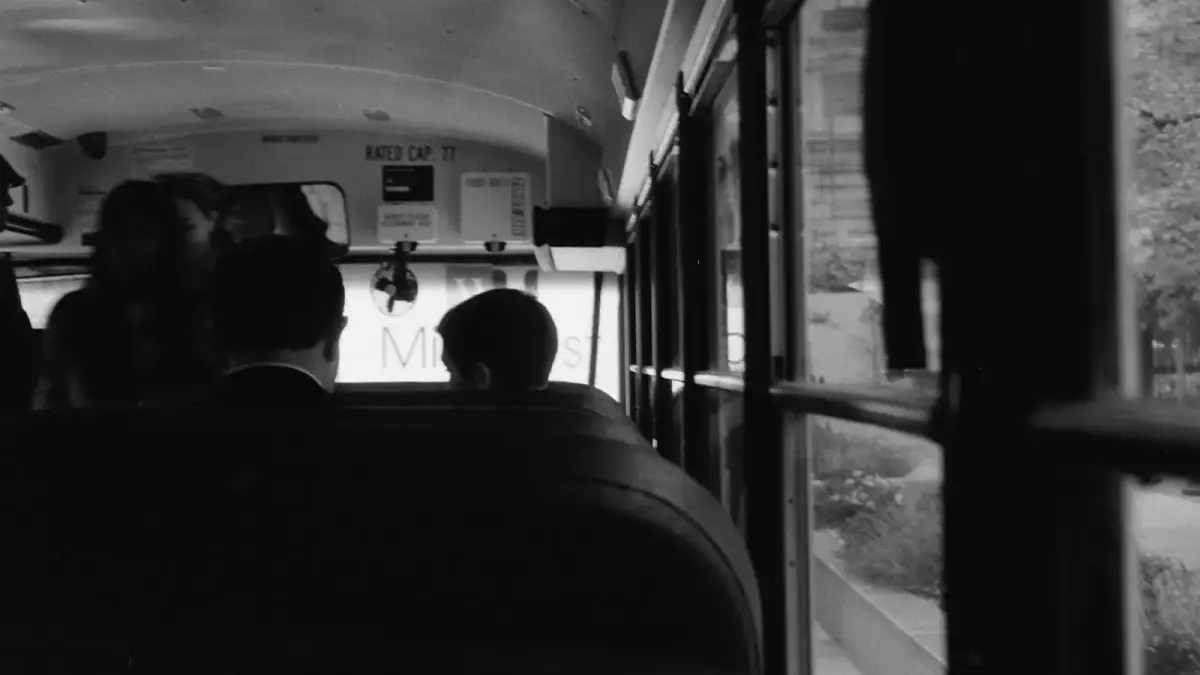
I can still tell you the exact order.
The white house with the slanted porch was stop number four. The dog that barked behind the chain-link fence was between stops six and seven. The pothole that made everyone’s backpacks slide off the seat came exactly ninety seconds before Mrs. Henderson’s mailbox - the one with the crack running diagonally through the flag. After that, the road curved left, then a hard right past the gas station, and I knew I was seven minutes from home.
I was eight years old. I had no control over the bus, the driver, the route, or the speed. But I had the map. Every landmark, every turn, every predictable second of a thirty-five-minute ride that I could not alter but could absolutely memorize. And that memorization was the only thing standing between me and the feeling that I was hurtling through space with no idea when the hurtling would stop.
It took me decades to understand what I was actually doing on that bus. I wasn’t being observant. I wasn’t being smart. I was building the only architecture of safety available to a child whose world felt deeply, quietly unpredictable - and I was teaching my nervous system that if I could just know what came next, I could survive it.
If you were that child - the one who mapped the route, counted the stops, tracked the seconds - these eight patterns probably followed you into adulthood. Not as quirks. As survival strategies that never received a retirement date.
1. You need the full itinerary before you can feel anything about the trip
Someone invites you on vacation and your first response is not excitement. It is a cascade of questions. What time does the flight leave? Where is the hotel relative to the airport? What is the parking situation? Is there a shuttle or do we need to arrange a car? You need every logistical detail locked into place before your body will release even a flicker of anticipation.
A 2021 study in Frontiers in Psychology found that adults who experienced unpredictable childhood environments showed significantly heightened activation in the prefrontal cortex during planning tasks - their brains literally worked harder to establish certainty before engaging emotionally. The researchers called it “anticipatory scaffolding,” the need to build a complete cognitive framework before the nervous system would agree to participate.
You are not a killjoy. You are not rigid. You are the child who learned that surprises were never pleasant, and your body remembers that lesson even when your mind knows better.
2. You arrive early to everything and use the extra time to study the room
You don’t show up early because you are punctual. You show up early because you need the room to be empty when you first encounter it. You need to see where the exits are. Where the bathrooms are. Where you will sit. What the lighting feels like. How the sound carries.
This is spatial mapping - the same skill you practiced on the bus, now applied to restaurants, conference rooms, airports, and dinner parties. You are constructing a mental blueprint so that when the room fills with people and noise and variables you cannot predict, you have already established a fixed geography beneath it all.
Psychologist Stephen Porges, whose polyvagal theory has reshaped our understanding of the nervous system, describes this as a “neuroception of safety.” Your body is constantly scanning the environment for threat cues. Arriving early gives you time to complete that scan before anyone asks you to be social, present, or relaxed.
3. You mentally rehearse conversations before they happen
Not just important conversations. All of them. The phone call to schedule a dentist appointment. The small talk at a neighbor’s barbecue. The moment someone might ask you a question you haven’t prepared for.
You run through the likely script in your head - what they will say, what you will say, what might go wrong, and what you will say if it does. You are not anxious in the clinical sense. You are doing something much more specific. You are eliminating unpredictability from a situation that most people walk into without a second thought.
A 2018 study published in the Journal of Research in Personality found that individuals with high intolerance of uncertainty - a trait strongly correlated with unpredictable childhood environments - engaged in what researchers called “cognitive pre-mapping,” mentally rehearsing social scenarios to reduce the chance of encountering something they hadn’t already accounted for.
The child on the bus counted stops. The adult in the car counts possible conversational turns. Same strategy, different vehicle.
4. You struggle to relax in situations where someone else is driving - literally and metaphorically
You are a difficult passenger. Not because you are critical of other people’s driving, but because sitting in a car you are not controlling triggers something old and wordless. Your foot presses an invisible brake pedal. Your eyes track the road with an intensity that exhausts you. You are not watching the scenery. You are watching for the thing that will go wrong.
This extends well beyond automobiles. When a colleague is leading a project, you feel a low-grade tension you cannot name. When your partner handles the dinner reservation, you fight the urge to double-check. When someone else is in charge, your body interprets it as a loss of the map - and a body that once survived by mapping does not let go of the pen easily.
Daniel Goleman, in his work on emotional intelligence, writes about the way early experiences wire our threat-detection systems. For a child whose safety depended on knowing what was coming, relinquishing awareness to someone else does not feel like trust. It feels like falling.
5. You keep backup plans for your backup plans
You do not simply plan. You plan in layers. If Plan A fails, you already know the route to Plan B. If Plan B is compromised, there is a Plan C that you mapped out while pretending to watch television last Tuesday. People sometimes call this anxiety. You call it being prepared. The truth lives somewhere between the two.
The child on the bus didn’t just memorize the route. That child also knew which stops had kids who might cause problems, which stretches of road had no houses nearby, and exactly how long the driver paused at the railroad tracks. The mapping was never about one thing. It was about everything - because a child living with unpredictability cannot afford to leave gaps in the architecture of knowing.
As an adult, this looks like having three routes to the hospital memorized, keeping an extra phone charger in every bag you own, and quietly noting the emergency exit in every building you enter. Not because you expect disaster. Because you once lived in a world where not expecting disaster was a luxury you could not afford.
6. You experience physical discomfort when plans change at the last minute
Other people pivot. You collapse internally. A restaurant changes its hours, a meeting gets rescheduled, a friend texts “actually, let’s do Thursday instead” - and something in your chest tightens. Your breath gets shallow. A flash of irritation rises, and beneath it, something that feels a lot more like grief.
A 2022 study published in Psychological Science found that adults who scored high on measures of childhood unpredictability showed elevated cortisol responses to minor schedule disruptions - not major life events, but small, ordinary changes that most people absorbed without notice. The researchers concluded that for these individuals, a changed plan did not simply represent an inconvenience. It represented a breach in the predictive architecture their nervous system depended on.
You are not being difficult when a last-minute change unravels you. You are watching the map you spent hours constructing dissolve - and for a few seconds, you are eight years old on a bus that just turned down a street you don’t recognize.
7. You find it nearly impossible to “just go with the flow”
People say this to you as though it is advice. Just relax. Just wing it. Just see what happens. And every cell in your body rejects it. Not out of stubbornness. Out of survival.
Going with the flow requires a nervous system that believes the flow is safe. Yours never received that evidence. What you received instead was a childhood in which the flow included raised voices, sudden moves, promises that dissolved, or an atmosphere that could shift between breakfast and lunch with no warning. So you built an alternative to the flow. You built the map. And the map worked. It kept you oriented when everything else was spinning.
Susan Cain, in her research on introversion and sensitivity, has written about how certain children develop extraordinarily detailed internal worlds not because they are imaginative in the whimsical sense, but because they need a stable interior landscape to compensate for an unstable exterior one. The bus route map was your interior landscape. Controlled, reliable, entirely yours.
8. You feel a deep, almost physical relief when you finally understand the full layout of a new situation
There is a moment - you know the one - when you have been in a new job for three weeks, or a new city for a month, or a new relationship for just long enough to see the patterns. And something in your shoulders releases. Your breathing deepens. A warmth spreads through your chest that you might mistake for happiness but is actually something more primal. It is the feeling of the map being complete.
This is what Gabor Mate describes when he talks about the body keeping the score of early experience. Your nervous system was trained to stay on high alert until the territory was fully charted. Not partially. Not mostly. Fully. And so you live in a constant cycle of mapping and relief, tension and release, arrival and orientation.
The tragedy is not that you do this. The tragedy is that you have done it so long you forgot it was ever a response to something. You think it is just who you are - someone who needs to know things, who likes to be prepared, who “doesn’t do well with surprises.” But it is not who you are. It is what you built when you were small and the world gave you no other tools.
You were a child on a bus you could not steer, riding a route you did not choose, and you did the most brilliant thing a child in that position could do. You learned the whole map by heart so that nothing - not one cracked mailbox, not one sharp turn, not one stretch of unfamiliar road - could catch you off guard.
That child deserves enormous credit. She kept you safe. She got you through.
But she also never heard anyone say: you can stop counting the stops now. The bus has arrived. You are already home.