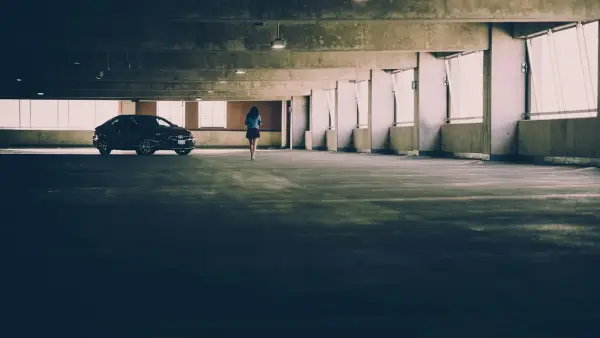
Children who memorized their parents' license plate numbers before they could spell their own last name - who could spot their mother's car from across a parking lot by the dent in the bumper and the sun visor always pulled halfway down, who scanned every pickup line for the one shape that meant safe - often become adults who notice every unfamiliar car on their street and register every face that does not belong in their building's lobby, because a child who spent her afternoons on a curb watching for a car that was sometimes late and sometimes did not come at all learned that the difference between safe and abandoned is the ability to recognize your rescue from a hundred yards away
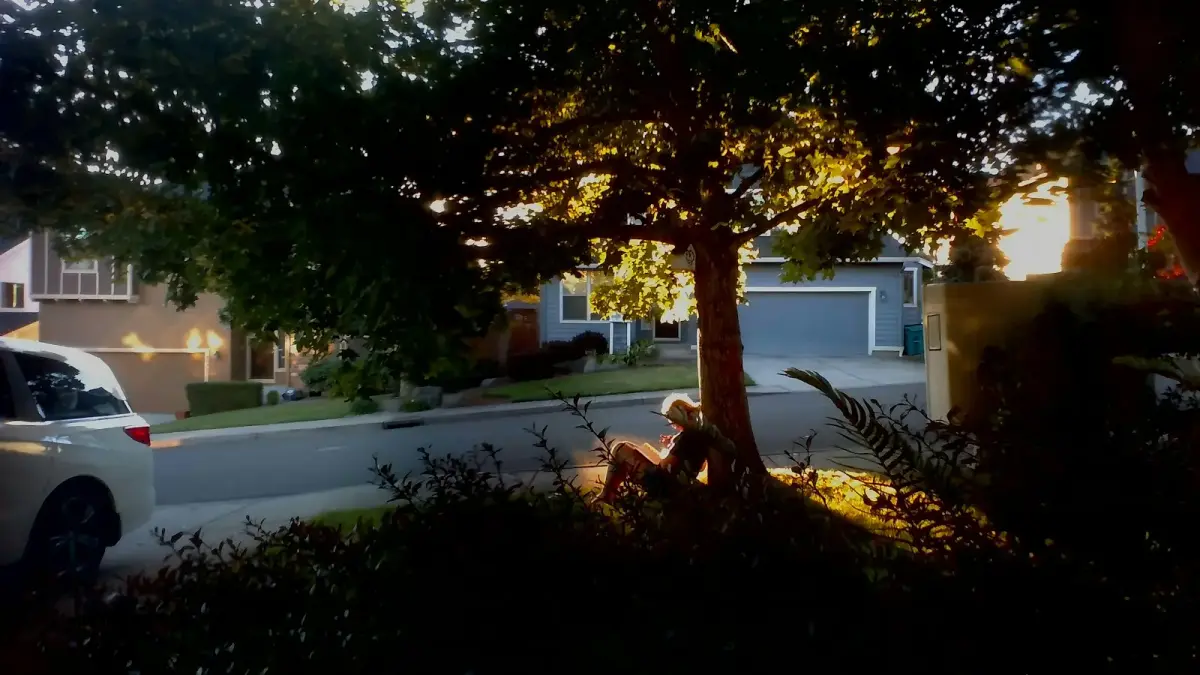
I was seven when I memorized my mother’s license plate number. Not because anyone asked me to. Not because it was a game. I memorized it because on a Tuesday in October, she was forty-five minutes late to pick me up from school, and I stood at the edge of the parking lot watching every single car that turned the corner, willing each one to be hers.
I remember the feeling in my stomach. Not panic exactly - something quieter than that. Something that settled into my bones like cold water.
By the time her tan sedan finally appeared, I had already catalogued the license plates of three other cars that looked similar. I had noted the specific way her bumper caught the light where the paint had chipped. I had memorized the angle of her rearview mirror. I was seven, and I couldn’t reliably spell “Wednesday,” but I could identify my mother’s car from two blocks away by the way it leaned slightly to the left when it braked.
I didn’t know it then, but I was building a system. A system that would follow me into every parking garage, every apartment lobby, every neighborhood street for the rest of my life.
The child at the window
There is a particular kind of childhood that doesn’t look like trauma from the outside. No one is yelling. No one is leaving for good. The parent does come - eventually. The car does appear - most of the time.
But in the gap between “school ends” and “someone arrives,” a child’s nervous system learns to do something extraordinary. It learns to scan.
Not casually. Not the way you might glance out a window to check the weather. This is systematic, full-body surveillance. The child learns the sound of a specific engine. The particular rhythm of a car door that sticks. The difference between headlights that are round and headlights that are square when they’re still four hundred feet away and blurred by rain.
A 2015 study published in the journal Development and Psychopathology found that children who experienced unpredictable caregiving - not abusive, not neglectful by clinical standards, just inconsistent - developed heightened perceptual sensitivity to environmental cues. Their brains literally became better at detecting subtle changes in their surroundings. The researchers called it “adaptive vigilance.”
I call it knowing that a blue Honda and a blue Toyota look nothing alike when your ride home depends on telling them apart.
What the scanning actually was
Here is what no one tells you about being the kid who waited: you weren’t anxious. You were solving a problem.
Your developing brain identified a threat - the possibility that safety might not arrive - and it immediately went to work building the most sophisticated early-warning system it could manage. You learned to read body language before you learned to read chapter books. You memorized patterns before you memorized multiplication tables.
The license plate wasn’t trivia. It was survival data.
The dent in the bumper wasn’t a flaw you noticed. It was a landmark on the map between abandoned and okay.
The sun visor, always pulled halfway down on the passenger side because the clip was broken - that wasn’t a detail. That was the difference between “that car looks like Mom’s” and “that car IS Mom’s,” and when you are eight years old and every minute past 3:15 feels like an hour, precision is everything.
Dr. Gabor Mate has written extensively about how children’s nervous systems adapt to their environment with remarkable efficiency. The child doesn’t choose to become hypervigilant any more than a plant chooses to grow toward light. The system simply orients itself toward whatever it needs to survive. For some children, what they needed to survive was the ability to pick their mother’s car out of a sea of identical sedans before anyone else even started looking.
The afternoon geometry of waiting
I want to talk about the specific geometry of those afternoons because I think it matters.
You learned where to stand. Not in the middle of the pickup area where teachers could see you and might ask questions. Not near the other kids whose parents were also late, because their anxiety was contagious and yours was already more than enough.
You found a spot - maybe a curb, maybe a set of steps, maybe a particular window on the second floor - where you had the widest possible view of the road. You calculated sight lines the way a general calculates battlefield positions.
You learned time differently than other children. Three-fifteen meant something physical to you. Three-twenty meant something different. Three-thirty meant the janitor might come by and ask if you needed to call someone, and that question was unbearable because calling someone meant admitting that the system had failed, that your scanning hadn’t worked, that maybe the car wasn’t coming at all today.
And on the days the car didn’t come - the days when a neighbor picked you up instead, or an aunt, or you walked home alone at an age when walking home alone wasn’t really walking home alone, it was navigating a world that had just confirmed your worst suspicion - those days rewired something.
Those days taught you that the scanning wasn’t optional. It was the only thing between you and the abyss.
What it looks like at forty-three
You are in your forties now, maybe your fifties, and you have a word for what you do: observant. People tell you that all the time. “You’re so observant.” They say it like a compliment.
They don’t know that you noticed the new car on your street before you finished pulling into your driveway. They don’t know that you clocked the unfamiliar face in your building’s lobby and already determined - by the way he held the door, by the confidence in his posture, by the visitor badge on his jacket - that he was probably there to see the accountant on the fourth floor.
They don’t know that when your partner is fifteen minutes late coming home, something ancient and wordless activates in your chest, and you find yourself standing near a window, scanning the road, calculating the angle of approaching headlights.
A 2020 study in the Journal of Research in Personality found that adults who reported inconsistent childhood pickup routines - the researchers used exactly this kind of specificity - scored significantly higher on measures of environmental monitoring in adulthood. They noticed changes in their surroundings faster. They were more likely to detect when something was “off” in a familiar setting. They also reported higher baseline anxiety, but here’s the thing that caught my attention: they didn’t experience their vigilance as anxiety. They experienced it as competence.
Because it was competence. Once.
The cost of never turning it off
The system you built was brilliant for a seven-year-old sitting on a curb. It is exhausting for a forty-three-year-old sitting in her own living room.
Your brain is still running the program. Still cataloguing. Still scanning. Every parking lot is a grid to be read. Every crowd is a puzzle to be solved. Every room you enter gets a three-second sweep that you’re barely conscious of - exits, faces, changes, threats.
You’re tired in a way that has nothing to do with sleep.
Susan Cain, in her work on temperament and overstimulation, has described how some nervous systems process more environmental data than others - not because they’re anxious but because they were trained to. The training happened before you had any say in it. The training happened while you were standing at a window, watching for a specific shade of blue that meant someone remembered you.
Your partner asks why you always sit facing the door at restaurants. You say you prefer it. The truth is more complicated than preference. The truth is that your back to the door feels like your back to the road, and your back to the road feels like missing the car, and missing the car feels like something a seven-year-old should never have to feel.
The license plate you still remember
I want to tell you something that might sound strange.
I am in my forties. I have a PhD. I have published papers and delivered lectures and built a career that my seven-year-old self could never have imagined. And I still remember my mother’s license plate number from 1989.
I remember it the way other people remember their childhood phone number - effortlessly, permanently, encoded in a part of my brain that doesn’t ask whether the information is still useful. It just keeps it. Just in case.
That number is thirty-seven years old. The car has been scrapped for decades. My mother has been gone for eleven years. And still, if you asked me right now, I could recite those six characters without hesitating.
That’s not a party trick. That’s what love looks like when it’s built on uncertainty. You memorize what matters because you learned early that what matters can disappear around a corner and take twenty minutes or two hours or forever to come back.
What I want you to hear
If you were this child - if you are the adult this child became - I need you to understand something.
The scanning was never a flaw. It was never a disorder. It was never something wrong with you. It was the most intelligent, adaptive, creative response your developing brain could produce in a situation where the adults were supposed to be reliable and sometimes weren’t.
You built a surveillance system out of love and fear, and it kept you safe. It told you when to relax and when to worry. It gave you information when information was the only power you had.
The fact that you still notice every car on your street, that you still register every face in every lobby, that you still feel a small electric pulse when someone you love is late - that isn’t dysfunction. That is the echo of a child who loved so hard and needed so much that she taught herself to see the world in higher resolution than anyone around her.
You are not broken. You were never broken.
You were just a kid on a curb, watching the road, waiting for a particular shape to round the corner and mean that everything was going to be okay. And you got so good at watching that you never quite learned how to stop.
That is not something to fix. That is something to hold gently, the way you’d hold that child if you could go back and sit beside her on the curb and say, “I see you scanning. I see how hard you’re working. The car is coming. And even if it’s late, you’re going to be alright.”