Children who grew up with one parent who showed affection easily and one parent who showed almost none often become adults who cannot fully relax into warmth - not because they doubt the person offering it, but because they learned at the dinner table that love and coldness could sit in the same room, and their nervous system still braces every time someone is gentle, waiting for the temperature to drop

The Two Climates of One Home
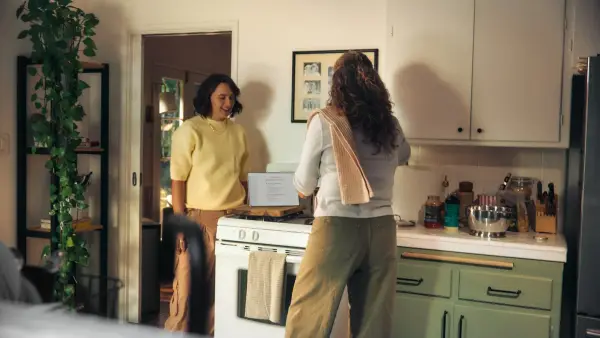
I remember sitting at the kitchen table as a kid, watching my mother laugh and reach across the counter to squeeze my hand while she told me about her day. It was warm. Easy. The kind of moment that should have just been a moment.
But I was already listening for the garage door.
My father wasn’t a bad man. He wasn’t angry or cruel or absent in any way you could point to on a chart. He came home, sat down, ate dinner, asked about school in that flat way that meant he was asking because the silence needed filling. He loved us. I believe that completely. But his love lived somewhere behind a wall I never found the door to, and as a child, I didn’t have the language for what that did to me.
What it did was this: it taught me that warmth was real but unreliable. Not because it would disappear - my mother was consistent - but because it shared a roof with something cooler, something I couldn’t name, and my little body learned to hold both truths at once. Love is here. Distance is also here. Both are true. Neither cancels the other out.
I carried that into every relationship I’ve ever had.
When Love Has Two Temperatures
If you grew up in a home like this, you probably wouldn’t call your childhood difficult. That’s part of what makes this pattern so invisible. There was no yelling, no neglect you could clearly identify, no event that qualifies as trauma in the way most people define it.
There was just a gap. A tonal shift between two people who were both your parents but operated at completely different emotional frequencies.
One parent held you when you cried. The other looked uncomfortable and left the room - not out of malice, but out of something they probably couldn’t help. One parent said “I love you” like breathing. The other said it like they were reading from a card, if they said it at all.
And you, the child, became the translator. The one who moved between those two climates dozens of times a day, adjusting yourself without realizing it. Softer voice for one parent. Lower expectations for the other. You learned the architecture of emotional inconsistency before you learned long division.
The Body Remembers What the Mind Forgives
Here’s what most people don’t understand about growing up in this kind of home: the confusion doesn’t live in your thoughts. It lives in your body.
A 2009 study published in the journal Development and Psychopathology found that children raised in environments with inconsistent caregiving responses - where warmth and emotional withdrawal coexisted within the same household - were significantly more likely to develop what attachment researchers call a fearful-avoidant attachment style. This isn’t the same as anxious attachment, where you chase love. It isn’t avoidant attachment, where you wall yourself off.
Fearful-avoidant attachment is both at once. You want closeness desperately, and the moment it arrives, something in your nervous system says: this won’t last. Brace yourself.
John Bowlby, the father of attachment theory, described the infant’s bond with caregivers as a kind of internal working model - a blueprint for what to expect from love. When that blueprint is drawn by two very different hands, the child doesn’t learn that love is absent. They learn something more disorienting. They learn that love is present and unpredictable. That gentleness and distance can occupy the same space, the same evening, the same family.
Your mind might have forgiven this years ago. Your body is still sitting at that table, listening for the garage door.
The Flinch You Can’t Explain
If this was your childhood, there’s a very specific thing that probably happens to you now, in your adult relationships. Someone is kind to you - genuinely, freely kind - and instead of relaxing, you tighten.
It’s not a thought. It’s not even a feeling you can name at first. It’s a flinch. A micro-withdrawal that happens before your conscious mind can catch it.
Your partner reaches for your hand in the car. Your friend tells you how much you mean to them. Your coworker says something generous about your work. And instead of absorbing it, you feel yourself pull back by a millimeter. Not because you don’t believe them. Because your body learned, decades ago, that warmth is the first half of a sequence. And the second half is a temperature drop.
A 2015 study in Personality and Social Psychology Review examined how early relational patterns shape what researchers call “approach-avoidance conflict” in adult intimacy. They found that individuals who experienced inconsistent emotional availability from caregivers showed heightened physiological arousal - faster heart rate, increased cortisol - during moments of closeness, even when those moments were safe. Their bodies were preparing for a withdrawal that wasn’t coming.
That’s the cruelest part. You know the withdrawal isn’t coming. You know this person is safe. And your nervous system doesn’t care what you know. It cares what you learned.
Not Broken, Just Bilingual
I want to be careful here, because it would be easy to read all of this and think: something is wrong with me. But I don’t think that’s the right frame.
What happened to you wasn’t abuse. It wasn’t neglect. It was something subtler and, in some ways, harder to heal - because there’s no villain in the story. There’s just a home where two people loved you differently, and you became fluent in both languages before you had any choice in the matter.
You learned to read a room the way other kids learned to read books. You developed an emotional radar that is, frankly, extraordinary. You can sense a shift in someone’s mood before they’ve said a word. You know when someone is about to pull away before they do it. You are exquisitely attuned to the people around you.
And the cost of that attunement is that you can never fully turn it off.
Psychologist Mary Main, who expanded on Mary Ainsworth’s foundational attachment research, found that children with disorganized attachment often become adults who are simultaneously the most perceptive and the most guarded people in any room. They see everything. They trust slowly. They love deeply but hold something back - not out of selfishness, but out of a self-protection so old it feels like personality.
You’re not broken. You’re someone who grew up bilingual in warmth and distance, and your nervous system still switches languages without warning.
What Withdrawal Really Taught You
Let me name the specific lessons that a childhood like this installs, because seeing them clearly is the first step toward loosening their grip.
You learned that love has a shelf life. Not because anyone told you this, but because you experienced it in real time - one parent’s affection was always available, the other’s was rationed in ways you couldn’t predict. So you started treating all love as perishable. You enjoy it, but you don’t store it. You don’t build a life around it. Because what if it goes back in the fridge tomorrow?
You learned that your worth depends on which version of someone shows up. With the warm parent, you felt full. With the distant parent, you felt like you were standing on the wrong side of a window. And the distance between those two feelings - sometimes only seconds apart, sometimes only a room apart - trained you to believe that your value isn’t fixed. It fluctuates based on who’s paying attention.
You learned to pre-empt withdrawal by withdrawing first. This is the one that does the most damage in adult relationships. If you pull back before someone else can, you stay ahead of the pain. It looks like independence. It feels like control. But it’s a child’s strategy, running on decades-old software.
The Grief of the “Good Enough” Childhood
There’s a particular loneliness in this experience, and it comes from having no clear wound to point to.
You can’t say your parents were bad. You can’t say you were unloved. You had a childhood that, from the outside, looked fine - maybe even good. And that “good enough” quality is exactly what keeps the pattern hidden for so long.
Because when you try to explain why intimacy makes you nervous, why you can’t stop scanning for withdrawal, why your partner’s sudden gentleness makes your chest tight instead of warm - people don’t understand. They say things like, “But your parents stayed together.” Or, “At least you had one parent who was affectionate.”
And they’re not wrong. But they’re missing the point.
The point isn’t whether you had love. The point is that you had love and its absence in the same room, at the same dinner, in the same family - and your brain did what any child’s brain would do. It tried to make sense of both at once. And the only way to make sense of warmth and cold existing simultaneously is to decide that warmth is conditional. That it depends on something you can’t control. That it will be offered and then, without warning, taken back behind a face that isn’t angry, just somewhere else.
A 2020 study in Frontiers in Psychology found that adults who reported mixed emotional environments in childhood - one caregiver warm, one emotionally unavailable - showed significantly higher rates of relationship hypervigilance than adults who reported either consistently warm or consistently cold households. The inconsistency, not the coldness itself, was the predictor.
It was never the distance that confused you. It was the distance sitting next to the warmth and nobody acknowledging the difference.
Learning to Stay When Your Body Says Go
I wish I could tell you there’s a switch you can flip. That once you understand this pattern, it dissolves. But that’s not how the body works. What I can tell you is that naming it changes the game.
When you notice the flinch - the tightening when someone moves toward you with kindness - you can say to yourself: That’s the old pattern. That’s the garage door. That’s me listening for a temperature drop that isn’t coming.
You don’t have to override it. You just have to notice it. And in the noticing, you create a tiny gap between the old reflex and the present moment. That gap is where healing lives.
You might also consider that the vigilance you developed isn’t only a wound. It’s also a gift. You understand emotional complexity in a way that people from simpler homes never will. You hold space for contradiction because you grew up inside one. You know that people can love you and be limited at the same time, and that’s not a failure of love - it’s the human condition.
You learned this too early. You learned it in a kitchen, at a dinner table, in the space between one parent’s laughter and another parent’s silence. But you learned it.
And now, when someone reaches for your hand, you get to choose. Not whether to feel the flinch - that might always be there. But whether to stay anyway. Whether to let the warmth linger one second longer than your body thinks is safe.
That one second is everything. It’s not about fixing yourself. It’s about giving yourself permission to stop translating, stop scanning, stop listening for the garage door - and just sit in the warmth for as long as it’s offered.
You survived two climates. You can learn to live in one.