Children who always walked one step behind their parents in public - adjusting their pace without being asked, falling back the moment anyone noticed - often become adults who let other people choose the restaurant, the movie, the direction of every argument, because a child who followed someone who never once looked back learned that keeping up was their job and being waited for was never going to happen
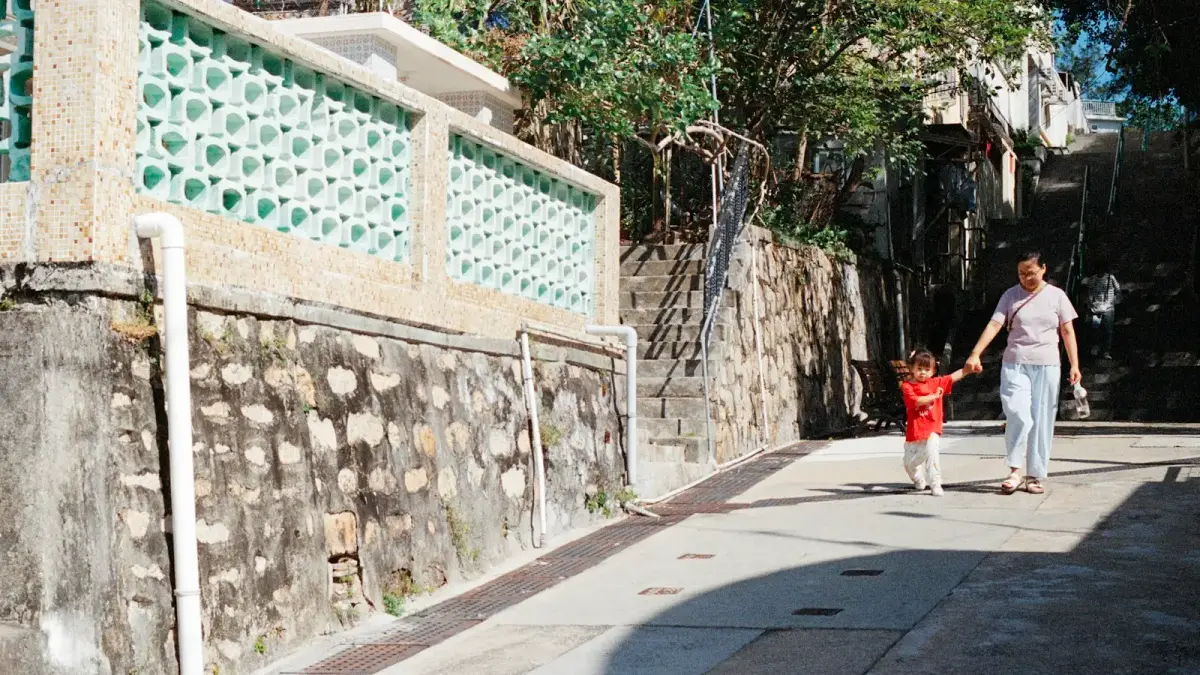
I have a memory that probably isn’t dramatic enough to count as a memory. I was maybe seven or eight, walking through a parking lot with my mother after grocery shopping. She was moving fast - she always moved fast - and I was half a step behind her, my shorter legs doing that quiet hustle children do when they don’t want to fall behind but also don’t want to look like they’re running.
She never turned around. Not once.
And I remember the exact thought I had, though I wouldn’t have had the words for it then: My job is to keep up. Her job is to keep going.
I didn’t resent it. I didn’t even notice it as a thing that was happening. It was just the physics of us. She walked, I followed. She set the pace, I matched it. And somewhere in that unremarkable parking lot, on an unremarkable Tuesday, I was learning something that would take me thirty years to unlearn.
I was learning that my stride didn’t matter.
The geometry of who matters
There’s a spatial language between parents and children that nobody teaches and nobody talks about. Whether a child walks beside you, behind you, or ahead of you communicates something that goes deeper than manners or obedience.
John Bowlby’s attachment theory describes what he called “proximity-seeking behavior” - the way children instinctively monitor their distance from a caregiver. A securely attached child uses their parent as a “secure base,” venturing out and returning, testing the distance, knowing they’ll be received when they come back.
But some children learn a different geometry. They learn that the distance is theirs to manage. That the parent isn’t tracking them - they’re tracking the parent. The child becomes the one scanning, adjusting, recalibrating.
Walking behind isn’t a choice these children make. It’s an adaptation they absorb. The parent moves through the world at their own pace, and the child learns to become invisible in their wake. Not defiant enough to fall far behind. Not bold enough to walk alongside. Just there - close enough to not get lost, far enough back to not be in the way.
That positioning becomes a posture. And that posture becomes a personality.
When matching someone else’s stride becomes your only stride
Here’s what’s interesting about children who walk behind: they develop an extraordinary ability to read movement. They know when their parent is about to speed up, slow down, turn left, stop abruptly. They become experts in the body language of someone who isn’t looking at them.
A 2018 study published in Frontiers in Psychology found that children who grow up in environments requiring high levels of adaptive compliance - where they need to monitor and respond to a caregiver’s emotional state without explicit cues - develop heightened perceptual sensitivity. They become remarkably good at reading rooms, predicting moods, sensing shifts before they happen.
This sounds like a superpower. And in many ways, it is.
But the cost is that the radar only points outward. These children grow into adults who can tell you exactly what everyone else in the room is feeling, but go blank when someone asks them what they want for dinner.
I spent years thinking I was easygoing. Flexible. Low-maintenance. I’d say “I’m fine with whatever” and genuinely believe it. It wasn’t until a therapist asked me, very gently, “But what would you choose if you knew no one would be disappointed?” that I realized the question itself didn’t make sense to me.
Choose based on what? My preference? I wasn’t sure I had one. I’d spent so long calibrating to other people’s preferences that mine had gone quiet - not suppressed, exactly, but atrophied. Like a muscle you forget you have because you’ve never been asked to use it.
The difference between adaptability and erasure
There’s a line between being attuned to others and being erased by that attunement, and it’s a line most people who grew up walking behind can’t see.
Adaptability says: I can adjust. Erasure says: I don’t exist unless I’m adjusting.
The adaptive child becomes the adult who genuinely doesn’t mind which restaurant you pick. The erased child becomes the adult who doesn’t know they’re allowed to mind.
Research on parentification - a concept explored extensively in the Journal of Research in Personality - describes how some children take on emotional responsibilities that should belong to the adult. They become the ones who manage, soothe, accommodate. A 2021 study found that adults who experienced emotional parentification in childhood reported significantly higher rates of self-silencing in intimate relationships. They’d learned that their role was to tend to the emotional climate, not to contribute their own weather to it.
This is where it gets painful to name: the walking-behind child didn’t just learn to follow. They learned that following was their contribution. That the most loving thing they could do was not require anything. Not slow anyone down. Not need to be waited for.
And so they became the partner who says “you decide.” The friend who says “I’m easy.” The colleague who says “whatever works for the team.” Not because they don’t have opinions - but because having opinions feels like an imposition. Like stepping out of line. Like walking too fast and making someone else have to adjust to them for once.
The moment someone says “what do YOU want?” and nothing comes
There is a specific kind of panic that the walking-behind person knows intimately. It happens when someone - usually someone who loves them - stops, turns around, and asks: “But what do you want?”
The question lands like a spotlight on someone who has spent their whole life in the wings.
What do I want? The honest answer, the one that takes years to admit, is: I don’t know. Not because I’m indecisive. Not because I’m passive. But because the part of me that wants things was never given space to develop.
A 2019 study in Psychological Science examined what researchers called “chronic self-subordination” - the pattern of consistently deferring to others’ preferences across contexts. They found that participants who scored highest on measures of chronic deference also showed the weakest neural activation in brain regions associated with reward anticipation when making choices for themselves. Their brains had literally quieted the circuitry of wanting.
This isn’t weakness. This is what happens when a child’s nervous system learns, over thousands of walks and thousands of dinners and thousands of small, unremarkable moments, that what they want is irrelevant data.
The walking-behind child doesn’t grow up angry. They grow up accommodating. They grow up “easy to be around.” They grow up being described as “such a good listener” and “so thoughtful” and “never any trouble.”
And they grow up exhausted in a way they can’t explain, because the labor they perform - the constant monitoring, the perpetual yielding, the invisible work of making sure everyone else is comfortable - isn’t labor that anyone recognizes. Not even them.
Attunement that only flows one way eventually empties you
The tend-and-befriend response, first described by psychologist Shelley Taylor, explains how some people respond to stress not with fight or flight but with caretaking. They move toward the threat, not away from it. They soothe. They manage. They make themselves useful.
Children who walk behind are often tend-and-befriend children. They learned early that the safest thing to do in an uncertain environment was to be helpful, to be quiet, to be no trouble. And that strategy worked. It kept them close to caregivers who might not have turned around otherwise.
But attunement is supposed to be reciprocal. In healthy relationships, you read me and I read you. You adjust and I adjust. We take turns setting the pace.
When attunement only flows one direction - when one person is always reading and the other is always being read - it creates a slow drain. The person doing the reading starts to disappear. Not dramatically. Not in a way anyone notices. They just get thinner and thinner, like a river that feeds a lake but is never fed itself.
This is the invisible labor of the walking-behind adult. They carry the emotional logistics of every relationship. They know their partner’s coffee order, their best friend’s love language, their mother’s tone when she’s about to be hurt. But nobody knows theirs - not because nobody cares, but because they’ve never put that information into the world.
They’ve never walked ahead and let someone else figure out their pace.
Learning to take up space on the sidewalk
I want to be careful here, because I don’t want to pathologize something that is, at its root, a form of love. The child who walks behind is paying attention. They are showing care in the most literal, physical way a small person can - by staying close, by not being a burden, by making themselves easy to have around.
That’s not a flaw. That’s a child doing their best with what they were given.
But if you’re reading this and you recognize yourself - if you’re the person who always says “you choose” and means it a little too much, the person whose friends describe as easygoing but whose chest tightens when someone asks what you actually think - I want you to know something.
You are allowed to walk beside someone. You are allowed to set a pace. You are allowed to want the Thai place instead of the Italian place and say so without prefacing it with “but only if you want to.”
Your attunement is not the problem. The direction is the problem. You learned to point all of that extraordinary sensitivity outward, and you forgot - or were never taught - that some of it is supposed to point inward.
You are not passive. You are not weak. You are not “too agreeable.”
You are someone who learned, on a hundred sidewalks and in a thousand small moments, that love meant keeping up. That being good meant not being noticed. That the safest place in any room was slightly behind whoever was leading.
And now, maybe for the first time, you’re allowed to walk at your own pace and see who turns around to find you. The ones who look back - those are the ones worth walking with.