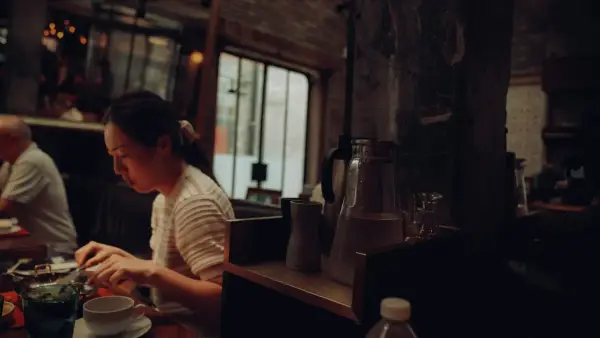
Children who could never fall asleep at sleepovers - who lay awake in someone else's house listening to unfamiliar sounds, watching shadows on an unfamiliar ceiling, feeling the wrongness of a pillow that wasn't theirs and blankets that smelled like someone else's laundry detergent - often become adults who still can't sleep the first night in a hotel room, who pack their own pillow on every trip, whose nervous system never learned to power down in a space it hasn't mapped
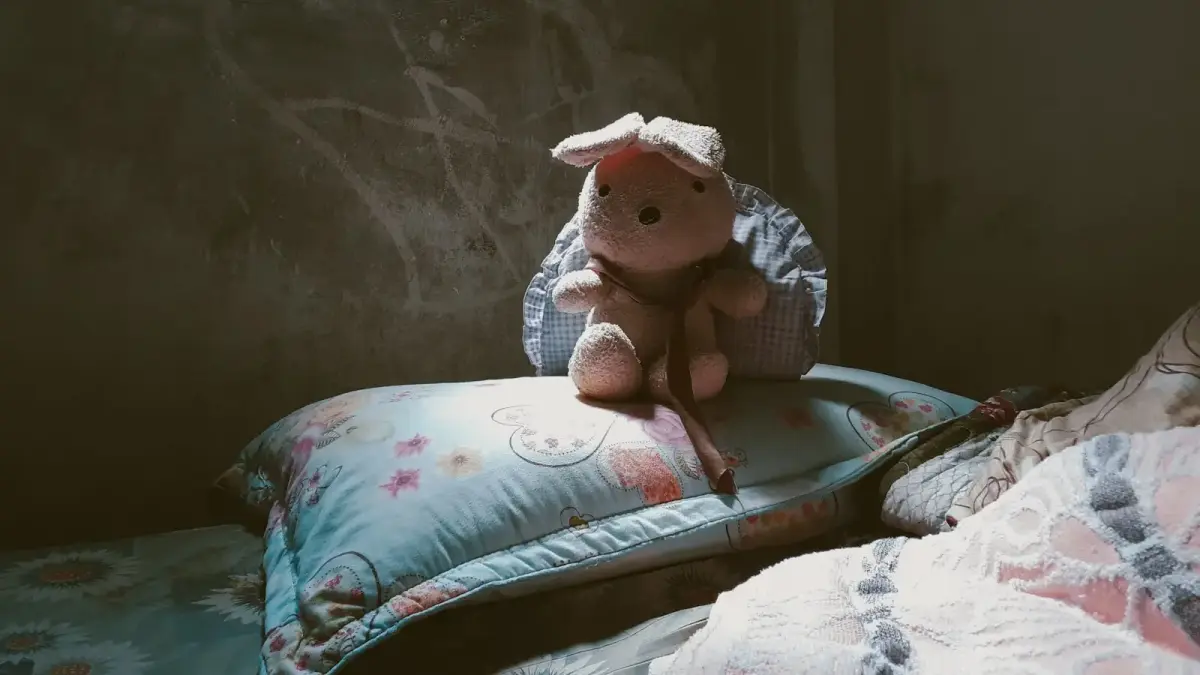
I was nine years old the first time I understood that my body had rules I hadn’t agreed to.
It was Ashley Callahan’s birthday party, and seven of us were spread across her basement floor in sleeping bags that smelled like attics and fabric softener that wasn’t my mother’s. Everyone else fell asleep by eleven. I know because I watched each one of them go - the breathing shifting, the fidgeting stopping, the room reorganizing itself around their stillness.
I was still awake at one in the morning.
Nothing was wrong, exactly. Nobody had been mean to me. The pizza was fine. The movie was fine. Ashley’s mom had checked on us twice and smiled in that warm way that should have made everything feel safe. But the refrigerator in the kitchen above us hummed at the wrong pitch. The furnace clicked on with a rhythm I didn’t recognize. The streetlight outside the basement window cast a stripe across the ceiling that landed in a place where no light had any business being.
I called my mom at midnight and told her my stomach hurt. She came and got me. In the car, I cried - not because I was sick, but because I didn’t have the words for what I actually felt. I wasn’t afraid of the dark. I was afraid of that version of the dark. The one that didn’t belong to me.
If you were that child, I want you to know something. You weren’t fragile. You weren’t being difficult. Your nervous system was doing exactly what it was designed to do - and it was doing it extraordinarily well.
Your brain was mapping the room before you could map the feeling
Here’s what was actually happening in that sleeping bag, on that unfamiliar floor, in a house that smelled like someone else’s life.
Your brain was running a security protocol. Not a conscious one - something much older and much faster than conscious thought. Before you could even register why you felt uneasy, your nervous system had already catalogued every sensory input in that room and compared it against the database it had been building since birth.
The database of home.
A 2016 study published in Current Biology documented what researchers call the “first-night effect” - a phenomenon where one hemisphere of the brain remains significantly more active during the first night of sleep in an unfamiliar environment. The researchers, led by Masako Tamaki at Brown University, found that the left hemisphere essentially stays on guard, maintaining a level of vigilance that prevents deep sleep.
Your brain, it turns out, has a built-in night watchman. And that watchman doesn’t clock out until the territory has been confirmed as safe.
For most people, this calibration takes a single night. By the second night in a new place, both hemispheres relax and sleep normalizes. But for some of us - for you, maybe - the calibration takes longer. Sometimes much longer. Sometimes it never fully completes unless the environment checks enough boxes on a list you didn’t write and can’t consciously access.
The right smell. The right sounds. The right quality of silence.
What you were actually listening for
You weren’t lying there anxious. You weren’t spiraling through worst-case scenarios or imagining burglars. You were listening.
That’s the part most people get wrong about the sleepover kid. They assume it was fear. They assume you were scared of something. But you weren’t scared of anything specific. Your body was scanning for the absence of something - the specific soundtrack of your own home that told your nervous system it was safe to shut down.
The particular creak of your house settling. The cadence of your parents’ footsteps. The distant sound of the TV in the other room, or the absence of it after a certain hour. The rhythm of the furnace that you knew so well you didn’t even hear it anymore - until you were somewhere that had a different furnace, and your body registered the difference like a fire alarm.
Dr. Stephen Porges’ polyvagal theory describes this beautifully. Your autonomic nervous system doesn’t just monitor for danger - it monitors for cues of safety. And those cues are extraordinarily specific. They are learned, environmental, and sensory. They are the particular combination of sounds, smells, textures, and spatial relationships that your body has filed under the category of “home.”
When those cues are missing, your nervous system doesn’t conclude that you are in danger. It concludes that safety has not been confirmed. And for your body, those two things feel almost identical.
The vocabulary gap
Here’s the part that stayed with you.
When you called your mom at midnight, or when you just lay there and survived until morning, you didn’t have the words for what was happening. You couldn’t say “my nervous system has not received sufficient environmental safety cues to downregulate into parasympathetic dominance.” You were nine. So you said your stomach hurt. Or you said you were homesick. Or you said nothing at all and just waited for the sun.
And the world gave you a story about what that meant.
You were shy. You were a mama’s boy, a mama’s girl. You were too sensitive. You weren’t adventurous enough. Other kids could handle it - why couldn’t you?
That story landed on top of a perfectly healthy neurological response and told you it was a flaw. And you carried that story into adulthood like a suitcase you forgot to unpack.
This is what developmental psychologists call an “internalized narrative.” A 2019 study in Developmental Psychology found that children who are repeatedly given external explanations for their internal experiences - “you’re just being dramatic,” “there’s nothing to be scared of” - develop a persistent gap between what they feel and what they believe they’re allowed to feel. The feeling doesn’t go away. It just goes underground.
You didn’t stop needing the familiar version of the dark. You just stopped telling anyone about it.
The adult version looks like preference
Now you’re forty-five, or fifty-five, or sixty-three. And you have a whole architecture built around this thing you never named.
You always bring your own pillow when you travel. You’ve told people it’s because of your neck, and maybe that’s partly true, but the real reason is that your pillow smells like your life. It smells like the specific combination of your shampoo and your laundry detergent and the years of nights when your nervous system confirmed, through scent alone, that this was the place where rest was authorized.
You never sleep well the first night in a hotel. You’ve accepted this as just how you are. You arrive, you unpack, you go through all the motions, and then you lie in a bed that is objectively comfortable - possibly more comfortable than your bed at home - and your body refuses to let go. The air conditioning hums at the wrong frequency. The hallway has sounds that don’t match any pattern you know. The darkness behind the blackout curtains has a different weight than the darkness in your bedroom.
By the second night, you sleep a little better. By the third, you’re almost normal. And then you go home and sleep for twelve hours straight, and you think it’s because you’re tired from the trip.
It’s not because you’re tired from the trip. It’s because your nervous system finally exhaled.
You sleep facing the door and you might not have noticed
There’s another piece of this that you might recognize.
You have a side of the bed. Not just a preference - a requirement. You know which direction you need to face to fall asleep, and it is almost always the direction that gives you a sightline to the door or the window. You figured this out decades ago and you’ve arranged every bedroom you’ve ever had around this piece of information without ever questioning why.
This is spatial mapping. Your nervous system has decided that rest requires a specific orientation - a position from which you could, theoretically, monitor entry points. Not because you expect danger. Because your body needs to know it could respond if danger came.
You do the same thing in restaurants. You prefer the seat facing the room. You feel vaguely unsettled with your back to the entrance. You’ve called this a quirk. It’s not a quirk. It’s the same protocol that kept you awake on Ashley’s floor - your nervous system confirming spatial safety before it will agree to lower its guard.
The child who mapped the sounds of her own house
Here’s what I want you to understand about that nine-year-old on the sleeping bag.
She wasn’t broken. She was precise. Her nervous system had spent every night of her life building an intricate sensory map of safety - the exact pitch of the house settling, the way light fell through her own curtains, the sound of her parents breathing down the hall, the smell of her own sheets. That map was her body’s operating manual for the transition from vigilance to rest.
And when she was placed in an environment where none of those coordinates matched, her body simply said: I don’t have enough information to stand down.
That’s not weakness. That’s an extraordinarily sophisticated security system. One that most people have in some form, but that some of us have in high definition.
Research by Elaine Aron, first published in the Journal of Personality and Social Psychology in 1997, identified what she called “sensory processing sensitivity” - a trait present in roughly 15 to 20 percent of the population. People with this trait process sensory information more deeply. They notice more. They register subtleties that others filter out. And their nervous systems take longer to habituate to new environments because there is simply more data to process before the all-clear can be issued.
You are not anxious. You are thorough.
The familiar version of the dark
You love your friends. You love travel, or at least the idea of it. You love seeing new places and eating unfamiliar food and standing in cities you’ve never stood in before.
And you also love coming home.
Not because the world is too much for you. Not because you can’t handle it. But because your body has a definition of rest that is more specific than most people’s, and that definition has always been tied to place. To the particular sounds of your own house at two in the morning. To the weight of your own blanket. To the version of the dark that you have been breathing in since childhood.
You are not less adventurous than the person who sleeps soundly anywhere. You are differently calibrated. Your nervous system asks for more information before it agrees to let you go unconscious, and that is not a flaw in the system. That is the system working.
The child who lay awake on Ashley’s floor was not failing at something other children could do. She was succeeding at something she didn’t know she was doing - keeping watch over herself in an unmapped space, waiting for a version of safety that only her own home could provide.
You still do that. And the pillow you pack in your suitcase is not a quirk. It’s a love letter from your nervous system to the only version of rest it has ever fully trusted.
You are not too sensitive. You are just someone whose body has always known, with extraordinary precision, what home sounds like.