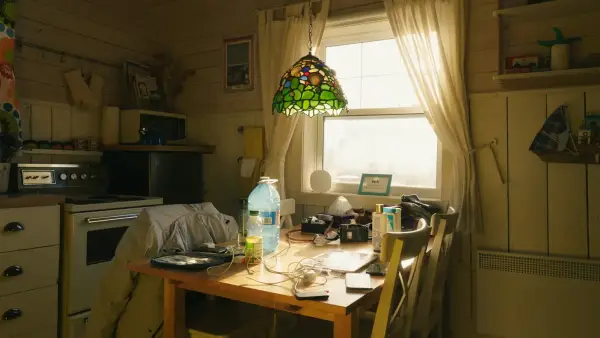
Children who could always tell what kind of evening it was going to be before they stepped through the front door - who knew by the porch light, by the sound of the television through the walls, by the particular quality of silence leaking under the door - often become adults who can read any room they walk into within three seconds, not because they are intuitive but because a child who needed the house itself to warn her what was coming never stopped listening to what buildings have to say about the people inside them
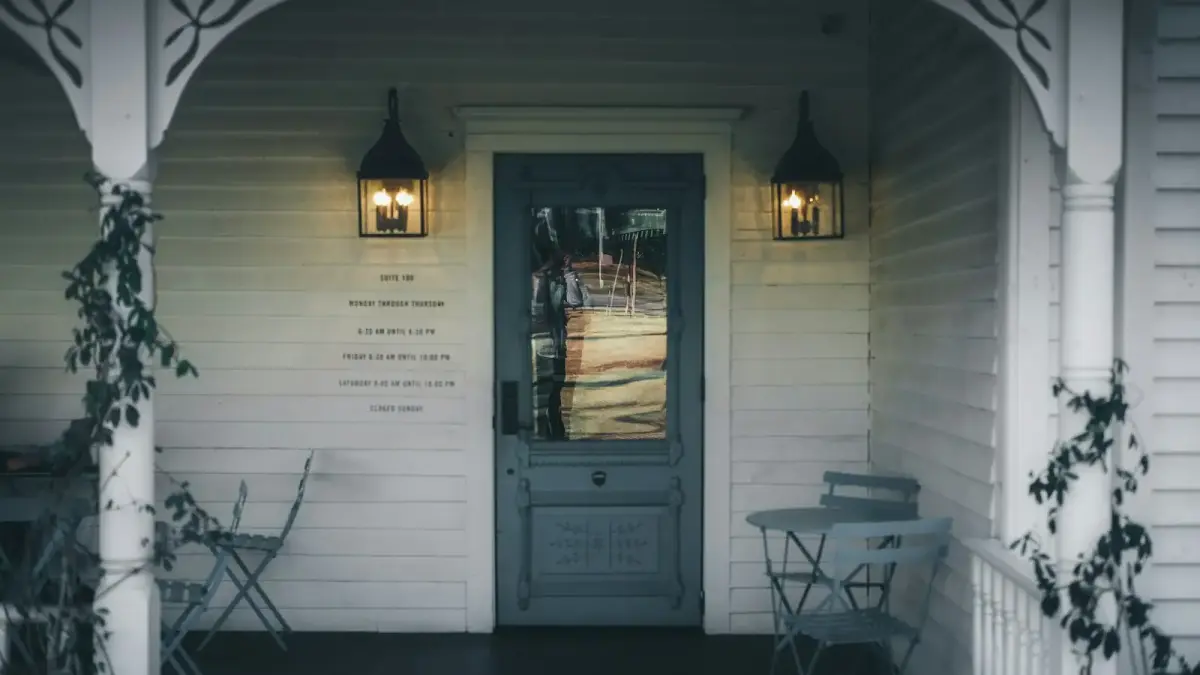
I used to stand on the front porch for a moment before I opened the door.
Not long. Maybe three seconds. But in those three seconds, I was doing something I wouldn’t have a name for until I was well into my thirties. I was reading the house. Not the structure. Not the architecture. The feeling of it. The temperature that had nothing to do with weather.
I could tell by whether the kitchen light was on or off. By whether the television was playing a show someone was actually watching or just filling space so the house wouldn’t be too quiet. By the way the screen door sat - pulled all the way shut meant someone had come in calmly, left slightly open meant someone had come through quickly, maybe upset, maybe just distracted enough not to care.
I didn’t know I was doing it. I thought everyone stood on their porch for a beat, gathering information. I thought everyone’s stomach tightened before a door opened, not after. I thought that was just what coming home felt like.
It wasn’t.
The house always spoke first
Children who grow up in emotionally unpredictable households develop a relationship with their environment that most people never have reason to build. The house becomes a narrator. A reliable one - more reliable, often, than the people inside it.
The driveway tells you who’s home. The position of shoes by the front door tells you how someone arrived. Whether the dishes are washed or stacked in the sink tells you what kind of afternoon it was. The particular weight of silence - not just quiet, but that specific kind of loaded stillness where the air feels thick - tells you something happened before you walked in.
A 2014 study published in the journal Psychological Science found that children raised in unpredictable environments develop heightened sensitivity to environmental cues, processing contextual signals faster and more accurately than children from stable households. The researchers noted that this wasn’t a deficit. It was adaptation. The brain prioritized threat detection because the environment demanded it.
But here’s what the study didn’t say, and what every child who lived this already knows: the house was the most honest thing in the home. People lied. People said “I’m fine” when they weren’t fine. People smiled while seething. But the house didn’t know how to perform. The dishes were either done or they weren’t. The bedroom door was either open or closed. The porch light was either on or left forgotten.
A child who couldn’t trust the words learned to trust the walls.
Reading the emotional weather before it arrived
This was never about fear exactly. It was about preparation.
You learned which car in the driveway meant a certain kind of evening. You knew that if the garage door was left open, someone had come home in a hurry, and hurry usually meant frustration. You knew the difference between the TV being on at a reasonable volume and the TV being turned up loud enough to cover something.
You didn’t just walk into a room. You entered it the way a meteorologist reads a radar screen - scanning for pressure systems, looking for the subtle shifts that predict what’s coming next.
Dr. Gabor Mate has written extensively about how children in unstable environments become extraordinarily attuned to emotional undercurrents. He describes it as a kind of acquired brilliance - the child’s nervous system learns to detect shifts in emotional atmosphere that most people miss entirely. But it comes at a cost. The system never fully powers down. The radar stays on.
And so you developed this extraordinary skill set. You could tell by the way someone set their keys down whether they were calm or coiled. You knew by whether the mail had been brought in or left in the box. You understood the grammar of household objects - what it meant when things were in their place and what it meant when they weren’t.
You were seven. You were running a surveillance operation. And you were doing it with near-perfect accuracy.
What other people call intuition
Fast forward twenty or thirty years. You walk into a dinner party and within seconds you know the couple hosting has been arguing. You can’t explain how you know. You just feel it in the room. Something about the way the kitchen is slightly too clean, like someone scrubbed it aggressively. Something about the music being a little too loud, as if it’s working to cover a silence that was there before you arrived.
Your friends marvel at this. “You’re so intuitive,” they say. “You always know when something’s off.”
You nod. You accept the compliment. But something about the word “intuitive” has always felt wrong to you, like wearing a shoe that almost fits. Because intuition implies something mystical, something effortless. What you do is neither of those things.
What you do is work.
A 2019 study in Frontiers in Psychology examined what researchers called “environmental sensitivity” and found that individuals with heightened sensitivity to their surroundings showed increased activation in brain regions associated with awareness, empathy, and sensory processing. The study emphasized that this sensitivity was not pathological. It was a genuine perceptual difference - these individuals were literally taking in more information from their surroundings than others.
But the study framed it as a trait. Something you are. And maybe for some people, that’s true. But for you, it’s something you became. You didn’t develop this sensitivity because you were born with some gift. You developed it because a child standing on a porch needed the house to tell the truth three seconds before the people inside would.
The cost of reading every room
Here’s the part that nobody talks about when they call you perceptive.
You can’t stop doing it.
You walk into your own home after a long day and you’re scanning. Is the energy different? Did something happen while you were gone? Are the lights the way you left them? You check the kitchen. You check the living room. You’re looking for tells.
In a house where nothing is wrong. In a life you chose. In an evening that holds no danger whatsoever.
Your body doesn’t know that yet. Your body is still standing on that childhood porch, reading the house before the house reads you. And so every room you enter gets the same treatment. The office. The restaurant. The friend’s apartment. You walk in, you scan, you assess, and you carry what you find for the rest of the time you’re there.
If the room is fine, you carry relief. If the room is tense, you carry the weight of knowing something is wrong before anyone has said a word. Either way, you’re carrying something. You’re never just present. You’re always also monitoring.
Susan Cain, in her exploration of highly sensitive people, describes this kind of processing as depth of engagement - the mind doesn’t skim the surface of an experience but plunges into it, often involuntarily. For people who developed this pattern in childhood, the depth isn’t a choice. It’s the only mode the nervous system knows.
The three-second read
People who grew up this way tend to share a very specific experience as adults. They walk into a space - any space - and within roughly three seconds, they have a complete emotional map of the room.
They know who is comfortable and who is performing comfort. They know whether the laughter is real or decorative. They know if someone has been crying in the last hour, even if the evidence has been cleaned away. They can sense the residue of a conversation that ended right before they arrived.
Three seconds. That’s all it takes.
Not because they’re gifted. Not because they have some rare emotional superpower. But because they spent years - formative years, developing years, years when their brains were literally being wired - practicing on the hardest room in the world. Their childhood home.
Every other room since then has been easier by comparison.
A 2021 study published in the Journal of Personality and Social Psychology explored what the researchers termed “rapid social assessment” - the ability to accurately gauge social dynamics within moments of entering a new situation. The findings indicated that individuals who reported high childhood environmental unpredictability scored significantly higher on rapid social assessment tasks. They were faster and more accurate. But they also reported higher baseline anxiety, even in safe settings.
Faster. More accurate. More anxious.
That’s the trade.
The surveillance system built by a child
Here’s what I want you to hear if this is your story.
You built something remarkable. Not because you wanted to, but because you had to. And the thing you built works. It works in boardrooms and at family gatherings and on first dates and in grocery stores when you can tell the person ahead of you in line is having the worst day of their life and everyone else is just seeing someone who’s slow to find their card.
You see what other people don’t see. You hear what buildings are saying about the people inside them. You feel the shift in a room’s temperature when someone’s mood changes, and you feel it before they’ve said a word or moved a muscle.
That is not a small thing.
But I also want you to hear this: you are allowed to put it down sometimes. Not forever. Not even for long. But you are allowed to walk into a room and not read it. You are allowed to come home and just be home. You are allowed to let an evening unfold without predicting it first.
The child who stood on that porch needed every bit of that skill. She was brilliant for building it. But you are not on that porch anymore.
The door in front of you now opens to a life you chose. And most of the time - not always, but most of the time - what’s on the other side is just an ordinary evening. The lights are on because someone turned them on. The quiet is just quiet. The house is just a house.
You can still read it if you want to.
But you don’t have to read it to be safe.