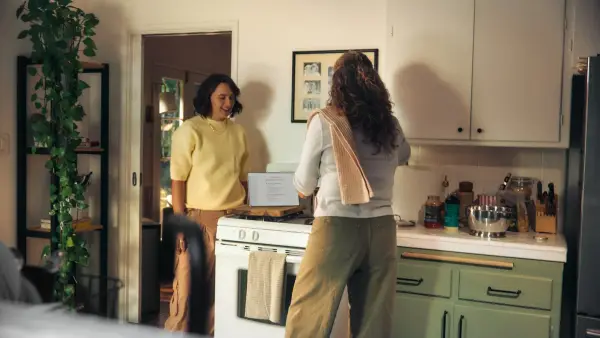
Children who grew up with a parent who used silence as punishment - not the quiet that means I need space but the silence that means you will sit in this discomfort until I decide you have earned my voice back - often become adults who cannot hear a partner go quiet for an hour without their entire body entering a state of emergency, because a child who was taught that silence was a weapon never learned it could also be rest

I knew something was wrong the moment my husband stopped talking.
He wasn’t angry. He was reading. He was sitting on the couch, turning pages, lost in a chapter the way people get lost in chapters - peacefully, harmlessly, with no agenda at all. But my body didn’t know that. My body was already running the old program: scanning his posture for micro-expressions, replaying the last thing I said to check if I’d made a mistake, calculating how many minutes had passed since the last time he spoke to me.
Eleven minutes. It had been eleven minutes.
By minute fifteen, I was standing in the kitchen pretending to reorganize the spice rack, but really I was rehearsing apologies for something I hadn’t done. By minute twenty, I was asking if he wanted tea - not because I wanted to make tea, but because I needed to hear his voice confirm that I still existed to him.
It took me years to understand that this wasn’t anxiety. It wasn’t insecurity. It was a survival response I’d been carrying since I was seven years old, encoded in my nervous system by a parent who had taught me - through hundreds of long, airless silences - that when someone you love goes quiet, it means you are being erased.
The silence that had a temperature
There are two kinds of quiet in a home. One is warm. It’s the sound of people existing near each other comfortably, doing separate things, needing nothing. The other is cold. You could feel it the second you walked through the door.
The cold silence was my mother’s primary language of displeasure. She never yelled. She never threw things. She simply stopped. Stopped speaking, stopped looking, stopped acknowledging that you were in the room. The air changed. The house changed. You became a ghost in your own kitchen, eating cereal across from a woman who could look right through you like you were made of glass.
And the worst part - the part that did the real damage - was that you never knew what you’d done. There was no argument to point to, no rule you’d broken that anyone would name. You just woke up one morning and the world had gone silent, and it would stay silent for a day or two days or a week, and during that time you would turn yourself inside out trying to figure out what was wrong.
A 2014 study published in the journal Personality and Social Psychology Bulletin found that the silent treatment activates the same neural regions as physical pain. The researchers called it a form of “social ostracism” - and they noted that it was uniquely damaging when it came from a primary attachment figure, because the person withdrawing connection was the same person the child depended on for survival.
Your parent didn’t hit you. They disappeared. And somehow, that was worse.
What a child learns when silence means punishment
Children are extraordinary pattern-makers. They can’t afford not to be. When your survival depends on the emotional state of someone bigger, stronger, and in control of every resource you need, you learn to read atmospheres the way other children learn to read books.
A child in a silent-treatment household learns three things very quickly.
First, they learn that silence is never neutral. It is always loaded. It always means something, and what it means is almost always bad. There is no such thing as a person who is simply quiet. Quiet is a verdict.
Second, they learn that connection is conditional. It can be taken away at any moment, without warning, and there is nothing you can do to get it back except wait and perform contrition for an offense no one will name.
Third - and this is the one that follows you into every relationship you’ll ever have - they learn that they are fundamentally responsible for other people’s emotional states. If someone goes quiet, it must be because of something you did. The silence is your fault. It is always your fault. And the only way to end it is to figure out what you did wrong and fix it before the other person has to tell you.
Gabor Mate has written extensively about how children in emotionally unsafe homes develop what he calls “hypervigilance of attachment” - a state in which the child’s nervous system becomes exquisitely tuned to the availability of the caregiver. The child doesn’t just notice when the parent withdraws. The child’s body treats that withdrawal as a threat to survival. Because for a small child, it is.
The adult translation: when your partner’s quiet hour becomes your emergency
Fast forward twenty or thirty years. You’re in a relationship with someone who is, by all accounts, safe. They love you. They show up. They’re not your parent.
But your nervous system doesn’t know that.
When your partner goes quiet - because they’re tired, because they’re thinking, because they had a long day and want to sit with their own thoughts for a while - your body doesn’t register rest. Your body registers danger. The same alarm system that activated when your mother stopped speaking to you at age eight fires up like nothing has changed.
Your chest tightens. Your thoughts start racing. You begin scanning, the way you scanned as a child - what did I say at dinner? Was I short with them on the phone? Did I forget something? You cycle through every interaction from the last forty-eight hours looking for the mistake, because there has to be a mistake. People don’t just go quiet for no reason. Not in your experience.
A 2020 study in the journal Attachment and Human Development found that adults who experienced the silent treatment as children showed significantly heightened cortisol responses to partner withdrawal - even when the withdrawal was brief and benign. Their bodies were not reacting to the current moment. They were reacting to every moment like it that had ever come before.
This is the cruelty of the silent treatment’s legacy. It doesn’t just hurt you when it’s happening. It installs a permanent filter over every quiet moment for the rest of your life.
The impossible position it puts your partner in
Here’s where it gets painful for everyone involved. Because the person you love - the one who just wants to read their book or take a quiet shower or drive home without talking - has no idea they’ve just triggered a five-alarm fire inside you.
They experience the evening as peaceful. You experience it as abandonment.
And so you do what you learned to do as a child: you perform. You find reasons to start conversations. You ask unnecessary questions. You offer tea, suggest a movie, bring up something from the news - anything to break the silence, anything to get them to speak, because their voice is the only thing that tells your nervous system you’re safe.
Or you go the other way. You withdraw first. You get cold, or snippy, or you leave the room with a tight jaw, because if someone is going to go silent, at least this time you’ll be the one who does it. At least this time you’ll have control.
Neither version feels good. Neither version is who you actually are. Both versions are a child’s strategy running on adult hardware, and the mismatch is exhausting for everyone.
Why “just relax” doesn’t work
People who didn’t grow up with the silent treatment often give well-meaning advice: just talk to your partner, just ask if something’s wrong, just trust that silence doesn’t mean what it used to mean.
But this is like telling someone with a burn scar to stop flinching near fire. The knowledge is intellectual. The flinch is physical.
Daniel Goleman’s research on emotional memory shows that responses encoded during childhood bypass the rational brain entirely. They live in the amygdala, in the body, in the breath. You can know - cognitively, clearly, with full adult understanding - that your partner’s silence is harmless. And your hands will still shake. Your stomach will still drop. You will still find yourself standing in the kitchen at 9 p.m., reorganizing things that don’t need reorganizing, waiting for a voice that was never actually taken from you.
A 2018 study published in Frontiers in Psychology found that adults who experienced relational forms of control in childhood - including the silent treatment - showed altered nervous system regulation patterns that persisted even after years of therapy. The researchers described it as a “somatic imprint” - the body remembering what the mind has already processed and forgiven.
You’re not overreacting. You’re not being clingy. You’re not too sensitive. You are having a perfectly logical response to a perfectly illogical thing that was done to you when you were too young to understand it.
Learning to let silence be safe
The healing doesn’t start with your partner. It starts with your nervous system.
It means learning to sit in quiet and let your body feel the panic without acting on it. It means breathing through the eleven-minute mark and the fifteen-minute mark and the twenty-minute mark until your body learns - slowly, painfully, over many repetitions - that this silence is not that silence. That this quiet room is not that quiet room. That the person on the other end of this pause is not leaving. They’re just resting.
It also means learning to name it out loud. Not “why aren’t you talking to me?” but “I’m noticing that my body is reacting to the quiet, and I know it’s not about you - I just need a moment to let my system catch up to where I actually am.”
That sentence - or something like it - is the bridge between the child you were and the adult you’re becoming. It’s the moment you stop treating your partner like the parent who disappeared and start treating your own nervous system like the child who needs reassurance.
It’s not fast. It’s not clean. There will be nights when you can’t do it, when the old alarm is too loud and you pick a fight just to hear a voice. That’s okay. That’s not failure. That’s a seven-year-old who learned that silence was a locked door, trying to learn - at thirty-five, at fifty, at sixty-two - that sometimes a door is just closed, and the person behind it is still there, and they were never, ever going to leave.
If you grew up in a house where love went mute when you needed it most, I want you to know something. The silence was never about you. It was never because you weren’t enough or too much or wrong in some way you couldn’t name. It was a grown adult choosing the most devastating tool they had - the withdrawal of their presence - and using it on a child who had no power to leave the room.
You survived it. You adapted to it. And now, in the quiet moments of your adult life, you are slowly, bravely learning to put down the alarm that kept you alive but was never supposed to follow you here.
That’s not weakness. That’s one of the most courageous things a person can do.