Children who grew up translating one parent's mood to the other often become adults who cannot tell the difference between being close to someone and managing them from the inside, and by forty-five they have built an entire life of relationships no one has ever actually read them inside of

My friend Dana called me last spring from her car, parked in the lot outside her therapist’s office, and said the strangest sentence. She said, “I think I have been producing my own life.”
I asked her what she meant. She said that she had been sitting there trying to describe her marriage, and the word that kept coming up was not “partner” or “husband” or even “together.” The word was “cast.” As in, she had been casting him in the role of her husband for twenty-two years.
And she was not saying this cruelly. She was saying it the way a person says a thing they have finally seen.
I knew what she meant because I have had versions of that sentence crawl up my own throat. Most of the women I love who grew up holding their parents together have had that sentence. It sits in the back of you for decades, and then one Tuesday afternoon it comes forward and asks to be looked at.
The Job You Were Given Before You Could Refuse It
Some children grow up in houses where the weather between their parents is unstable. Not necessarily violent. Not necessarily loud. Just unstable, in that specific way where a dropped tone of voice at breakfast can decide what dinner feels like.
And in those houses, one child usually gets chosen. Not officially. Nobody hands you a badge. But you are the one whose nervous system is wired slightly finer than your siblings’, or you are the eldest, or you are the one who looks most like the parent whose feelings are hardest to read. And so you become the translator.
You learn to explain your father’s silence to your mother in a way that softens it. You learn to explain your mother’s tears to your father in a way that does not indict him. You relay tone. You relay intent. You smooth the rough edges of one person’s sentence before it reaches the other person’s ear, because at eight years old you have already understood that if that sentence lands the way it left, something will break, and the thing that breaks will be your whole week.
Nobody tells you this is what you are doing. You just do it, the way a child does anything they are asked to do without being asked.
Why Closeness Started to Feel Like Work
Here is the thing no one tells you about being that child. The skill you developed, which was keeping track of someone else’s interior weather while managing what you showed them of yours, is indistinguishable, from the inside, from love.
You thought you were loving your parents. You were, in a way. But the felt sense of it, the texture of what love meant in your body, was vigilance. It was watching someone’s face for the small shift. It was pre-editing your sentences. It was calibrating the temperature of a room before you spoke into it.
So when you grow up and you meet a partner, or you build a friendship, or you have your own children, what you do is the thing you know how to do. You watch their face. You pre-edit. You calibrate.
You call this “being close.”
You do not know it is not the same thing as being close. You have no reference point for the other thing, the thing where you just sit beside someone and stop scanning. You have been scanning your entire life.
The Adult Version Is Harder to See
By the time you are forty, or forty-five, the stage management has become so fine-grained you cannot see your own hand moving.
You know which of your friends needs to be called on a Sunday night and which one wants a Tuesday afternoon. You know which topic to raise with your mother-in-law and which to let die. You know how to tell your husband about a difficult day in a way that will make him feel like a good listener instead of a put-upon one.
You know, without thinking about it, how to be loved by the specific person you are with, in the specific way they are capable of loving.
And because you are good at this, because you have been good at it since you were nine years old, everyone around you experiences you as warm and easy and unusually attuned. They feel met by you. They will say so, often, and the saying of it will land in your body like a small coin dropped into a well you did not know was there.
Because here is the quiet part. You feel met by almost no one. You have spent so long doing the meeting that you have forgotten what being met feels like, and at some point in your forties you start to notice the forgetting.
What the Research Says About This
A 2014 study published in the Journal of Family Psychology found that children who take on caregiving roles for their parents’ emotional states, a phenomenon researchers call parentification, show elevated rates of both relational competence and chronic loneliness in adulthood. The competence is the part you can see from the outside. The loneliness is the part you feel at 10pm, after you have finished managing everyone’s evening.
The psychologist Lindsay Gibson, who has written extensively on emotionally immature parents, describes the way children of such parents develop what she calls a “healing fantasy.” You grow up believing that if you can just become attuned enough, careful enough, read the room well enough, one day someone will finally turn around and see you the way you have been seeing them.
And some version of you, a version still eight years old, is still waiting for that turning around to happen.
Research on attachment theory, including work published in Attachment & Human Development, suggests that children who develop what is sometimes called a compulsive caregiving attachment style tend to build adult relationships in which they are the giver, the soother, the one who manages the temperature. Intimacy, in their nervous system, is associated with labor.
When the labor stops, they do not feel peace. They feel unsafe.
The Particular Grief of Realizing It
Dana told me, in that car, that the hardest part was not being angry at her husband. He was not the problem. He had never asked her to run their marriage from the inside. She had just done it, because that was what being close looked like to her.
The hardest part, she said, was grieving all the years she had been technically loved and had not been able to feel it, because the part of her that could have felt it was busy running the stagecraft.
I think a lot of women in their forties and fifties are walking around with this grief and do not have a language for it. They love their families. They love their friends. They have, by any external measure, full lives.
And yet there is a faint hum underneath, a sense that they have never quite been caught, that they are the one doing the catching, always, and that the catching has become so second-nature they can no longer locate what it is they themselves needed to have caught.
This is not a character flaw. It is the adult shape of a child’s solution.
What Being Read Might Feel Like, If You Ever Let It
I do not have a tidy method for this. I do not think there is one.
What I have seen, in myself and in the women I love, is that the first move is not to stop managing. The managing is too old, too reflexive, too deep in the body. You cannot talk yourself out of a decades-old nervous system pattern in an afternoon.
The first move is smaller. It is noticing. It is sitting across from someone you love and feeling the familiar reach of your attention toward their face, toward their mood, toward the next sentence you need to shape, and just letting yourself see that you are doing it. Not judging it. Just seeing.
And then, sometimes, maybe, trying a tiny experiment. Saying the sentence you would not normally say, because it is not calibrated, not softened, not pre-digested. Saying the thing that is actually true about your day, without adjusting it to be received well. And letting the person in front of you have to meet it without your help.
Most of the time, they will. They have been waiting for you to stop producing the scene and just be in it. They did not know that was what they were waiting for. Neither did you.
Some of the people in your life will not rise to meet the unmanaged version of you, and that is information too, and it is the kind of information that, once you have it, tends to reorganize the rest of your life in ways that are slow and quiet and, eventually, merciful.
A Small Note, In Closing
If you recognized yourself in this, I want to say the thing I wish someone had said to me.
You were not born a manager. You became one because a child in an unstable room does what she has to do, and what you did kept your family functional for years, possibly decades. The vigilance was not a flaw. It was a gift you gave people who could not give it back.
But you are allowed, now, to put some of it down. Not all of it, and not all at once. Just some.
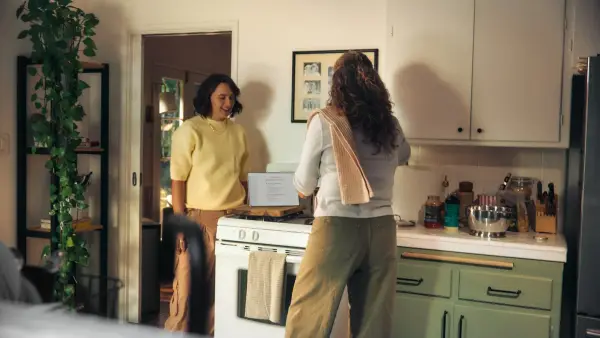
You are allowed to be read, instead of doing the reading. You are allowed to sit at your own kitchen table and not scan the weather. You are allowed to be loved in a way that does not require you to first arrange the room for it.
The fact that this feels almost unbearable is not evidence that it is not for you. It is evidence of how long you have been without it.
Somewhere in you is the child who learned to translate. She did beautiful work. She is tired now. And the adult you have become is allowed, finally, to let her rest.