Children who learned to measure the distance between their parents on the couch became adults who read every room by the geography of bodies - and what everyone calls intuition is actually a measurement system built by a seven-year-old who needed the furniture to tell the truth when nobody else would
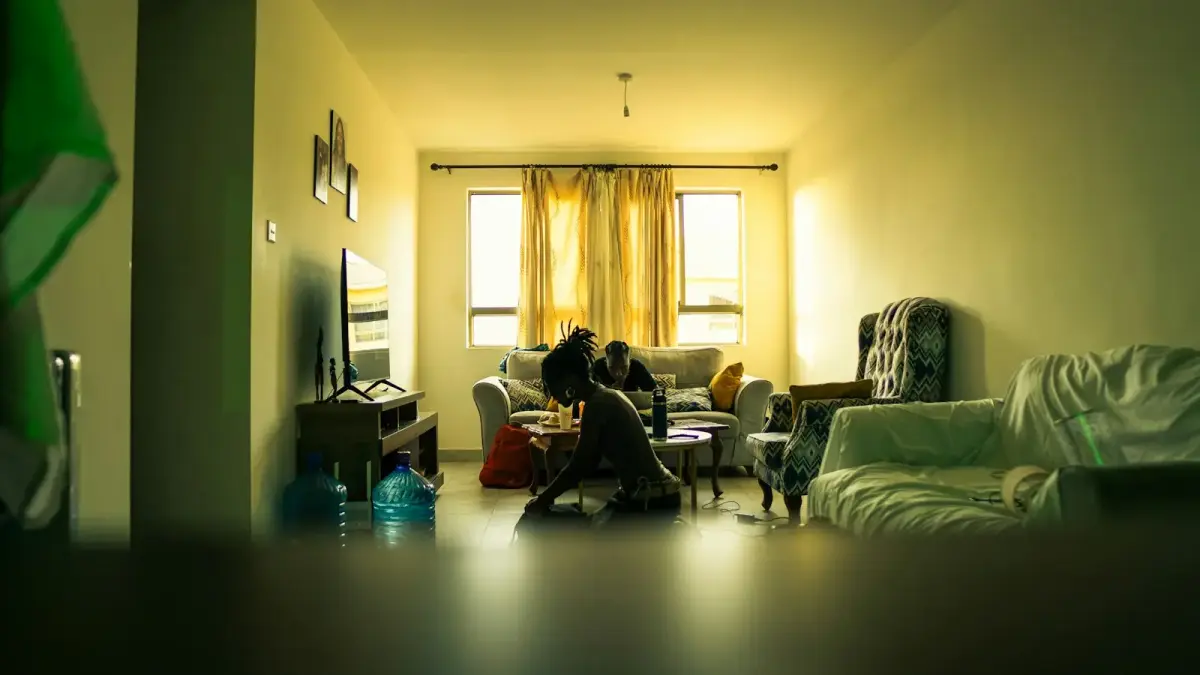
I used to count cushions.
Not consciously - not the way you count stairs or tiles or seconds between lightning and thunder. But somewhere in the back of my seven-year-old brain, a system was running. My parents would settle onto the couch after dinner, and before I could even name what I was doing, I had already taken the measurement.
One cushion apart meant the evening would be fine. Maybe a shared laugh at something on television. Maybe my mother’s feet tucked under my father’s leg without either of them noticing they’d done it.
Two cushions meant neutral. Tired, probably. Not angry, but not reaching for each other either.
A night where the house would stay quiet in the ordinary way - the kind of quiet that just means everyone is running low.
Three cushions meant I should stay in my room.
I didn’t learn this from a textbook. I learned it the way you learn the sound of a car engine that’s about to stall - by living inside a machine that gave you no dashboard but expected you to know when things were about to break down.
The couch was the only instrument I had. And it never lied.
The stage nobody meant to build
Every home has a piece of furniture that accidentally becomes the most honest surface in the house.
For some children, it’s the kitchen table - who sits where, whether the chair at the head gets pulled out or left empty. For others, it’s the car - which parent drives, whether the radio goes on immediately to fill the silence. But for a lot of us, it was the couch.
The couch is where a marriage shows its daily temperature without meaning to. Nobody rehearses how they sit down at the end of the day. Nobody thinks about how many inches they leave between their hip and another person’s hip. That’s exactly what makes it so reliable.
A child in an unstable home doesn’t get verbal updates on the state of the relationship. Nobody kneels down and says, “Your father and I had a disagreement about money today, but we’re working through it, and you’re safe.” What the child gets instead is data.
The angle of a shoulder. The way someone sits on the edge instead of settling back. The difference between a body that’s resting and a body that’s perched for departure.
Edward Hall, the anthropologist who pioneered the study of proxemics in 1966, described personal space as a form of nonverbal communication so powerful that it operates below conscious awareness. His book The Hidden Dimension mapped out the invisible distances humans maintain - intimate, personal, social, public - and argued that these distances carry more emotional information than most conversations.
Hall was studying cultures. But children in tense homes are studying something far more urgent. They’re studying survival.
A measurement system built from necessity
Here is what nobody tells you about growing up in a home where the emotional weather shifted without warning: you don’t develop anxiety. You develop instruments.
A child who can’t predict whether tonight will be laughter or silence, warmth or withdrawal, learns to build prediction models out of whatever raw material is available. And the rawest material - the most unguarded, most honest - is the body.
Where does Dad sit when he comes home? Does he drop into the armchair - the one that faces the TV but not Mom - or does he take the couch? If he takes the couch, which end?
If Mom is already there, does he sit close enough that their arms might brush, or does he leave the middle cushion empty like a demilitarized zone?
These calculations happen in fractions of seconds. The child doesn’t know they’re doing it. They just know that by the time everyone is seated, they already know what kind of night it’s going to be.
John Bowlby, the psychiatrist whose attachment theory reshaped our understanding of human bonding, described something he called proximity-seeking behavior - the instinct to move toward a caregiver when distressed. But what Bowlby studied from the child’s perspective, these children learn to study from the observer’s perspective. They become experts not in seeking closeness, but in measuring it between other people.
They learn that love has a width. That safety has a distance. That you can quantify the state of a relationship not by what anyone says but by how many inches of beige upholstery sit between two people who promised each other forever.
What it looks like at forty-three
You grow up. You leave the couch behind. You build your own life in your own apartment with your own furniture.
But the measurement system never shuts off.
You walk into a dinner party and within fifteen seconds you know which couple drove there in silence. Not because anyone told you. Because of the way she’s standing six inches farther from him than the other wives are standing from their husbands.
Because he’s angled toward the host instead of toward her. Because there’s a geometry to closeness that most people never notice, and you’ve been reading it since you were seven.
You sit down in a meeting and you know who’s aligned with whom before anyone opens their mouth. The two colleagues whose chairs are pulled slightly closer together. The manager who has positioned herself equidistant from everyone - neutral, deliberate, a practiced performance of fairness.
The new hire sitting slightly too far from the table, not because they’re disengaged but because they haven’t yet figured out where they’re allowed to be.
A 2019 study published in the Journal of Nonverbal Behavior found that interpersonal distance is one of the most reliable nonverbal indicators of relationship quality - and that individuals who experienced inconsistent caregiving in childhood tend to be significantly more attuned to spatial cues in adult relationships. The researchers called it heightened proxemic sensitivity. You might just call it the thing you can’t turn off.
You notice when your partner moves one inch farther away in bed. Not a foot - an inch. And that inch tells you everything.
It says something happened today that they’re not going to bring up. It says the space between you has changed temperature, and even though the change is invisible to anyone else, your seven-year-old self is already doing the math.
The gift that doesn’t feel like one
People tell you you’re perceptive. They say you read rooms well. They compliment your emotional intelligence as though it’s a talent you cultivated, like learning French or developing a taste for wine.
They don’t know it’s a surveillance system.
They don’t know that the reason you can walk into any space and immediately sense the tension between two people is because you spent your childhood in a house where tension didn’t announce itself. It arrived as a distance. As a turned shoulder.
As the sound of someone sitting down on the opposite end of the couch when they used to sit in the middle.
And here’s the part that’s hard to explain to people who grew up in homes where the couch was just a couch: you can’t separate the skill from the wound. The ability to read a room is the same ability that kept you hypervigilant as a child. The thing that makes you a thoughtful friend, a perceptive partner, a person who always knows when something is off - that thing was built from fear.
But I want to be careful here, because calling it only fear doesn’t honor what it became.
Yes, you learned to measure space because you had to. Yes, the couch was a barometer because nobody gave you words. But what you built from that necessity is real.
It’s not imaginary. It’s not pathology. You genuinely can read the emotional topology of a room faster and more accurately than most people, and that ability serves you in ways that have nothing to do with danger.
You know when your friend is struggling before she says anything - because she sat farther away at brunch. You know when your child had a bad day at school - because they dropped their backpack three feet from the door instead of right next to it.
You know when your partner needs you to reach for them - because the distance between your bodies has widened by exactly the amount that means someone is carrying something alone.
The distance was never just distance
What I’ve come to understand - slowly, and with a kind of tenderness I didn’t used to have for that child on the couch - is that what I was measuring was never really inches.
I was measuring safety. I was measuring love. I was measuring the likelihood that the two people responsible for my entire world were going to hold it together for one more night.
And the reason the measurement system persists into adulthood isn’t because I’m broken. It’s because the system works. It was accurate then, and it’s accurate now.
The problem was never the instrument. The problem was that a child had to build it at all.
Brene Brown has written about how the most empathic people are often those who learned early to scan for emotional danger. She describes it as a kind of armor that doubles as a gift - the hyperawareness that kept you safe becomes the sensitivity that lets you connect deeply. The armor and the antenna are the same thing.
I think about this when I catch myself reading a room I’ve just walked into. The quick scan - who’s near whom, who’s turned away, who’s leaning in, who’s sitting alone but watching the door. It takes me less than ten seconds.
It’s automatic. It’s the same scan I ran every evening at 7 PM when I heard the garage door open and the footsteps come down the hall and I watched, from the corner of my eye, which end of the couch my father chose.
What the couch was really saying
The couch was saying what nobody would say out loud.
It was saying: tonight we are close. Or: tonight there is a wall between us made of something that happened at 2 PM that you will never be told about. Or: tonight we are pretending, and the pretending looks like sitting near each other but not touching, and if you are a very observant child, you can see the difference between nearness that means safety and nearness that means performance.
And you were a very observant child. Not because you wanted to be. Because the house required it.
If you recognize yourself in this - if you’re the person who walks into a room and immediately knows the emotional temperature by the way bodies are arranged in space - I want you to know something.
That skill is yours. It belongs to you now. It isn’t just a scar from a childhood that asked too much. It’s a fluency in a language most people don’t even know exists - the language of distance, of proximity, of the space between two people that tells the truth even when everything else is performing.
You learned to read that language because you had to. But you get to keep it because it’s beautiful.
The seven-year-old who counted cushions grew up into someone who understands - in their bones, in the part of the brain that processes information faster than conscious thought - that love is spatial. That closeness is a choice people make with their bodies before they make it with their words.
That the distance between two people is never just distance.
It’s always a sentence. And you learned to read it before you learned to read books.
That’s not a wound. That’s a language. And you’re fluent.