Psychology says the hardest year of most long marriages is not the first or the seventh - it is the September the youngest child leaves for college, and two people who spent two decades co-managing a household sit across from each other at a dinner table that seats four but only holds two, and realize they cannot remember what they used to talk about

The chicken was overcooked, which almost didn’t matter because neither of you was really tasting it.
It was the first Tuesday in September. The car still smelled like the dorm move. You could still feel the ache in your arms from carrying boxes up three flights of stairs.
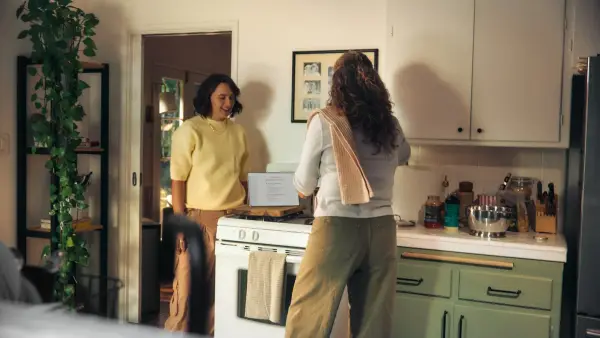
And now the kitchen was the kind of quiet that made the hum of the refrigerator sound like a statement.
You sat across from the person you had been married to for twenty-two years. You loved them. You were fairly sure they loved you.
And yet when you opened your mouth to say something - anything - what came out was, “Did you check if the garage door was closed?”
They nodded. You both chewed. The silence grew a body and sat down in the empty chair between you.
If this has happened to you - or if it is happening right now - I need you to hear something before the shame settles in any deeper.
That silence is not proof that your marriage is over. It is not a sign that you chose the wrong person, or that the love ran out while you were busy packing lunches and attending parent-teacher conferences.
That silence is two people meeting each other again for the first time in twenty years. And like most first meetings, it is painfully, beautifully awkward.
The project ended, and nobody planned for what came after
Here is what happens in a lot of long marriages, and nobody warns you about it.
Somewhere around the time the first child starts school, your marriage quietly shifts from a relationship into a project. Not because you stop loving each other.
Because the project is enormous and relentless and it requires every resource you have.
You become co-managers. You divide labor. Someone handles mornings and someone handles bedtime.
Someone tracks the dentist appointments and someone coaches the soccer team. You develop a communication style that is brutally efficient - shorthand, logistics, decisions made in the hallway between the bathroom and the bedroom.
This is not a failure of love. This is love in its most operational form. You are building something together, and the building requires almost everything.
But the thing about projects is that they end.
A 2020 study published in the Journal of Family Psychology found that couples who described their primary shared identity as “parenting partners” experienced significantly higher distress during the empty nest transition than couples who maintained other shared identities throughout the child-rearing years. The researchers called it “role loss grief” - the mourning of a function that gave the relationship its daily structure.
You are not grieving each other. You are grieving the scaffolding that held you together.
You forgot what they sound like when they are not managing something
The strangest part of the empty nest dinner table is not the silence. It is the moments when the silence breaks.
Your spouse laughs at something on the television in the other room, and you realize you forgot what they found funny. Not funny in the way you both laugh at the kids or at the absurdity of the water heater breaking on Christmas Eve.
Funny in the way that is just theirs - the kind of humor that existed before you had children, before every joke between you became a shared reference to some domestic catastrophe.
You notice them holding their coffee mug with both hands, and it hits you that you have not really looked at their hands in years. Not their hands doing something - carrying, fixing, driving. Just their hands, still, wrapped around something warm.
They mention a podcast they have been listening to and you think: when did you start listening to podcasts? And what else have you been thinking about that I never asked?
This is the disorientation of it. You are living with someone you know completely and not at all.
You know how they take their coffee and which side of the bed they sleep on and the exact sound they make when they are pretending not to be annoyed. But you do not know what they wonder about at 2 a.m. You do not know what they would choose if the only person they had to consider was themselves.
The myth of the seven-year itch gets it backwards
We talk about the early years of marriage as the dangerous ones. The adjustment period. The seven-year itch.
The idea that if you survive the first decade, you are probably fine.
But research tells a different story.
A 2009 study published in Psychological Science found that marital satisfaction follows a U-shaped curve - highest in the early years, lowest when children are adolescents and leaving home, and then gradually rising again in later life.
The bottom of the curve is not year seven. It is somewhere around year eighteen to twenty-two, right when the last child is preparing to leave.
The dangerous year is not the one where you are learning each other’s habits. It is the one where you have to decide whether the person behind the habits is someone you want to learn all over again.
And that decision is terrifying, because it requires admitting something most long-married people do not want to say out loud.
I do not know who you are anymore. Not because you hid from me. Because I stopped looking.
The silence is not distance - it is a doorway
Here is the reframe, and I want you to sit with it even if it feels uncomfortable.
The awkwardness across that dinner table is not the sound of a marriage failing. It is the sound of a second introduction.
Think about what it takes to sit across from someone you have shared a bed with for twenty years and feel nervous. To feel like you do not know what to say.
That is not emptiness. That is the trembling awareness that there is a whole person over there that you have been too busy to meet.
Dr. John Gottman’s research at the University of Washington has shown that couples who successfully navigate the empty nest transition share one critical behavior - they turn toward each other’s bids for connection, even when those bids are clumsy and uncertain.
Even when the bid is just “did you see that thing about the weather” and what they really mean is “please talk to me, I am trying to find us again.”
The couples who make it through are not the ones who had a perfect marriage all along. They are the ones who decided that the stranger sitting across the table was someone worth getting curious about.
What rediscovery actually looks like
Nobody tells you that falling in love with the same person a second time looks nothing like the first time.
The first time was electric and consuming and felt like the whole world rearranging itself around two people. The second time is quieter. It is slower.
It is noticing.
It is your spouse saying, “I think I want to take a pottery class,” and instead of thinking about the schedule, you think about them standing at a wheel with clay on their hands, and something in your chest shifts.
It is sitting on the porch after dinner and realizing that neither of you has spoken in ten minutes, but this silence is different from the one in September. This one has weight. This one chose to be here.
It is asking, “What were you like in college before I knew you?” and genuinely wanting to hear the answer. Not because you are gathering information. Because you are gathering them.
A 2018 study in the Journal of Social and Personal Relationships found that couples who engaged in “self-expanding activities” together - new experiences that challenged their routine - reported significant increases in relationship satisfaction during the post-parenting transition. But the researchers noted something interesting.
It was not the novelty itself that mattered. It was the willingness to be beginners together again.
That is what the empty dinner table is really offering you. Not an ending. A second chance at being new to each other.
The ones who were never fine are not the ones who struggle
There is a common fear among long-married couples facing the empty nest, and it goes something like this: if we struggle now, it means something was always wrong.
But that is not what the research shows, and it is not what I have seen.
The couples who struggle most in the transition are often the ones who were the best project managers. The ones who ran the household like a well-oiled machine, who never dropped a ball, who showed up for every game and every conference and every holiday with matching energy and split responsibilities.
They did not neglect each other because they were careless. They neglected each other because the project genuinely needed everything they had.
And the fact that they gave it - both of them, fully, for twenty years - is not a sign of a weak marriage. It is a sign of an extraordinary one.
The question was never whether the marriage was good enough. The question is whether you are brave enough to let it become something new.
You are allowed to feel lost at your own kitchen table
If you are reading this in September, or in October, or in the January after, and the house still feels too big and the evenings still feel too long and you still do not know what to say over dinner - I want you to know something.
You are not failing. You are standing in the doorway between the marriage you built and the marriage you have not imagined yet.
And doorways are supposed to feel uncomfortable. That is how you know they lead somewhere.
The silence across that table is not a verdict. It is a question.
And the question is not, “Was any of this real?”
The question is, “Who are you now? And can I sit here long enough to find out?”
You can. You already did the harder thing.
You raised humans together. You showed up every morning for two decades and chose the same person and the same life and the same kitchen table.
Sitting there without a script is not the end of the love story. It is the first page of the next one.
And this time, you get to write it without a schedule, without a carpool, without anyone else’s needs drowning out the sound of your own.
Just two people. One table. And all the time in the world to remember what you used to talk about - or, better yet, to find something new.