There are conversations that happen between old friends in the first three minutes of a phone call that cover more emotional ground than most marriages cover in a year, because two women who have known each other since they were twenty-three have built a language so compressed that a single sigh after 'how are you' tells the other person everything - the week, the husband, the daughter who still hasn't called, and the tiredness that goes all the way to the bone
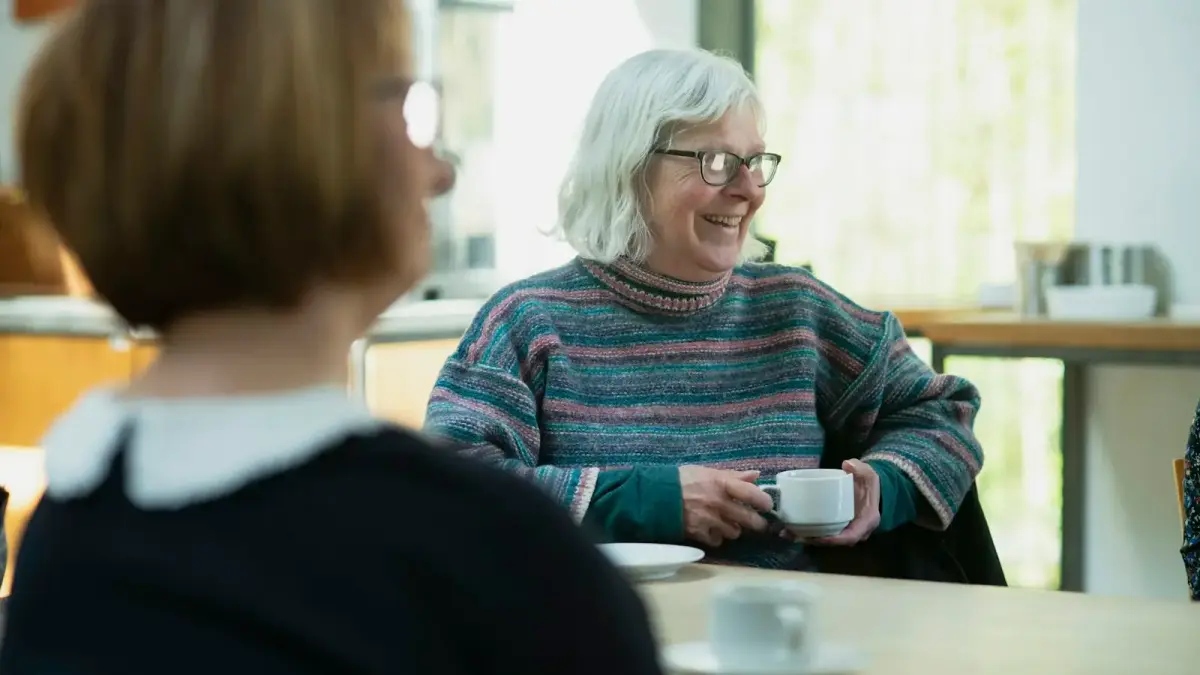
She called at 7:14 on a Tuesday, and I knew before she spoke
My friend Lisa called me last Tuesday evening. She said “hey” and then nothing for about two seconds. That was all I needed.
I knew the week had been long. I knew the thing with her mother’s assisted living facility had gotten worse, not better. I knew her husband had said something careless again - not cruel, just careless in the way that accumulates over thirty years like dust on a shelf nobody can reach.
I knew all of this before she said a single word about any of it. Because Lisa and I have been friends since we were twenty-three, and in the thirty-two years since then, we have built something between us that I can only describe as a language. Not English. Something older and more precise. A language made of pauses, breath patterns, the specific weight of a “well…” and the exact half-second delay between “I’m fine” and the inhale that means she isn’t.
Nobody talks about this. Nobody writes vows for it. There is no anniversary dinner, no ceremony, no legal recognition. But this friendship - this specific, unremarkable, Tuesday-evening phone call - is the most intimate relationship in my life, and I suspect it might be the most intimate relationship in hers.
The dictionary nobody wrote down
There is a vocabulary between old friends that took decades to compile, and neither person remembers building it.
Lisa and I have a word - it’s not even a real word, it’s a sound she makes, somewhere between “mm” and “hmm” - that means “I hear you and I’m not going to try to fix it because we both know it can’t be fixed, but I’m here and that’s the only thing that was ever going to help anyway.” That sound carries thirty years of context. It carries the night her first marriage ended and I drove forty minutes in the rain to sit on her kitchen floor.
It carries the year my father was dying and she called me every single morning at 6:15 without ever once asking how I was doing, because she knew the question itself was a burden.
A 2020 study published in the Journal of Social and Personal Relationships found that long-term friendships develop what researchers call “interpersonal cognitive complexity” - the ability to read and respond to a friend’s emotional state with increasing precision over time. The longer the friendship, the more nuanced the understanding becomes.
But “interpersonal cognitive complexity” doesn’t begin to capture what it actually feels like. What it feels like is this: she can hear the shape of my week in the way I say her name.
Three minutes that hold more than most people’s entire marriages
I don’t say this to diminish marriage. I’ve been married for twenty-six years to a good man who tries. But there is a kind of emotional ground that David and I simply cannot cover, not because he doesn’t care but because the language between us is different. Slower. More careful. Full of small negotiations and unspoken agreements about what we will and won’t say to each other.
With Lisa, there are no negotiations. There is no protecting each other’s feelings because our feelings have already been seen - fully, repeatedly, in every ugly and beautiful configuration possible. She watched me become a person I didn’t like during my thirties and she stayed. I watched her shrink herself for a man who didn’t deserve it and I said nothing until she was ready to hear it, and then I said everything.
That history creates a compression that marriage rarely achieves. In three minutes on the phone with Lisa, I can say “the thing happened again” and she knows exactly which thing, with whom, and what it cost me. She knows the backstory, the pattern, the part I’m embarrassed about, and the part I still haven’t admitted to myself. She holds the entire map of me.
David holds a different map. An important one. But Lisa’s map has contour lines that nobody else can read.
The sigh that carries a chapter
There is a specific exhale - women who have friends like this will know exactly what I mean - that happens after “how are you” and before any actual answer. It is a sigh that carries an entire chapter of someone’s life in about one and a half seconds of breath.
A 2018 study in Psychological Science found that humans can distinguish at least twenty-four distinct emotions from vocal bursts alone - brief, nonverbal sounds like sighs, groans, and laughs. But that study measured strangers. Between two women who have known each other for three decades, a single sigh doesn’t communicate one of twenty-four emotions. It communicates a specific narrative with specific characters and a specific history that stretches back further than some people’s children have been alive.
When Lisa sighs after I ask how she is, I hear the daughter who moved to Portland and calls once a month if Lisa is lucky. I hear the weight of being needed by her mother in ways that are physically and emotionally exhausting. I hear the particular loneliness of a woman who has spent her entire adult life making sure everyone around her is okay and has only recently started to wonder who is making sure she is okay.
I hear all of that in a breath. Not because I’m gifted at reading people, but because I’ve been listening to this particular person breathe for thirty-two years.
The most intimate relationship nobody applauds
Here is what I think nobody says enough: for millions of women, especially women over fifty, the deepest emotional intimacy in their lives is not with their spouse. It is with a friend they’ve had since before their lives took shape. And this is not a failure of their marriages. It is a testament to what women build with each other when nobody is watching, when there is no incentive other than love, when the whole relationship exists purely because two people chose each other and kept choosing.
Brene Brown has written extensively about how vulnerability is the birthplace of connection. But what she describes as a practice - learning to be vulnerable, choosing to let someone see you - is something that old female friendships achieve almost accidentally, through sheer accumulation. You don’t decide to be vulnerable with your friend of thirty years. You simply are, because she has already seen every version of you and she’s still calling on Tuesday evening.
Daniel Goleman’s work on emotional intelligence describes the capacity to perceive, understand, and manage emotions in yourself and others. But the emotional intelligence between old friends isn’t a skill anyone developed on purpose. It is an artifact of attention. Of showing up for three decades. Of listening not just to the words but to the spaces between them, the speed of the speech, the specific way she says “anyway” when she wants to change the subject because she’s about to cry.
The Wednesday text and the twenty-year translation
Lisa texted me on Wednesday morning. It said: “Coffee Thursday?”
Anyone else would read that as a simple invitation. I read it as: the Tuesday phone call wasn’t enough. She’s still carrying it. She needs to sit across from someone who knows her face as well as her voice. She needs the version of our friendship that includes eye contact, because whatever is happening with her mother or her daughter or the tiredness that lives in her bones is bigger than a phone call can hold.
I texted back: “Same place. 9?”
She sent a thumbs up emoji.
That entire exchange - nine words and an emoji - contained a complete conversation about emotional need, availability, the location that has been our place for eleven years, a time that works around her mother’s morning nurse, and a confirmation that yes, I understood what she was actually asking, which was not for coffee but for witness.
This is the language I am talking about. This dense, coded, decade-old compression of two entire inner lives into a handful of syllables. This is what women build with each other. And it is, I am convinced, one of the great unrecognized art forms of human relationship.
She was never just a friend
I bristle when people say “just a friend.” There is nothing just about it.
A 2022 study in the Journal of Personality and Social Psychology found that the quality of close friendships is a stronger predictor of well-being than the quality of romantic relationships, particularly in midlife and beyond. The researchers suggested that friendships, unburdened by the logistical and financial entanglements of marriage, often become purer containers for emotional exchange.
Lisa is not just my friend. She is the person who held my emotional continuity when I couldn’t hold it myself. She is the keeper of stories I’ve forgotten I told her.
She remembers who I was at twenty-three - hopeful and ridiculous and convinced I’d be a poet - and she holds that version of me alongside the fifty-five-year-old version who worries about her cholesterol and hasn’t written a poem in nine years, and she treats both versions as equally real.
She is the only person alive who can say “you’re doing it again” and I know exactly what “it” is without asking. The it has shifted over the years - at thirty it was people-pleasing, at forty it was overworking, at fifty it’s withdrawing - but she tracks the pattern the way a meteorologist tracks weather systems. She sees it forming before I feel it arrive.
What I want you to know
If you have a friend like this - someone who can hear your whole week in the way you say hello, someone who texts you on Wednesday morning because Tuesday night wasn’t enough, someone who has been translating your silences for longer than some marriages last - I want you to know that what you have is not small.
It is not secondary to romance. It is not the consolation prize for the relationships that supposedly matter more. It is its own thing, enormous and irreplaceable, and the fact that there is no word for it in any language is not evidence of its insignificance but evidence of our collective failure to name what women have always quietly built.
Lisa will call me again next Tuesday. She’ll say “hey” and then there will be a pause. And in that pause I will hear everything. Not because I’m special, but because I’ve been listening for thirty-two years, and the language we’ve built in that time is the most fluent I have ever been in anything.
Some relationships get ceremonies and rings and anniversaries. This one gets a Tuesday phone call and a Thursday coffee and a shorthand so dense it could fill a novel.
That has always been enough. It has, in fact, been everything.