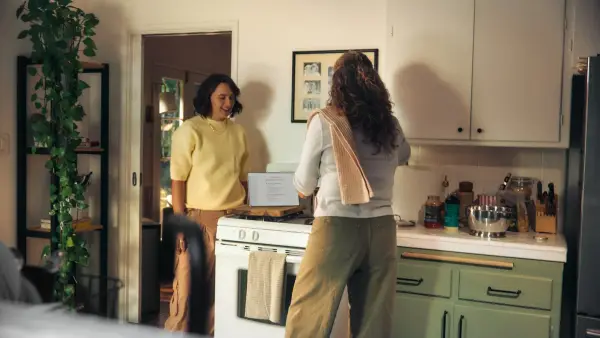
There are couples who have spent so many years together that they have built a language no one else can speak - a particular sigh that means 'I need to leave this party in fifteen minutes,' a hand on the knee that means 'do not say what you are about to say,' the way one of them refills the other's water glass without asking because they both know the headache comes at four if she does not drink enough by two - and the thing nobody tells you about long love is that the most intimate dialect two people ever develop is the one made entirely of things they stopped needing to say out loud
The Glass of Water at Two O’Clock
My parents have been married for forty-one years, and there is a moment that happens every afternoon in their kitchen that I have never seen them discuss.
At roughly two o’clock, my father fills a glass of water and sets it on the counter near my mother’s elbow. He does not say anything. She does not look up. She drinks it over the next twenty minutes while she reads or answers emails, and by four o’clock, the headache that would have come does not come.
I watched this happen for decades before I understood what I was seeing. It was not a glass of water. It was a sentence in a language that took them twenty years to write and that no one outside their marriage could read.
The Grammar of Long Love
We have a cultural obsession with the beginning of love. The first kiss. The moment you knew. The butterflies, the sleepless nights, the desperate early texts where every word felt electric. We write songs about that part. We build entire movie plots around whether two people will finally say what they feel.
But nobody writes songs about what happens in year seventeen, when you stop needing to say it at all.
Long-term couples develop what psychologists call “implicit relational knowing” - a concept first described by Daniel Stern and the Boston Change Process Study Group. It refers to the unspoken procedural knowledge two people accumulate about how to be with each other. Not what they say, but what they do without thinking. The reach for the other person’s hand at the exact moment the doctor’s tone shifts. The way one partner turns the music down slightly when the other picks up the phone because they know it is probably their sister, and conversations with her sister require concentration.
This is not mind reading. It is something more patient and more earned. It is a fluency that can only be built by showing up, over and over, for years.
A Dictionary No One Else Can Open
Every long marriage contains hundreds of micro-communications that would mean nothing to an outsider.
A particular clearing of the throat at a dinner party that means “you have told this story before and you are about to get the detail wrong.” A specific way of setting down a fork that means “I am not angry, I am tired, please do not ask me what is wrong right now because I do not have the words yet.” The fact that one of them always buys the specific brand of peanut butter that the other one ate as a child, not because it is better, but because it is the one that feels like home.
A 2019 study published in the Journal of Nonverbal Behavior found that couples who had been together for more than fifteen years could accurately interpret their partner’s nonverbal cues with nearly twice the accuracy of newer couples. But here is what struck me about that research - the long-term couples did not describe themselves as being particularly good at reading each other. They described it as obvious. As automatic. As something that just happens.
That is the thing about fluency. Once you have it, you forget it was ever hard.
The Bids You Stopped Noticing
John Gottman, who has spent over four decades studying what makes relationships last, talks about “bids for connection” - the small moments where one partner reaches out to the other emotionally. A comment about the weather. A sigh. Pointing out something funny on a screen. These micro-moments, Gottman found, are the actual architecture of a relationship. Couples who stay together respond to each other’s bids roughly 86 percent of the time. Couples who eventually separate respond about 33 percent of the time.
But what Gottman’s research also reveals - and what I find more beautiful - is that in long relationships, the bids themselves become almost invisible. They shrink. They compress. They turn into a hand on the small of a back, a particular way of exhaling, the act of plugging in your partner’s phone before bed because you know they will forget and then be anxious in the morning when it is at twelve percent.
These are not grand gestures. They are not romantic in the way movies teach us to recognize romance. They are better than that. They are evidence that someone has been paying close enough attention, for long enough, that the care has become automatic.
And automatic care is not lesser care. It is care that has graduated from effort into instinct.
The Silence That Is Not Empty
There is a particular kind of quiet that long-term couples share that can look, from the outside, like disconnection. Two people sitting in the same room, not speaking, apparently absorbed in separate activities. A stranger might see that and think the love has gone out of it.
But the couples themselves know something different.
A 2021 study in Psychological Science examined co-regulation in long-term partnerships - the phenomenon where two people’s nervous systems begin to sync over time. Researchers found that couples who had been together for decades showed remarkable physiological attunement. Their heart rates aligned during shared silence. Their cortisol patterns mirrored each other. One partner’s calm could literally regulate the other’s stress response, even without a word being spoken.
This means that the silence between two people who have loved each other for a long time is not empty. It is doing something. Their bodies are in conversation even when their mouths are not.
My mother once told me that the most romantic thing about her marriage was that she could sit in a room with my father and feel her shoulders drop. Not because of anything he said. Because of what his presence had come to mean to her nervous system after four decades of safety.
I think about that all the time.
The Parts You Cannot Translate
Here is what I want you to understand if you are someone who has been with the same person for a very long time and you have started to wonder whether the love is still there because it does not look the way it used to.
The love is there. It just changed languages.
The early love spoke in declarations. In grand gestures and urgent confessions and the desperate need to be understood. That language was beautiful, and it was necessary, and it was never going to last. Not because the feeling faded, but because the words became insufficient. You outgrew them.
What replaced them was something that cannot be taught in a weekend workshop or described in a self-help book. It is the language of someone who knows that you get cold in movie theaters and brings a jacket without being asked. Someone who knows the particular pause that means you are about to cry and adjusts accordingly - not by asking “what’s wrong” but by simply moving closer. Someone who has memorized the landscape of your needs so thoroughly that meeting them has become as unconscious as breathing.
Psychologist Elaine Hatfield’s research on companionate love - the deep, enduring attachment that develops over years - suggests that this kind of love activates different neural pathways than passionate love. It lights up regions associated with calm, security, and pain regulation. The brain, it turns out, knows the difference between being desired and being known. Both matter. But being known is what lasts.
The Thing Nobody Tells You
Nobody tells you that long love is an act of translation that never ends.
Nobody tells you that the most intimate thing you will ever build with another person is not a home or a family or a life. It is a language. A private, evolving, untranslatable language made of glances and grocery lists and the way one of you always checks the stove before bed so the other does not have to get up.
Nobody tells you that the moment you realize you have stopped narrating your needs out loud - because the other person already knows - is not the moment the passion dies. It is the moment the partnership deepens into something most people spend their whole lives hoping for and never quite find.
If you are reading this and you know exactly what your partner’s sigh means at nine o’clock on a Tuesday, you have something extraordinary. If you have built a dialect of small, uncelebrated gestures that would make no sense to anyone else on earth, you have done the most creative work a relationship can do.
You have written a language in real time, over years, with another human being. And the most beautiful part is that neither of you will ever be able to fully explain it to anyone else.
That is not a limitation.
That is the whole point.