There are couples who have slept on the same side of the bed for thirty years, left and right fixed since the first night, not because they are creatures of habit but because that small territorial claim was the last unspoken negotiation they ever won, and everything since has been a series of concessions neither of them can name

I don’t remember choosing the left side.
I know I sleep there. I know I have slept there for longer than I lived in my childhood bedroom, longer than I occupied any apartment, longer than I’ve done almost anything consistently in my life. But the moment of choosing - if there was one - is gone. Absorbed into the architecture of a shared life the way a nail disappears into old wood, still holding everything together, no longer visible.
My husband sleeps on the right. He has always slept on the right. He sleeps on the right the way he is right-handed - as though the alternative never occurred to him.
I asked him once. When did you pick the right side? He looked at me the way you look at someone who has asked you when you decided to breathe. He didn’t pick the right side. The right side picked him. Or I picked the left side first. Or neither of us picked anything - we just lay down one night in the early days when everything felt temporary, and our bodies made an agreement our mouths never discussed.
That is how a marriage begins, I think. Not with vows. With a body choosing a side of the bed and never moving again.
The archaeology of a shared room
If you’ve been married long enough, your bedroom is not really a room anymore. It’s a dig site. Every surface holds the sediment of negotiations you’ve forgotten having.
His nightstand has the alarm clock because he’s the one who wakes first. Your reading lamp is on the left because you’re the one who stays up. The extra blanket lives folded on your side because you’re the one who gets cold, and at some point, reaching across him to steal warmth stopped being romantic and started being logistically inconvenient.
None of this was discussed. None of it was decided. It accumulated, the way dust accumulates - particle by particle, until one day you realize the entire landscape has shifted and you can’t point to the moment it happened.
A 2019 study published in the Journal of Social and Personal Relationships found that long-term couples develop what researchers call “relational coordination” - a set of behavioral routines so deeply embedded that partners can predict each other’s movements with startling accuracy. The researchers described it as a kind of choreography. But choreography implies someone wrote the dance. In most marriages, the dance wrote itself, and neither partner can remember the original music.
The bed sides are just the beginning.
The kitchen belongs to someone, and you both pretend it doesn’t
There is a geography to every long marriage, and if you mapped it honestly, you’d find borders as rigid as any geopolitical boundary.
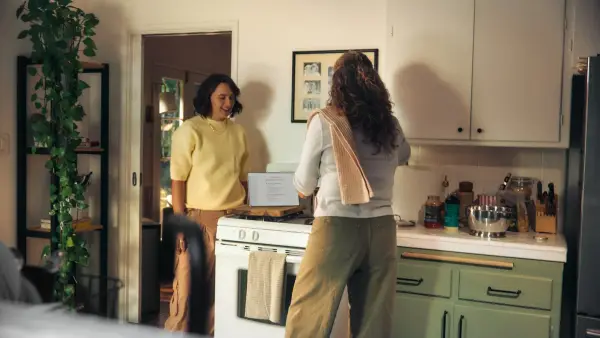
The kitchen belongs to her. Not officially. Not in any way either partner would articulate. But he enters it like a guest - opening cabinets carefully, asking where things go, loading the dishwasher in a way she will later quietly rearrange. He is not incompetent. He is performing the particular competence of a person who learned, years ago, that this territory has already been claimed, and his role is to move through it without disturbing the arrangement.
She doesn’t see it as her kitchen. She sees it as the kitchen. She happens to be the one who knows where everything is, which is not ownership - it’s just memory. But memory, in a long marriage, is a form of sovereignty. The person who remembers where the cinnamon goes is the person who governs the shelf.
The garage is his. The bathroom counter has been divided by an invisible line that both partners respect with the seriousness of a ceasefire. The thermostat is contested territory - a demilitarized zone where neither side has fully conceded.
These arrangements are not trivial. They are the physical manifestation of every compromise that never got spoken aloud. Every time one person moved their things to make room, every time one person stopped reaching for the remote, every time one person started automatically sitting in the same chair at the table - a small piece of selfhood was offered up to the marriage and absorbed into its geography.
The car knows who drives
My friend Catherine told me something once that I haven’t stopped thinking about.
She said that after thirty-two years of marriage, she realized she had not driven anywhere with her husband in the passenger seat in over a decade. He drives. He always drives. She couldn’t remember the last time she’d adjusted the mirrors.
It wasn’t that she couldn’t drive. She drives perfectly well on her own - to work, to her sister’s house, to the grocery store. But when they are together, she walks to the passenger side the way water flows downhill. Without thinking. Without choosing. Without friction.
She told me it bothered her, but only abstractly. In practice, it felt fine. It felt like nothing. That was what bothered her most - that she couldn’t locate the feeling she thought she should have about it. The loss of something she’d stopped noticing she’d given up.
This is the particular cruelty of spatial negotiation in a long relationship. The concessions don’t feel like concessions. They feel like preferences. I prefer the left side of the bed. I prefer to sit in the passenger seat. I prefer to let him handle the thermostat.
But preference, examined closely, is often just the scar tissue of a negotiation so old you’ve forgotten the wound.
The body remembers what the mind files away
Dr. Esther Perel has written extensively about how long-term couples develop what she calls “the most elaborate system of checks and balances since the U.S. Constitution.” She’s talking about the emotional negotiations. But the physical ones are just as intricate - and in some ways more revealing, because they bypass language entirely.
Your body knows things about your marriage that your mind hasn’t processed.
It knows which side of the couch is yours. It knows the exact distance to maintain while walking together - not too close, not too far, calibrated over decades to a spacing that communicates we are together without requiring contact. It knows whether you reach for each other in sleep or drift to separate edges. It knows the choreography of the bathroom in the morning - who showers first, who uses the mirror when, the precise ballet of two bodies in a small space, rehearsed so thoroughly that any deviation feels like a disruption.
A 2022 study in Psychological Science examined how couples’ bodies synchronize over time - heartbeats aligning during proximity, breathing patterns matching during sleep, even pain thresholds shifting in tandem. The researchers called it “physiological linkage.” But what struck me was a detail buried in the methodology: the synchronization was strongest in couples who reported the highest relationship satisfaction, and it was entirely unconscious. The bodies were in conversation. The minds were elsewhere.
This is the strange paradox of a long marriage. The longer you share space, the more fluently your bodies communicate. And the less your conscious minds participate in the conversation.
Where did I go
There is a version of this essay that is purely tender. That celebrates the beautiful choreography of a shared life, the wordless coordination, the way two people can build an entire civilization of small arrangements and inhabit it together for decades.
I want to write that version. Part of me believes it.
But there is another part - the part that wakes up at 3 a.m. on the left side of the bed and wonders when the last time was that she chose something in this room. Not accommodated. Not adjusted to. Chose.
The pillow is hers. But she bought it because his preferred pillow firmness left her neck aching, and she adapted. The nightstand arrangement is hers. But she cleared half of it five years ago to make room for his CPAP machine, and never reclaimed the space. The reading lamp is on her side. But she reads on her phone now, in the dark, because the lamp wakes him, and at some point she stopped minding.
These are not complaints. That is precisely the problem. They are not anything. They are the absence of insistence. The gradual, imperceptible retreat from I want this to this is fine, repeated across every surface of a shared life until fine becomes true, and you can no longer remember what you wanted before you started adjusting.
Research by psychologist Eli Finkel at Northwestern University describes what he calls the “suffocation model” of marriage - the idea that modern marriages carry an unprecedented burden of expectation, and that many couples respond by slowly lowering their demands rather than voicing them. Not in dramatic acts of surrender. In tiny, daily spatial concessions. Moving your things. Adjusting your sleep position. Learning to want what’s available.
The bed doesn’t change. You change around it.
The last unspoken negotiation
I have been thinking about why the bed sides never switch.
Couples renovate kitchens. They move to new cities. They survive affairs, illnesses, decades of transformation that would make their younger selves unrecognizable. But the bed sides remain fixed. Left and right, permanent as compass points.
I think it’s because the bed sides were the first agreement. The ur-negotiation. The foundational treaty upon which every subsequent arrangement was built. To change them now would be to admit that the whole architecture is arbitrary. That every accommodation was a choice, not an inevitability. And that admission would crack something open that most marriages cannot afford to examine too closely.
Because if you could have slept on the other side - if either of you could have, at any point in thirty years - then everything that followed was not fate. It was just two people, slowly reshaping themselves around each other, until the shapes became permanent and the reshaping became invisible.
That is not a tragedy. But it is not nothing, either.
What the pillow knows
If you are reading this and you sleep on the same side you’ve always slept on, I am not telling you to switch.
I am not telling you that your marriage is a series of losses catalogued in furniture placement and driving habits. I am not telling you that the kitchen doesn’t belong to whoever organized it, or that the car should have two drivers, or that the thermostat should be set by committee.
I am telling you that the next time you lie down on your side of the bed - the side you didn’t choose, the side that chose you, the side you’ve occupied for so long it feels like a fact about the universe rather than a decision made one Tuesday in 1994 - you might let yourself feel the weight of that.
Not as grief. Not as resentment. Just as recognition.
You built something. Both of you did. You built it out of a thousand concessions that felt like nothing, out of spatial negotiations that never had words, out of bodies learning to share a room and a life and a bed without ever discussing the terms.
That is not a small thing. That is the whole thing.
And you are still there. Still on your side. Still reaching for the lamp that isn’t there anymore, or the pillow that used to be different, or the person beside you whose breathing you know better than your own.
The bed remembers everything you agreed to. Even the things you’ve forgotten. Especially those.