There are fathers who have memorized the sound of their adult children's cars pulling into the driveway and who stand at the window for exactly three seconds before going back to their chair so they will not be caught waiting, because a man who spent thirty years being the person everyone leaves learned that the sound of someone returning is the only prayer his body knows how to answer
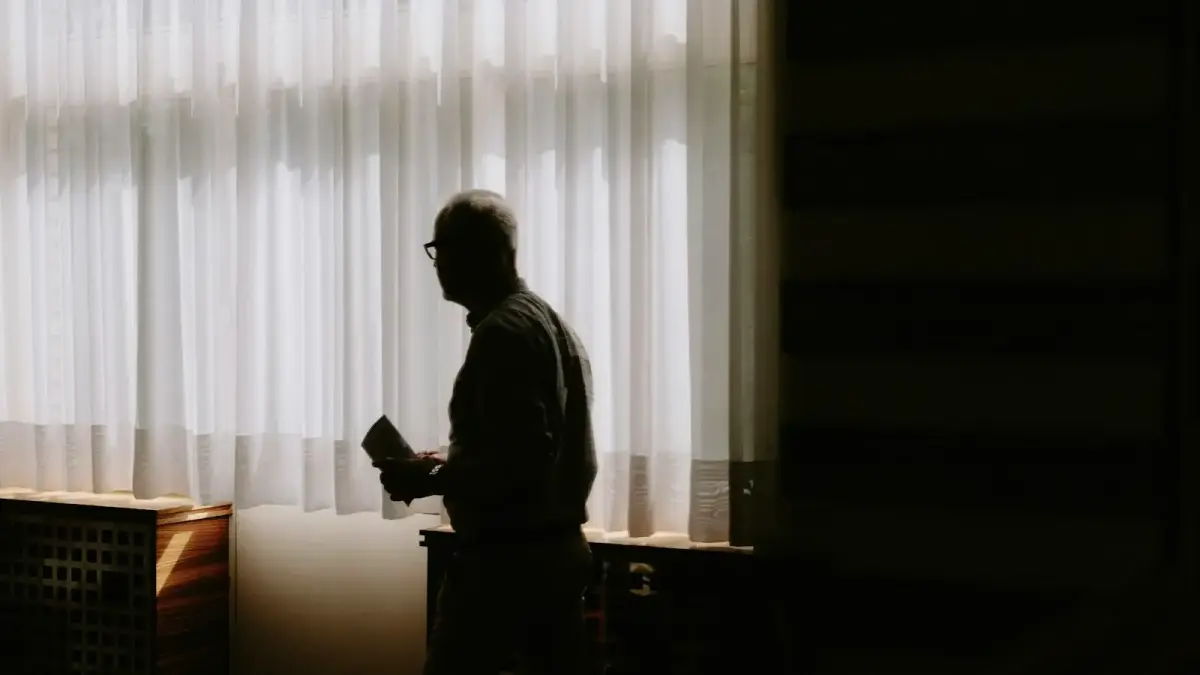
He knows your engine the way other people know voices
My father never said he missed me. Not once in the twelve years since I moved out.
But my mother told me something that I haven’t been able to stop thinking about. She said that on Sundays - the days I usually visit - he turns the television volume down around two o’clock. Not off. Just down. Enough that he could hear a car pulling onto their street if one happened to arrive.
She said he’s been doing it for years.
I don’t know what to do with that information. I’ve carried it around like something fragile, something I’m afraid to hold too tightly because it might change shape if I examine it. My father - the man who greets me at the door with “Oh, hey, didn’t know you were coming by” even when we confirmed it that morning - has been quietly arranging the acoustics of his Sunday afternoons around the possibility of my arrival.
And I think there are a lot of fathers like him.
The empty nest is a listening room
When your children leave, the house doesn’t just get quieter. It gets louder in all the wrong places.
The refrigerator hum you never noticed. The settling of walls at night. The particular silence of a hallway that used to absorb the sound of footsteps and now just holds still air.
A 2019 study published in the Journal of Family Psychology found that fathers report higher levels of grief during the empty nest transition than previously understood, but they express it almost exclusively through behavioral changes rather than verbal disclosure. They don’t say “I miss my children.” They rearrange their routines around the ghost schedules of people who no longer live there.
They sit in the chair that faces the window. They take the dog out at the exact time their daughter used to come home from practice - seven years after she stopped coming home from practice. They develop a sudden interest in yard work that positions them near the driveway.
The empty nest isn’t empty. It’s full of listening.
A father’s body learns the acoustic signature of his household the way a musician learns a song. Every engine, every door, every footfall on the porch steps gets cataloged somewhere below language. And when those sounds disappear, the catalog doesn’t delete itself. It just keeps searching.
The difference between leaving sounds and returning sounds
There’s something I’ve never seen anyone talk about, and it’s this: for a father, leaving sounds and returning sounds are completely different instruments.
A car backing out of a driveway is a slow extraction. You hear the engine catch, the shift into reverse, the gradual fade. It’s a sound that gets quieter. It diminishes. And a father standing at a kitchen window with his coffee learns to hold very still during that diminishing, because if his child looks in the rearview mirror and sees him watching, it becomes a scene. It becomes weight. It becomes something his kid has to carry.
So he learns not to watch.
But a car pulling in - that sound builds. It gets louder. It arrives. And that arrival triggers something in a father’s nervous system that I think he would be embarrassed to name. Something close to relief. Something closer to answered prayer.
The psychiatrist and researcher Daniel Siegel has written extensively about how our attachment systems remain active throughout the lifespan - we never outgrow the neurological response to reunion with people we love. For fathers who were raised in generations that treated emotional expression as a kind of weakness, that reunion response has to go somewhere. It can’t come out as words. It can’t come out as a hug that lasts too long.
So it comes out as listening.
It comes out as knowing the difference between a Honda Civic and a Toyota Camry at two hundred yards. It comes out as a body that goes still when it hears tires on gravel.
The performance of casualness
Here is the choreography, and I think you’ll recognize it.
He hears the car. He stands - not quickly, not urgently, but with a kind of controlled nonchalance that has been rehearsed by years of practice. He moves to the window. He looks out for two, maybe three seconds. Just long enough to confirm.
Then he goes back to his chair.
When you walk in, he’s sitting. Reading something. Watching something. Doing something that suggests he was absorbed in his own life and your arrival is a pleasant interruption rather than the event he’s been orienting his entire afternoon around.
“Oh, hey. Didn’t hear you pull up.”
This is the lie. This is the beautiful, careful, architecturally precise lie that fathers tell because the truth - “I’ve been listening for your car for forty-five minutes and the sound of your engine in the driveway is the best thing that has happened to me all week” - would violate every rule of masculine performance they were taught.
A 2021 study in Psychology of Men and Masculinities found that men over fifty frequently use what researchers call “covert emotional monitoring” - tracking the wellbeing and proximity of loved ones through indirect behavioral observation rather than direct inquiry. They don’t call to ask how you’re doing. They check whether your car is in the driveway when they drive past your apartment. They notice whether you texted your mother back. They keep a quiet census.
The casualness is the costume. The listening is the man.
What thirty years of being the person everyone leaves does to a body
Think about the trajectory of fatherhood for a moment.
You spend the first years holding someone who can’t leave. An infant in your arms, a toddler on your hip, a child who reaches for your hand in parking lots. The physics of early parenthood are centripetal - everything moves toward you.
Then it reverses.
The teenager who needs the car keys. The eighteen-year-old loading boxes into a dorm room. The twenty-five-year-old whose visits get spaced further and further apart until they follow a calendar you have no say in.
Fatherhood, after a certain point, is the practice of being left. And not left with cruelty or intention - left with the healthy, necessary momentum of children becoming adults. But the body doesn’t parse intention. The body just registers departure.
Psychologist and author Adam Grant has written about how humans are meaning-making creatures who develop rituals around their most significant emotional experiences. For a father, the ritual becomes the vigil. The chair by the window. The volume turned down on the television. The ears tuned to the specific frequency of a familiar engine.
He has been left so many times - not abandoned, just graduated from - that the sound of someone returning became sacred. Not in a way he would ever articulate. But in a way his body rehearses every Sunday at two o’clock.
The children who learned to listen from the fathers who listened first
Here’s what I didn’t expect when I started thinking about this.
I realized I do it too.
When my partner comes home from work, I register the sound of her car before I register anything else. The slam of the door. The particular rhythm of her keys in the lock. I have a full-body response to the sound of someone I love arriving, and I never once learned it consciously.
I learned it from watching a man pretend he wasn’t listening.
This is how love transmits in families that don’t have the vocabulary for it. Not through conversations or declarations or any of the things we’re told healthy families are supposed to do. Through frequency. Through attention disguised as inattention. Through a father whose ears were always tuned to the driveway even when his mouth was tuned to the weather or the ball game or some neutral territory that wouldn’t betray how much he cared.
A 2022 study in Frontiers in Psychology found that children of emotionally reserved parents often develop heightened sensitivity to nonverbal cues - they become, in effect, translators of silence. They learn to read love not from what is said but from what is attended to. The volume turned down. The chair repositioned. The tiny, invisible adjustments a person makes when they are waiting for someone they won’t admit they’re waiting for.
We became fluent in the language our fathers couldn’t speak.
The prayer his body knows how to answer
I called my father last week. Just to talk. He picked up on the second ring, which means he had the phone nearby, which means nothing and everything.
We talked about the weather. We talked about his tomato plants. We talked about a documentary he’d watched about bridges - he’s always liked bridges, the engineering of them, the way they solve the problem of separation.
I didn’t say “I know you listen for my car.” He didn’t say “I’ve been waiting for you to call.”
We just stayed on the line a little longer than we needed to, two men performing casualness across thirty miles of telephone wire, both of us listening past the words for the thing underneath.
If you have a father like this - a man whose love lives in the architecture of his attention rather than the vocabulary of his speech - I want you to know something. He hears you. He has always heard you. Not just your car in the driveway but you, the full fact of you, the sound your life makes as it moves through the world.
And every time you return - to his house, to his phone, to his orbit - something in him answers. Something that has been waiting. Something that would never call itself love because that word feels too exposed, too unprotected, too much like standing at the window where someone might see you.
But it is love. It has always been love.
The listening was never casual. And neither was the man.