There is a generation of fathers who showed love by fixing things, the broken faucet and the squeaking door and the car that wouldn't start, and now find themselves at seventy in houses with adult children who don't need anything fixed, and don't know how to say I love you in any language other than the one nobody is asking for
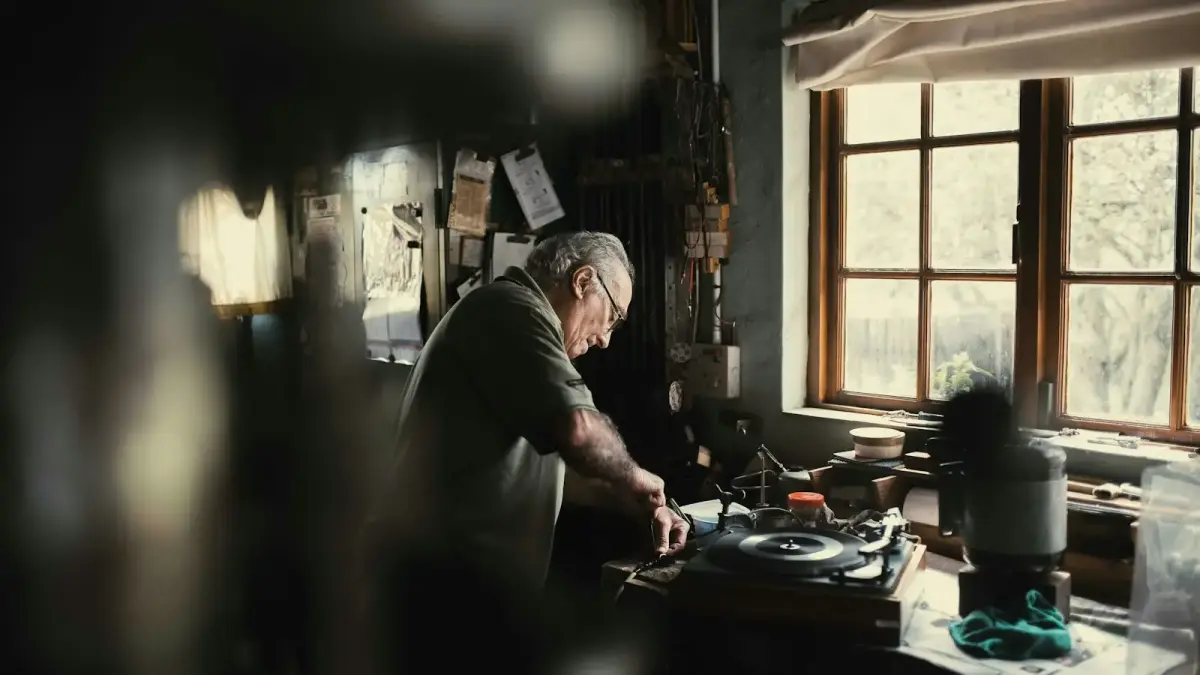
My father is seventy-two, and last Sunday I watched him walk three times around my kitchen before he found a reason to open the cabinet under the sink.
There was nothing wrong under there. He knew it. I knew it. But he got down on his knees anyway, in that stiff way men his age move now, and he looked at the pipes for a long time before he said, “Your trap’s fine. You’re good.”
Then he stood up, and we stood in the kitchen, and neither of us knew what to say next.
The Language He Was Given
He grew up in a house where his own father didn’t hug him. Not once, as far as he can remember.
What his father did was teach him how to re-wire a lamp, how to change the oil on a ‘67 Dodge, how to shingle a roof in August without losing your footing. Love was a transmission. It passed from hand to hand, through the work.
I think about that a lot now. The men of his generation were not withholding. They were fluent - just in a different vocabulary. A vocabulary of carburetors and crawl spaces and things that could be brought back from the dead with enough patience and the right socket wrench.
The psychologist Terrence Real has written for years about what he calls the “covert depression” of older men, the way a generation was trained to translate everything - grief, fear, tenderness, longing - into action or silence. There was no permission for anything else. There was barely a word for it.
The Workshop as Confession
If you grew up with a father like this, you probably remember the workshop. Or the garage. Or the corner of the basement where the vise was bolted to the bench.
That was the room where he said things he couldn’t say anywhere else.
He’d call you in to hold the flashlight. You’d stand there for an hour, holding the beam on the same spot, and he’d say almost nothing. But somewhere in the middle of it he’d say, “Hand me that half-inch,” and the way he said it - not barking, not hurried - was the closest thing to I’m glad you’re here that he had ever learned how to say.
You knew it. He knew it. Nobody ever named it, because naming it would have broken the spell.
When The House Stops Breaking
And then the strangest thing happens. You grow up.
You move out. You buy your own house, or you rent an apartment where the landlord handles the repairs, or you call a plumber because your time is worth more than the Saturday it would cost you. You marry someone who has her own tools, or you live alone and you figure it out from YouTube.
Suddenly there is nothing for him to fix.
He comes over on Sunday and he walks the perimeter of your life looking for something, anything, that is slightly out of alignment. A door that sticks. A loose hinge on a cupboard. A light switch that hums. He is not being nosy. He is looking for a way in.
A 2018 study published in the journal Psychology of Men and Masculinities found that older men whose identities were built around instrumental caregiving - providing, protecting, repairing - report significantly higher rates of loneliness in retirement, especially once their adult children become self-sufficient. The finding that stayed with me wasn’t the loneliness. It was that most of the men in the study said they still felt the love. They just couldn’t locate a delivery system for it anymore.
The Silence That Follows
This is the part nobody prepares you for, as a son or a daughter.
Your father gets quiet. Not distant - quiet. He calls less. When he visits, he brings a bag of tools he doesn’t open. He asks how the car is running, and you say fine, and there is a pause, and you both feel it.
You might read the pause as disinterest. You might read it as disapproval. You might read it as the slow fade of a man drifting into his own inner world, the way we’re told older men drift.
It’s almost never that. The pause is a man reaching for a tool that isn’t in the drawer anymore.
The researcher Niobe Way, who has spent decades studying emotional connection in men and boys, has described how boys are systematically taught to lose access to their own relational language somewhere around adolescence. What she doesn’t always get asked is what happens to those men at seventy. What happens is this: the language they were given in its place - the language of repair - is suddenly obsolete. And the original language, the tender one, was forgotten so long ago it feels like a foreign country.
What He Is Actually Saying
If your father is the kind of man I’m describing, listen to what he does say. Not what he doesn’t.
When he asks about your tires, he is asking if you are safe. When he asks about your furnace, he is asking if you are warm. When he offers to come over and look at “that thing you mentioned,” he is asking if he can still matter to you. When he brings you a five-dollar flashlight for your glove compartment, he is saying I lie awake sometimes thinking about you driving home in the dark.
I used to roll my eyes at the flashlights. There have been a lot of flashlights.
Now I keep them all. Every one. In a drawer in my kitchen, in my car, in the bag I take when I travel. They are not flashlights. They are sentences he couldn’t finish.
A New Question, For Both Of You
The men of this generation are not going to change, mostly. They are too far down the road for that. Asking a seventy-two-year-old man to suddenly start saying “I love you” is a little like asking him to suddenly start writing poetry in Portuguese. It is not cruelty that stops him. It is the fact that he was never given the pen.
But the question has changed, for those of us who are their children.
The question used to be, why won’t he say it? The better question is, can I learn to hear it when he’s already saying it, in the only vocabulary he knows?
Work by John Gottman and others on what Gottman calls “bids for connection” - those small, easy-to-miss gestures that people make toward each other - has shown that long-term closeness is less about grand declarations and more about whether we notice the small bids and turn toward them. Your father’s bids are shaped like tools. They are shaped like rides to the airport, and checking your oil, and driving forty minutes to stand on your porch and look at a screen door that doesn’t really need fixing.
Turn toward them. That is the whole thing.
The Last Time In The Kitchen
After my father closed the cabinet last Sunday, he washed his hands at the sink. He took a long time at it, which is what he does when he is about to say something and isn’t sure how.
He said, “You know, if you ever need anything, you call.”
I said, “I know, Dad.”
He nodded. He dried his hands on the dish towel. He folded it, badly, and put it back. Then he looked at me for a second longer than he usually does, and I saw it - the whole life, the whole language, the whole generation of men behind him standing in kitchens trying to say something there was never a word for.
I said, “I love you, Dad.”
He said, “Yeah. Drive safe.”
And I understood him completely. He had just said it back.
You’re not broken if your father is like this. He’s not broken either. He is, like so many men of his generation, a whole country of love with no translator at the border. But if you listen carefully - to the flashlights, to the questions about your tires, to the long slow walk around your kitchen - you can hear it.
He has been saying it the whole time.