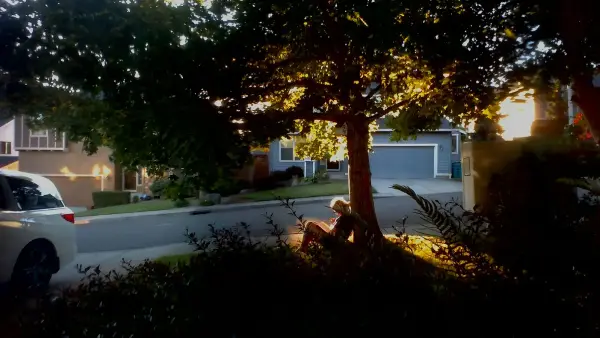
There is a kind of forgiveness that only arrives in your fifties - not the kind you decide on but the kind that happens to you like weather, the morning you realize the person who hurt you twenty years ago has become a story you can tell without your chest tightening, and the woman who spent two decades rehearsing what she would say if she ever saw him again discovers she has nothing left to say, not because she has forgotten but because the anger finally left her body the way guests leave a party - one by one, without announcing their departure, until the room was empty and she was the only one still standing in it

I drove past the restaurant last Tuesday. The one with the blue awning and the cracked parking lot where I once sat in my car for forty-five minutes because I couldn’t stop shaking long enough to turn the key.
That parking lot used to own a piece of me. For years, even the name of the street it was on could tighten something behind my ribs. I’d take alternate routes. I’d change the subject when someone mentioned the neighborhood.
But last Tuesday, I drove past it and felt nothing. Not peace, exactly. Not triumph. Just - nothing. The way you feel about a gas station or a dry cleaner. A building. Concrete and glass and somebody else’s lunch hour.
And I pulled over, not because I was upset, but because the absence of the old feeling was itself a feeling. A strange, quiet disorientation. Like reaching for a suitcase you’ve been carrying for twenty years and finding your hand closing around air.
That’s when I understood something nobody had warned me about. The forgiveness hadn’t arrived because I’d worked on it. It hadn’t arrived because I’d journaled enough or breathed deeply enough or said the right affirmation in the mirror. It arrived the way weather arrives - without asking, without ceremony, while I was busy thinking about what to make for dinner.
The speech that lost its voltage
You know the conversation. You’ve had it a thousand times - in the shower, in the car, at 2 a.m. when the house is dark and your mind won’t stop editing the script.
The one where you finally say everything perfectly. Where every word lands with the weight it deserves. Where the person who hurt you sits in stunned silence while you deliver the closing argument you’ve been rehearsing since before your youngest started school.
I had that speech memorized. I could have performed it on a stage. I knew exactly where to pause, where to let my voice drop, where to look them in the eye and say the thing that would make them understand, finally, what they’d broken.
And then one day, I tried to rehearse it and the words wouldn’t come.
Not because I’d forgotten. I remembered every detail. But the words had lost their voltage. They were just sounds. The way a word stops looking like a word if you stare at it long enough - the meaning drains out and you’re left holding empty letters.
I sat with that emptiness for a long time, trying to feel cheated by it. Trying to be angry that my anger had left without permission.
But you can’t force yourself to feel something that has already packed its bags. I had nothing left to say. Not because the hurt hadn’t been real, but because the version of me who needed to say it had quietly stepped aside for a version who didn’t.
Why it takes the body two decades to reclassify a wound
Here’s what I’ve come to understand about why this kind of forgiveness can’t be rushed - and why it so often arrives in your fifties, not your thirties.
Your brain stores traumatic or deeply painful memories differently than ordinary ones. A 2010 study published in the journal Nature found that emotional memories undergo a process called reconsolidation - each time you recall them, they become briefly unstable, and your brain essentially re-saves them with subtle updates. The memory doesn’t change, but its emotional charge can shift, little by little, each time it’s retrieved and stored again.
This is not something you can accelerate by deciding to feel differently. It is a biological process. It takes the time it takes, the way a bone takes the time it takes to knit.
Psychologist Daniel Goleman has written about how the amygdala - the part of the brain that flags experiences as threats - can hold onto emotional patterns for years, even decades, long after the conscious mind has intellectually moved on. Your thinking brain might understand that the person who hurt you is no longer a danger. But your body keeps responding as though the threat is current, because the amygdala doesn’t read calendars.
A 2019 study in Psychological Science found that older adults show reduced amygdala reactivity to negative emotional stimuli compared to younger adults. The researchers described it as a shift in emotional processing - not numbness, but a natural recalibration. The brain, with enough time and enough distance, begins reclassifying old wounds from “active threat” to “archived history.”
This is why forgiveness at fifty feels different than forgiveness at thirty-five. At thirty-five, you’re still deciding to forgive. You’re using willpower. You’re gripping the wheel with both hands, trying to steer yourself toward something that feels unnatural.
At fifty, the car is parked. You’re just noticing that you forgot to be angry today. And yesterday. And the day before that.
The quiet grief of putting the anger down
Nobody tells you about this part.
The part where the anger leaving feels like a loss.
Because the anger was yours. It was reliable. It showed up every morning and gave you something to hold onto when everything else felt uncertain. The anger was proof that you had been wronged, that the hurt was real, that you weren’t making it up.
Brene Brown has spoken about how some of us use anger as armor - a way to avoid the more vulnerable emotions underneath. And she’s right. But she’s also describing something more tender than she maybe intended. Because armor isn’t just protection. Armor is company. It’s the thing that stands between you and the quiet.
When the anger left, I grieved it. Not dramatically. Not with tears or a breakdown. But with the low, persistent hum of something missing. The way you feel when a neighbor you never liked moves away and you realize, to your surprise, that you’d grown accustomed to the sound of their dog barking at six in the morning.
The anger had become part of my identity. I was the woman who’d been hurt by that person. I was the one who carried that story. Without it, I had to figure out who I was in the absence of the wound.
And that, I think, is why so many people resist forgiveness even when they say they want it. Not because they enjoy being angry. But because the anger has become structural. It’s load-bearing. Pull it out and you have to figure out what else will hold the ceiling up.
At fifty-three, I discovered that the ceiling holds itself. It always did. The anger was never structural. It just felt that way because it had been there so long I’d stopped noticing it was separate from the walls.
The forgiveness nobody posts about
The version of forgiveness you see online is loud. It’s a declaration. “I forgive you - not for you, but for me.” It’s a woman in soft lighting with her journal, eyes closed, releasing something ceremonially into the universe.
And I don’t begrudge anyone that version. If ritual helps, do the ritual.
But that’s not the forgiveness I’m talking about.
The forgiveness I’m talking about is the kind that never makes it onto a vision board. It doesn’t photograph well. There’s no moment of catharsis, no dramatic exhale, no soundtrack.
A 2015 study published in the Journal of Personality and Social Psychology found that what the researchers called “decisional forgiveness” - the conscious choice to forgive - is psychologically distinct from “emotional forgiveness” - the gradual, often involuntary release of negative emotions toward someone who hurt you. The study found that emotional forgiveness was far more strongly associated with long-term well-being, but it was also far less controllable. You couldn’t schedule it. You couldn’t will it into being.
It just arrived. Or it didn’t.
The forgiveness I experienced didn’t require the other person to apologize. It didn’t require them to change, or to understand what they’d done, or even to be alive. It had nothing to do with them at all.
It was my nervous system finally completing a process it had started years ago. It was my body deciding, on its own timeline and without consulting me, that it was finished carrying something it no longer needed.
You don’t get credit for this kind of forgiveness. You don’t get to feel noble about it. It’s not a moral achievement. It’s more like a season changing. You didn’t make spring come. You just woke up one morning and the ground was soft.
The woman who stayed after the room emptied
I think about this sometimes - the image of anger leaving the way guests leave a party. One by one. Without announcing their departure.
First the sharp, hot fury goes. That one leaves early, usually within the first few years. It’s too exhausting to sustain.
Then the fantasies of confrontation slip out. The rehearsed speeches lose their edges. The imagined conversations become less frequent, then sporadic, then gone.
Then the physical responses fade. The tightened jaw when someone says their name. The shallow breathing when you pass through the old neighborhood. These leave slowly, so slowly you don’t notice until they’ve been absent for months.
And one day you’re standing in the room alone. The party is over. The anger is gone. All of it. And you’re still here.
Not because you’re strong. Not because you did the work. Not because you read the right book or followed the right practice.
Because you lived long enough. Because your body is wise in ways your mind will never fully understand. Because time is not a healer - time is a remodeler. It doesn’t fix what was broken. It builds something new around the break, until the break is still there but the structure no longer depends on it.
If you’re reading this at forty-two, still carrying the anger, still rehearsing the speech, still flinching when you drive past the building - I’m not going to tell you to let go. That advice is useless. You can’t let go of something your body isn’t finished processing.
But I will tell you this. One morning, you will wake up and it will be gone. Not because you conquered it. Because it completed itself. Because the anger ran its course the way a fever runs its course, and what’s left on the other side is not emptiness but an ordinary Tuesday morning where a restaurant is just a restaurant and a parking lot is just a parking lot and the story you once couldn’t tell without shaking is just a story now - one you can hold gently, the way you hold an old photograph of someone you loved a long time ago in a life that barely resembles this one.
You didn’t become a better person. You became a lighter one. And that is enough.