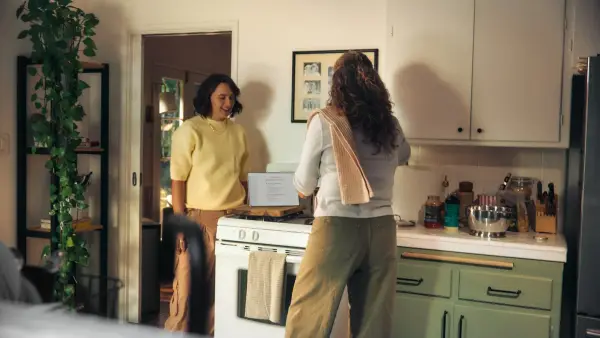
There is a kind of friendship that only exists between two women who raised their children on the same street at the same time, who never called it love but held each other's lives together through school runs and whispered conversations over garden fences, and the grief nobody warned them about was not the children leaving but that without them there was no longer a reason to knock on each other's door at nine in the morning
She was the first person I told
I remember the morning I found out I was pregnant with my second. I hadn’t even told my mother yet. I hadn’t told my husband - he was away for work, unreachable until the evening. But I walked across the street at seven forty-five in the morning, still in my dressing gown, and knocked on her door.
She opened it with a toddler on her hip and a piece of toast in her hand. I said, “I think I’m pregnant again.” She said, “I’ll put the kettle on.”
That was it. No fanfare. No occasion. Just two women in a kitchen that smelled like jam and milk, sitting with something enormous between them, treating it like it was ordinary. Because between us, everything enormous was treated as ordinary. That was the whole architecture of the thing.
I have never loved anyone the way I loved her during those years. And I never once called it love.
The friendship that has no name
There is a kind of intimacy that builds between women who are raising small children in close proximity. It doesn’t announce itself. It doesn’t arrive with declarations or grand gestures. It accumulates - like sediment, like the slow layering of years against riverbed stone.
It’s the borrowed cup of flour at four in the afternoon. The text message that says “mine won’t stop crying, yours?” The standing arrangement that needs no arrangement - school drop-off, alternating Tuesdays, the unspoken agreement that if one of you is having a bad morning, the other one takes all the children without asking why.
A 2021 study published in the Journal of Social and Personal Relationships found that women’s closest friendships are often maintained through what researchers call “everyday talk” - the mundane, repetitive exchanges that don’t register as emotionally significant but form the deepest relational bonds. These friendships rarely look dramatic from the outside. They look like logistics.
But they are not logistics. They are love wearing the disguise of routine.
We built our closeness inside the domestic
Nobody teaches you this. Nobody warns you that the most profound relationship of your adult life might be the woman three doors down who you see every single day for fifteen years and never once have dinner with in a restaurant.
You don’t go on holiday together. You don’t have “girls’ nights.” You don’t post about each other on social media. What you have is less photogenic and more essential than any of that.
You have the nine o’clock knock. The “I’m just popping over” that means I need to be in a room with someone who knows me. The ten-minute conversation at the garden fence that somehow holds more truth than anything you’ve said to anyone else that week.
You have the way she noticed you’d been crying before you said a word. The way you noticed her husband’s car wasn’t in the drive for three nights running and you didn’t ask, but you brought round a lasagne. The way neither of you ever demanded the other explain herself. You just showed up. Over and over. For years.
Brene Brown has written extensively about how vulnerability is the birthplace of connection. But what she doesn’t always say is that for many women, vulnerability doesn’t look like a brave confession. It looks like letting someone see you in your dressing gown at seven in the morning with unwashed hair and a screaming child. It looks like not performing competence. It looks like proximity without pretense.
That was us. That was all of us on that street.
The children were the excuse, not the reason
Here’s what nobody tells you about these friendships. They are structured entirely by circumstance. The school run. The playdate. The after-school pickup. The summer afternoon when all the kids are in one garden and all the mothers are sitting on someone’s patio with cold tea they keep forgetting to drink.
You think the friendship exists because of these things. You think it’s a convenience, a byproduct, a pleasant side effect of living where you live and having children the same age.
You don’t realize until it’s gone that the children were never the reason. They were the permission.
They were the socially acceptable excuse to need someone every single day. To show up unannounced. To be entangled in someone else’s life without it seeming strange or excessive or too much.
A 2019 study in Developmental Psychology found that the transition to the empty nest affects women’s social networks more profoundly than previously understood - not because women lose interest in friendship, but because the logistical scaffolding that supported daily contact simply disappears. Without the school run, there is no natural reason to see each other at eight fifteen every morning. Without the children’s friendships overlapping, there is no excuse for the nine o’clock knock.
And so the knocking stops. Not because the love stopped. Because the architecture collapsed.
The grief that has no language
When my youngest left for university, people asked me how I was coping. They meant - are you sad about your child? Are you lonely in the house? Have you found new hobbies?
Nobody asked me about her. Nobody asked me about the woman across the street whose door I hadn’t knocked on in three weeks because I no longer had a reason to.
I grieved that silence more than I grieved the empty bedroom. I’m not sure I’ve ever admitted that before.
But it’s true. The loss of my children was expected. It was celebrated, even - a milestone, a success, proof that we’d done our jobs. There were cards. There were rituals. There was a cultural script for that grief.
There is no cultural script for the loss of a friendship that was never named as a friendship. There is no language for mourning a closeness that existed entirely inside domestic labor. There is no card that says, “I’m sorry you no longer have an excuse to need each other every day.”
Susan Cain writes about how our culture dramatically undervalues quiet, sustained forms of connection. We celebrate the dramatic - the grand reunion, the lifelong best friend, the soul sister. But we have almost no recognition for the woman who held your life together for fifteen years through nothing more spectacular than showing up.
What it actually was
I’ll tell you what it was. It was the deepest, most sustaining relationship of my adult life. It was partnership without the word. It was devotion without the performance. It was love expressed entirely through presence and repetition and showing up with a lasagne when things looked wrong.
It was raising children together in the truest sense - not co-parenting, not a commune, but something more subtle. A shared witnessing. A mutual agreement to not let the other one drown.
And it was invisible. Entirely invisible. To our husbands, to our families, to the culture at large. Because women’s domestic labor is invisible. And the love that lives inside that labor is invisible too.
We never called it anything. We never had to.
The door is still there
If you are reading this and you recognize it - if there is a woman on your street or in your past whose absence you have grieved without anyone understanding why - I want you to know something.
You are not being dramatic. You are not being silly. You did not lose a casual acquaintance. You lost a form of love that our culture has never bothered to name.
A 2023 study in Frontiers in Psychology found that women who maintained close neighborhood friendships during their child-rearing years reported significantly higher wellbeing and lower rates of depression than those who didn’t - and that the dissolution of these friendships during the empty nest transition was associated with a grief response comparable to other significant losses.
It was real. It was love. It counted.
And here’s the other thing I want to say, gently, because I had to learn it myself. The children were the excuse. They were never the only possible excuse. The door is still there. The fence is still there. The kettle still works.
You are allowed to knock on someone’s door at nine in the morning for no reason at all. You are allowed to need someone without a child-shaped justification. You are allowed to say, “I miss you. I miss us. I miss the ordinary way we used to hold each other’s days.”
You don’t need a reason. You never did. You just thought you did.
And maybe she’s been waiting for you to knock. Maybe she’s been standing in her kitchen every morning, looking at the door, wondering if it would be strange to walk across the street with no excuse, no borrowed sugar, no child in tow.
Maybe the only thing that’s missing is one of you deciding that the love was real enough to survive without its scaffolding.
I think it was. I think it is.