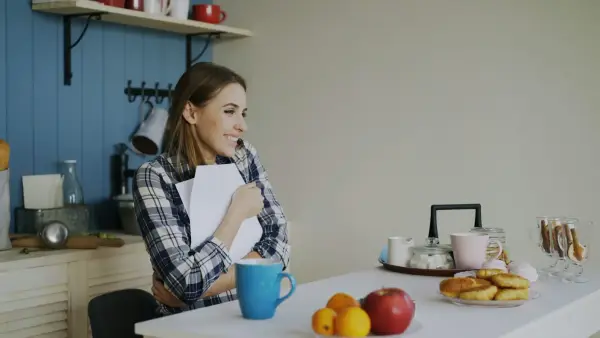
There is a generation of women who spent forty years telling themselves that once the children were grown and the husband was retired and the house was finally theirs again they would finally learn how to want something just for themselves, and are only now, at sixty-seven, beginning to suspect that the waiting itself became the shape of who they were, and that a woman who has not practiced wanting in four decades does not remember how
It is a Tuesday morning in early April, a little after ten, and she is sitting at her own kitchen table with a second cup of coffee that has gone slightly cool in her hands.
Her husband is on a golf trip in Arizona and will not be back until Thursday. Her daughter in Portland is doing fine. Her son in Denver is doing fine.
The dog is asleep on the rug by the back door, the way he always is at this hour, one ear twitching at nothing. The phone on the counter is silent. The dishwasher is silent. The whole long Tuesday stretches out in front of her like a field with no fence around it.
She has been waiting for this morning, or a morning exactly like it, for thirty-five years.
And she is sitting here thinking, with a quiet kind of panic that does not yet have a name, that she does not actually know what she wants to do today.
Not in the cheerful sense of “so many choices, where to begin.” In the real sense. She has asked herself the question, honestly, the way you might ask a friend, and the part of her that used to answer has not answered in a long time.
She looks out the window at the back garden, the one she put in the spring of 1992 when the kids were small, and she realizes with a soft startle that she is sixty-seven years old and she has no earthly idea what to do inside this morning she has been waiting for her whole adult life.
The promise you made yourself at thirty-three
There was a promise. You remember making it, even if you never said it out loud. It was a quiet promise, folded into a dish towel somewhere around the age of thirty-three, and it went something like this.
When the kids are grown. When the house is paid off. When he retires. When there is finally time.
You were going to read all those books that had been stacking up on the nightstand. You were going to take that painting class at the community college. You were going to walk on the beach in the mornings.
You were going to finally know yourself.
The woman making that promise was not lying to herself. She was planning. She was throwing a rope forward into her own future and tying the other end around the ankle of some later, freer version of herself who would catch it and haul her in.
What she did not know, because nobody told her and there was no way to know, was that wanting for yourself is a muscle. And muscles you do not use for forty years do not simply snap back into shape the morning you decide to need them.
The one skill she did not get to practice in those four decades was the very one she was going to need most on the Tuesday the promise came due.
Why wanting for yourself is a skill, and why it atrophies
Here is the gentle physiology of it, the part nobody explains to you.
The pathways in your brain that light up when you ask “what do I want” are like any other pathway. They get stronger with use. They get quieter with disuse. They are shaped by what you practice.
When a woman spends forty years asking, morning after morning, “what does the baby need, what does my mother need, what does my husband need, what does my boss need, what does this dinner need, what does this family need” - her wanting system does not die. It is not gone. It waits.
But it has not been spoken to in a very long time.
And when she finally turns to it at sixty-seven, sitting at her kitchen table, and says softly, “and what about you, what do you want” - the part of her that used to answer looks up slowly, the way a child looks up when she is told after thirty years of silence that she is allowed to speak again. Uncertain. Half-awake. Not sure if the question is a trick.
This is not depression. It is not empty nest syndrome. It is not a failure of imagination or gratitude.
It is something older and more specific than that, and it deserves to be named.
What the research actually knows about this
For decades, researchers who studied women’s inner lives described something they called the “loss of voice” - the way girls around adolescence begin to edit themselves, to silence what they actually think in order to stay connected to the people they love. Carol Gilligan built much of her career on that territory.
What fewer people talk about is the long version of the same story. The one that happens across a whole adult life.
A 2014 paper in Psychology of Women Quarterly examined what the authors called the silenced self in older women, and what they found was tender and specific. Women who had spent the bulk of their adult lives in caregiving roles reported, in their sixties and seventies, a particular kind of interior quiet that was not quite grief and not quite numbness. They still had feelings. They still loved their families. But when researchers asked them what they wanted, they often paused for a long time, and then said something like, “I have not thought about that in a while.”
Laura Carstensen’s work on aging tells us that older adults often become more selective about how they spend their emotional energy, more attuned to what actually matters. That is real. That is a gift.
But selectivity assumes you still remember the language of preference. And for a particular generation of women, the language itself has gotten rusty. Not lost. Rusty. You have not forgotten what a verb is. You have forgotten the word for “I want.”
The specific ways it shows up
It shows up like this.
It shows up in the sixty-seven year old who walks into the self-help section at the bookstore and stands there for twenty minutes, and realizes she has no idea what kind of book she would pick up if nobody was watching her.
It shows up in the seventy year old who signs up for a watercolor class because her daughter suggested it, and goes three times, and then quietly stops going because she realized she was only painting in the class for the same reason she used to cook dinner: because someone was expecting her to.
It shows up in the sixty-five year old who has a streaming subscription and cannot pick a show, because every time she scrolls she feels her hand moving toward the kind of thing her husband would like, and when she tries to pick something for herself her mind simply goes blank, like a radio tuned to static.
It shows up in the woman who is asked what she wants for her birthday and says “oh, I really do not need anything,” and means it, because she has not let herself practice wanting a thing just because she wants it since sometime during the Reagan administration.
These are not character flaws. These are not failures of spirit. These are the behaviors of a woman whose wanting muscle was never allowed to develop strong preferences, because preferences take up space, and the space in her life had to be kept clear for everyone else.
The tenderness of the thing
Here is the part that matters most. Nobody did this to you on purpose.
The men in the story are not villains. Most of them were trying their best in languages nobody had ever taught them. The children are not villains. They were children, and then they were young adults, and then they were grown people with their own lives, which is exactly what you raised them to become.
Nobody sat down in 1978 and decided to erase you. You were doing an enormous, beautiful, impossible thing for forty years, and you did it well. You held entire families steady through more decades than anyone had the courtesy to acknowledge.
What atrophied in you was not your soul. What atrophied was a particular kind of attention to yourself that the culture around you never gave you permission to develop in the first place.
The grief is real. Let it be real. Do not rush past it.
And it is not the end of the story.
The pathway is not gone. It is quiet. It is waiting. And neural pathways that have quieted can, slowly, start lighting up again. Not by “finding your passion.” That language is cruel to a woman in this position, because it demands a size of wanting she does not yet have.
The way back is much smaller than that. It is one question, asked gently, every morning. “What would feel good in the next ten minutes?”
And then the harder part. Listening for the answer. Even if the answer is tiny. Even if the answer is embarrassing. Even if the answer is just “sit in the good chair” or “eat the toast by the window” or “not vacuum today.” Especially then.
That is the first rung.
A Tuesday morning, continued
The coffee is cold now. She has been sitting with the question for almost thirty minutes, which is longer than she has sat with any question about herself in a long time.
She stands up, slowly, the way women her age stand up on cool mornings. She does not turn on the television. She does not pick up the vacuum. She does not check the phone.
She walks into the living room and stops in front of the bookshelf. Her hand moves, uncertain at first, and then settles on a novel she bought in the spring of 2003 and never read, because that was the year her mother got sick and there was no room in her that year for novels.
She carries the book to the couch. She sits down in the same spot she has sat in for twenty-two years, the cushion softened in the exact shape of her.
She opens to the first page.
Somewhere in her chest, very small, some part of her she has not heard from since she was maybe twenty-four, says quietly, “Yes.”
It is not a revelation. It is not a breakthrough. It is one sentence of one book on one ordinary Tuesday, by a woman who chose it because she wanted to and no other reason.
She does not know yet that she is going to read the whole book before the day is out. She does not know that the voice that just said yes is going to get a little braver in the coming weeks, and start making other tiny suggestions, and that she is going to start listening to it the way she used to listen to her babies in the night.
She just knows that the room is quiet, and the light coming through the window is exactly the kind of April light she has always loved without ever once stopping to say so out loud, and the book is open in her lap, and for the first time in forty years she picked a thing because she wanted it.
That is where it starts.