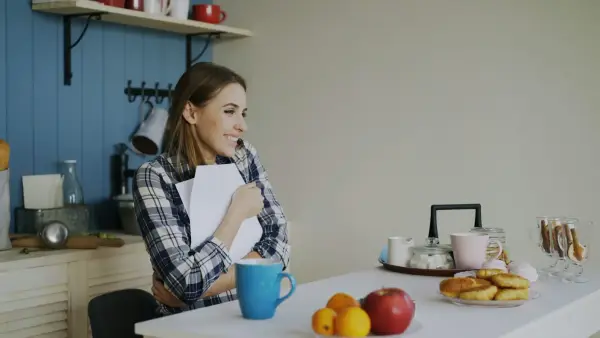
Girls who watched their mothers address every envelope by hand at the kitchen table, with a pen and a stack of Christmas cards and the quiet belief that a typed label meant you didn't care enough to slow down, often become women who cannot send a birthday card with a printed address without feeling they have committed a small act of emotional negligence
I was sitting at my desk last December, printing address labels for holiday cards, when a feeling I can only describe as disloyalty crept up my spine.
The labels were clean. Efficient. Perfectly aligned. And I peeled the first one off the sheet, pressed it onto the envelope, and immediately wanted to peel it back off.
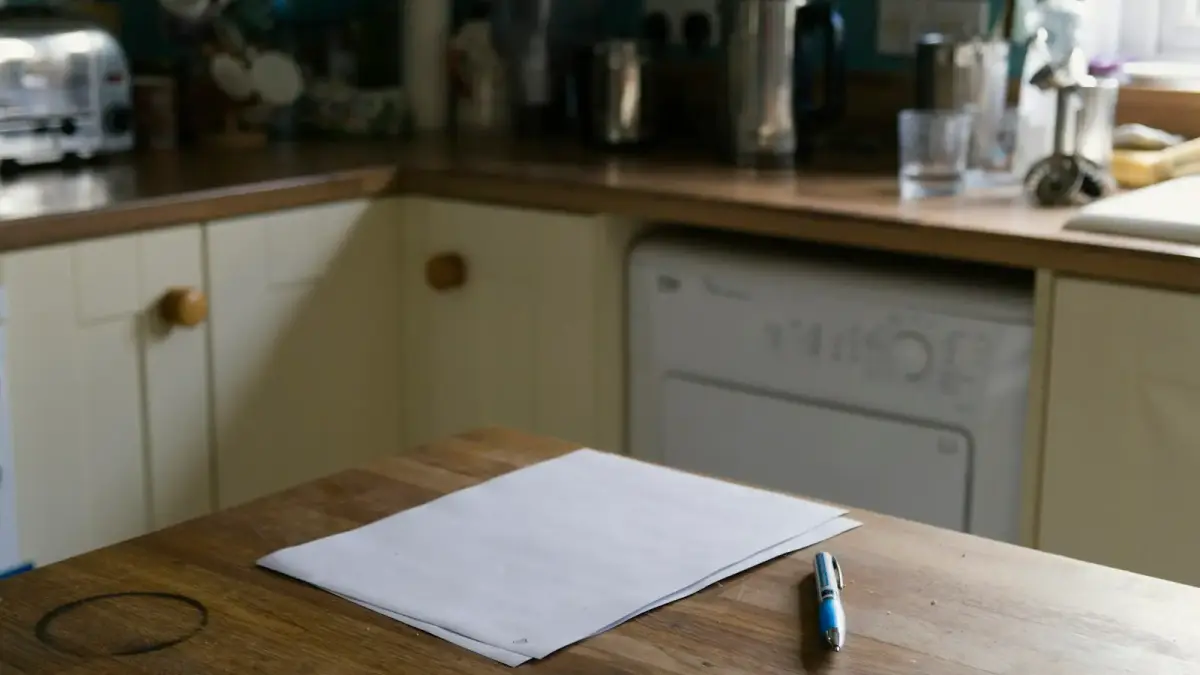
Because somewhere in my body - not my brain, my body - I carry the image of my mother at the kitchen table in early December, hunched over a stack of envelopes with her good pen, writing each name and address in that careful cursive she saved for occasions that mattered. She never once considered printing labels. It would not have occurred to her, the same way it would not have occurred to her to buy a cake for a birthday instead of baking one. Not because she judged people who did. Because for her, the effort was the point.
I am fifty-three years old, and I still handwrite my envelopes. Not because I think it looks better. Not because I am nostalgic for a slower era. Because my mother taught me, without ever saying a word about it, that love is supposed to cost you something visible.
And I have never been able to unlearn it.
The kitchen table classroom
You didn’t know you were being taught. That is the thing about care rituals - they arrive without curriculum.
Your mother didn’t sit you down and explain her philosophy of correspondence. She just did what she did, and you watched from the doorway or from across the table where you were doing homework, and you absorbed it the way children absorb everything - through observation, repetition, and the quiet assumption that the way your family does things is the way things are done.
She sat at the kitchen table. She had her address book - the one with the worn cover and the entries crossed out and rewritten as people moved or died. She had her pen, always a specific pen, never a random one pulled from a junk drawer. And she wrote.
A 2019 study published in the Journal of Family Psychology found that children develop their understanding of relational care primarily through observing parental rituals rather than through direct instruction. The researchers called these “ambient socializations” - lessons absorbed not from what parents say but from what parents repeatedly do.
Your mother’s envelope ritual was ambient socialization at its most potent. She was teaching you a definition of love. Not the dictionary definition. Her definition. The one that said caring should leave evidence. That affection should take time. That if something could be automated but you chose to do it by hand, that choice itself was a form of tenderness.
You learned it perfectly. You learned it so well you cannot unlearn it even now, decades later, when the address book is a contacts app and the pen feels almost ceremonial.
What handwriting actually meant
It was never about penmanship. Your mother was not a calligrapher. Her handwriting was probably inconsistent - tidy on the first ten envelopes, looser by the thirtieth, slightly crooked by the fiftieth.
That inconsistency was the whole point.
Handwriting carries the body’s evidence. It shows that a human hand moved across the paper, that muscles contracted and relaxed, that someone sat still long enough to form each letter individually. It cannot be faked by a machine. It cannot be scaled. And it degrades over time - the writing gets tired as the person gets tired, and that fatigue is itself a kind of proof.
Your mother understood this intuitively. A handwritten address said: I sat down for you. I gave you minutes of my life that I cannot get back. I was inefficient on purpose, because you are worth my inefficiency.
A printed label, by contrast, said nothing at all. It was correct and fast and utterly silent about the person who produced it.
Dr. Brene Brown has written extensively about how vulnerability functions as the foundation of meaningful connection. Your mother’s handwriting was vulnerable in a way a label never could be - it was imperfect, it was exposed, it could be judged. She offered her actual hand to each recipient. That was the gift underneath the card.
The woman at fifty who still reaches for the pen
If you are reading this and recognizing yourself, you are probably somewhere between forty-five and seventy. You have a drawer with good stationery. You know which pen writes smoothly enough for envelopes. You may have even practiced your return address on scrap paper before committing it to the real envelope, the way your mother did.
And you have probably stood in front of a printer, holding a sheet of labels, and felt something tighten in your chest.
Not guilt exactly. Something older than guilt. A sense that using the label would be a betrayal - not of your mother specifically, but of the contract she taught you existed between caring and effort. The contract that said love should be visible, physical, slightly inconvenient.
A 2021 study in Psychological Science examined how individuals internalize parental values around effort and care, finding that adults who grew up watching parents invest physical labor in relational maintenance were significantly more likely to associate emotional authenticity with tangible, time-consuming gestures. The researchers noted that these associations often persisted even when participants intellectually recognized them as unnecessary.
This is you. You know, intellectually, that a printed label does not mean you care less. Your brain understands efficiency. Your hands refuse it.
Because your hands remember your mother’s hands. And your hands believe that love should look like work.
The generational gap that nobody talks about
Your daughter texts “happy birthday” at midnight and means it completely. Your granddaughter sends a gif of a cartoon cake and a heart emoji and feels she has fully expressed her affection.
They are not wrong.
But you cannot make yourself believe they are right, either. And this is the lonely part - the place where generational definitions of love diverge and nobody can convince the other side.
Your children did not sit at the kitchen table watching you address envelopes. Or maybe they did, but they also grew up with email and instant messaging and a thousand ways to reach someone that do not require a stamp. Their definition of care is different. It is not lesser. It is simply calibrated to a different world.
The pain lives in the gap. You watch your daughter send a quick text instead of a card and you feel - what? Not anger. Not disappointment, exactly. More like a low-grade grief for a definition of love that is becoming extinct, and the quiet fear that when it disappears, something real will have been lost.
You cannot explain to her why the handwriting matters without sounding like you are criticizing her. So you say nothing. And you keep handwriting your envelopes, alone now at the kitchen table, performing a ritual that fewer and fewer people recognize as sacred.
The larger inheritance
Envelopes were only the beginning. If your mother taught you that handwriting was caring, she probably also taught you other equations.
That a meal made from scratch meant love, and a meal from a box meant something less. That a gift wrapped in paper you chose carefully - paper that matched, paper with weight to it - communicated more than a gift bag ever could. That a thank-you note written the day after was not optional but moral. That showing up in person when a phone call would do was how you proved someone mattered.
These were not rules she stated. They were rules she performed, hundreds of times, until they became the architecture of your emotional world.
Psychologist Susan Cain has explored how temperament and environment shape our deepest convictions about relationships. The rituals your mother modeled became what researchers in developmental psychology call “relational scripts” - automatic patterns that tell you what caring is supposed to look and feel like. You follow them not because you decided to but because they are embedded in you, the way an accent is embedded in your voice.
And here is the thing nobody tells you about relational scripts: they do not update automatically. The world changes. Communication changes. The cultural definition of “making an effort” changes. But your internal script stays frozen at the kitchen table in 1978, watching your mother pick up her pen.
You are not old-fashioned
I want to say this clearly, because I think you need to hear it.
You are not being sentimental. You are not clinging to the past. You are not making a fuss about nothing.
You are honoring a definition of love that required your mother’s whole body - her hand, her time, her posture bent over the table, her attention held steady for an hour when she could have been doing something easier. You absorbed that definition at an age when you did not yet know there were other options. And it became part of you.
The guilt you feel when you consider a printed label is not irrationality. It is loyalty. Loyalty to a woman who taught you, through the specific movement of her pen across paper, that the people you love deserve your slowness.
Your children will carry different rituals. Maybe they will feel guilty if they do not respond to a text within five minutes. Maybe their version of the kitchen table is the group chat where they show up consistently, day after day, making sure no one feels forgotten. Their love will look different from yours. It will not be less.
But yours - yours with its envelopes and its careful cursive and its quiet insistence that caring should leave a mark on paper - yours is not less either.
The next time you sit down with a pen and a stack of envelopes, know what you are actually doing. You are not addressing mail. You are continuing a conversation with your mother that started before you had words for it. You are saying, with every letter you form: I remember how you showed me what love looks like. I am still doing it your way.
That is not a small act of emotional negligence.
That is one of the most faithful things a daughter can do.