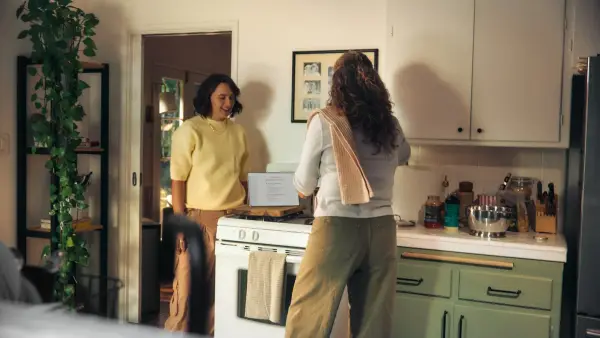
There is a specific kind of exhaustion reserved for the adult child who lives closest to the aging parent, the one who refills the pill organizer and drives to every appointment and notices when the fridge holds three identical cartons of milk, while the sibling three states away calls once a week and still gets told your sister takes such good care of me as though proximity were a personality trait and not a slow, quiet weight no one ever voted on

The one who lives twenty minutes away
I started noticing it on Tuesdays. That was the day I drove to my mother’s house to sort her medications, check that the furnace filter had been changed, and sit with her while she told me the same story about the neighbor’s dog for the third time that week.
It wasn’t the repetition that wore me down. It was the quiet arithmetic I did in the car on the way home - calculating how many hours I’d spent that month in her kitchen versus how many hours my brother had spent on the phone with her, his voice warm and unhurried in a way mine never seemed to be anymore.
He called every Sunday. She talked about those calls like they were visits.
When love becomes logistics
There is a version of caregiving that nobody warns you about. It’s not the dramatic kind - not the hospital vigils or the hard conversations about end-of-life plans. It’s the ordinary, invisible kind that accumulates like dust on a shelf nobody else can see.
It’s noticing that her mail has been piling up by the door. It’s realizing she bought three jars of the same jam because she forgot she already had two. It’s checking the expiration dates on the things in her fridge and throwing away leftovers she’ll never eat but would be upset to know you discarded.
It’s becoming the person who knows which pharmacy has her prescriptions, which doctor wants bloodwork before the next visit, and which pair of shoes she can actually walk safely in on the icy driveway.
You don’t sign up for this. You just happen to live close enough that the role finds you.
The geography of obligation
A 2021 study published in The Gerontologist found that adult children who live within thirty minutes of an aging parent provide, on average, nearly three times more hands-on caregiving hours than siblings who live farther away. The researchers noted something that surprised no one who has lived it - the nearby sibling often reported higher levels of stress, resentment, and emotional fatigue, not because they loved their parent less but because proximity had turned love into labor without anyone formally acknowledging the shift.
Geography becomes destiny in families like this. The child who moved away - for a job, for a partner, for a life that simply unfolded in a different direction - is not wrong for leaving. But the child who stayed, or who moved back, or who simply never left, absorbs a weight that is almost impossible to name because it disguises itself as something voluntary.
No one forced you to check on her every Tuesday. No one asked you to be the one who drives her to the cardiologist. And because no one asked, no one thinks to thank you in the specific, sustained way the work deserves.
The phone call sibling
I want to be careful here because I’m not interested in vilifying the sibling who lives far away. That would be too simple, and it would miss the real wound.
The real wound is not that your brother doesn’t help. It’s that the help he provides - a weekly phone call, a birthday gift ordered online, a visit twice a year where he arrives cheerful and rested and your mother lights up in a way she never seems to when you walk through her door on a rainy Wednesday with groceries - is received as love. Pure, uncomplicated love.
While yours is received as expected.
There is a brutal distinction between being appreciated and being relied upon. Appreciation comes with warmth, with surprise, with gratitude that has some air in it. Reliance comes with silence. It comes with the assumption that you’ll keep doing what you’ve been doing because you always have.
Your mother says your sister takes such good care of me to the sibling who called, and she means it as a compliment. She does not hear what you hear - that your care has become so constant it has turned into background noise. The wallpaper of her daily life. Something she would only notice if it suddenly stopped.
The resentment you’re not supposed to feel
A 2019 study in the Journal of Family Issues found that unequal caregiving distribution among siblings was one of the strongest predictors of lasting family conflict - stronger than disagreements about money, inheritance, or end-of-life decisions. But what the study couldn’t capture was the particular guilt that comes with resenting a situation you technically chose.
Because you did choose it, didn’t you? You could have moved. You could have said no. You could have set boundaries the way the articles tell you to, with clear communication and family meetings and shared Google calendars.
But you know what happens when you try. You’ve had the conversation. You’ve said I need more help and heard I wish I could be there more, you know I would if I could, followed by nothing changing. You’ve suggested hiring someone to help and watched your mother’s face fold in on itself, as though the suggestion itself was a betrayal.
So you keep going. Not because you’re a martyr. Not because you don’t know how to say no. But because the alternative - letting things slip, letting her struggle, letting the mail pile up and the medications get confused - is something you can’t live with. And your sibling, whether they know it or not, is counting on exactly that about you.
The weight of being the one who notices
What nobody tells you is that the hardest part isn’t the driving or the appointments or the groceries. The hardest part is the noticing.
You notice when her handwriting on the birthday card is shakier than last year. You notice when she starts repeating a concern she already mentioned ten minutes ago. You notice when she’s wearing the same blouse three days in a row, or when the house smells faintly different in a way you can’t quite name but that makes your stomach tighten.
You carry this noticing alone. You can call your sibling and report it, but reporting is not the same as seeing. By the time you’ve translated your gut feeling into a sentence on the phone, it has already lost its texture. Your brother hears a fact. You experienced a shift.
Psychologist Pauline Boss, who spent decades researching what she called ambiguous loss, described a particular kind of grief that occurs when someone you love is still physically present but psychologically changed. She found that this grief - unresolved, ongoing, without a clear endpoint - was among the most difficult forms of loss for the human mind to process, precisely because there is no funeral, no closure, no socially recognized moment when people bring you casseroles and say I’m sorry.
You are grieving in the middle of an ongoing Tuesday. And then you go home and make dinner for your own family.
What you deserve to hear
If you are the one who lives closest, I want to tell you something that your family may never say clearly enough.
You are not doing this because you are the most available. You are doing this because you are the most willing to tolerate the discomfort of watching someone you love change in real time. That is not convenience. That is courage.
The resentment you feel toward your sibling is not a character flaw. It is the natural result of an unbalanced equation that everyone in your family can see but no one wants to solve, because solving it would require admitting that the current arrangement is unfair, and admitting that would mean someone else would have to change.
A 2023 study in Psychology and Aging found that caregiving siblings who received even modest acknowledgment of their disproportionate contribution - not more help, just honest recognition - reported significantly lower levels of burnout and depression. The researchers described it as the validation effect. It turns out that what we often need most is not relief from the work but proof that someone sees it.
The conversation that might help
If you’re reading this and you’re the sibling who lives far away, I’m not writing this to make you feel guilty. Guilt doesn’t help anyone, and distance doesn’t make you a bad person.
But I am asking you to do something that costs nothing and changes everything. Call your sibling - not your parent, your sibling - and say this: I know you’re carrying more than I am. I see it. I’m not going to pretend the arrangement is equal because it isn’t, and I don’t want you to feel like you have to perform being fine about it.
That sentence, spoken honestly, will do more than a dozen offers to “help with anything you need.” Because the person who lives twenty minutes away has been needing something very specific for a very long time.
They need someone to stop treating their sacrifice as a personality trait and start treating it as what it is - a gift that has a cost, given daily, to someone who may never fully understand what it takes.
You are not the only one
If you are sitting in your car outside your parent’s house right now, engine running, forehead against the steering wheel, gathering yourself before you drive home - you are not alone in this.
Millions of people are doing exactly what you’re doing. Showing up on Tuesdays. Sorting pills. Throwing away expired milk. Carrying the kind of love that looks, from the outside, like an errand.
It is not an errand. It is the most intimate, thankless, necessary form of devotion, and the fact that it exhausts you does not mean you’re failing at it.
It means you’re human. And you’re doing something that matters more than anyone in your family has figured out how to say.