He's 58 and has just realized every compliment he ever received from another man came disguised as an insult, because boys who grew up in the seventies learned admiration between men had to be wrapped in mockery or it became something dangerous
The last thing I said to him was “don’t die on me, you miserable bastard”
He laughed. I laughed. The nurses looked uncomfortable. And three weeks later, when I stood in a suit I hadn’t worn since my daughter’s wedding and listened to his wife describe a man I recognized but had never once described out loud myself, I kept thinking about that sentence.
Don’t die on me, you miserable bastard.
I meant: You are one of maybe four people on this earth who actually know me. I meant: I am terrified of what my life looks like without you in it. I meant: I love you and I have never once said that to you plainly and I am running out of time to figure out how.
But what came out was “miserable bastard.” Because that’s the language. That’s the only language I was ever given.
I’m 58 years old, and I have just started to understand that every moment of genuine affection in my closest male friendships has arrived wearing a disguise. Every compliment came wrapped in an insult. Every expression of care was delivered as a joke. And the man who understood that code better than anyone - who could hear “you look terrible” and know it meant “I’m worried about you” - is gone. And I never once gave him the plain-text version.
We learned the rules before we had words for them
I grew up in the late seventies in a suburb where the fathers came home from work, sat in their chairs, and said almost nothing about what happened inside them. They talked about the car. They talked about the game. They communicated displeasure through silence and approval through the absence of criticism.
And we absorbed this. Not through lectures - nobody sat us down and explained the rules. We learned them the way children learn everything: by watching what happened to boys who broke them.
There was a kid in my neighborhood - I won’t use his name - who told another boy he was his best friend. Just said it out loud, in front of everyone, on the blacktop during recess. He was maybe nine. The mockery lasted weeks. The word that followed him around the playground is one I won’t repeat here, but you already know it. We all learned the same lesson from watching him: admiration between boys had to be disguised. Affection had to arrive as its opposite. And if you ever said something real, something naked, you’d better be ready to immediately turn it into a joke.
A 2021 study published in the Journal of Social and Personal Relationships found that men consistently report lower levels of emotional expressiveness in same-sex friendships compared to women - but critically, they report equivalent levels of emotional closeness. The feelings were there. The language wasn’t.
We felt everything. We just learned to deliver it encrypted.
The insult as intimacy
Here’s what nobody who didn’t grow up this way seems to understand: the insults were not hostile. They were the opposite. An insult from a close male friend was a precision instrument. It said: I know you well enough to find the exact thing that would sting if a stranger said it, but because I’m saying it, it doesn’t sting at all, and that gap between the sting and the safety is where our love lives.
My friend Dave - the one who died - once looked at a shirt I was wearing and said, “Nice shirt. Did your wife pick that out, or did you lose a bet?” And what I heard, because I spoke the language, was: I noticed you’re wearing something different. I see you. You look good but I will never say that directly because neither of us would know what to do with it.
When his doctor told him the diagnosis was serious, I said, “Well, you’ve always been dramatic.” He said, “And you’ve always been useless.” And we both understood, in that terrible bright-lit hospital corridor, that we had just said something enormous to each other.
The problem is not that the code didn’t work. It worked perfectly. For decades, it carried everything we needed it to carry. The problem is that it only works between people who share it. And when one of those people is gone, you realize the translated version - the real version - was never spoken aloud, never recorded, never given to anyone. It existed only in the space between two people who both knew the cipher. And now that space is half-empty.
The funeral is where the language fails
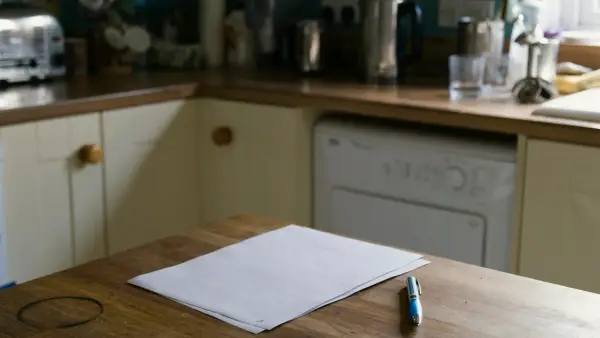
Dave’s wife asked me to say something at the service. I sat at my kitchen table for two nights trying to write it. And I realized I didn’t have the vocabulary. Not because I didn’t feel it - I felt it so much my chest hurt - but because every sentence I wrote sounded wrong. Too soft. Too exposed. Too much like the thing I’d spent forty years learning to never say out loud.
I wanted to say: You were the person I called when I was scared. When my marriage almost ended. When my father died and I didn’t know how to grieve properly because he never showed me how. You were the one who sat beside me and made me feel less alone, and you did it without ever saying anything that would have made either of us uncomfortable.
What I actually said at the funeral was a story about the time Dave accidentally drove his truck into a ditch on a fishing trip, and everyone laughed, and I sat back down feeling like I had failed him one final time.
Research by Niobe Way, a developmental psychologist at New York University, has documented how boys in early adolescence often describe their male friendships with striking emotional depth - using words like “love” and “closeness” openly. But by age fifteen or sixteen, that language disappears almost entirely. Not because the feelings change, but because the culture teaches them that this kind of vulnerability between men is dangerous. The window closes, and for many of us, it never opens again.
I think about that. The window. Somewhere around fourteen or fifteen, I had a best friend I would have done anything for, and I could have told him that, and it would have been simple and true. But the window was already closing. And by twenty, it was sealed shut. Painted over. Wallpapered. You’d never know it was there.
What the jokes were protecting
I don’t think the insult-as-affection pattern was cowardice. I’ve spent a lot of time turning that over, and I don’t think that’s what it was. I think it was a kind of engineering. Boys who grew up the way we did needed a delivery system for affection that couldn’t be turned against them. The joke was the armor around the payload. If someone overheard you and thought less of you, you could always say you were kidding.
It was protection. It was also a cage.
Because the armor became permanent. The delivery system became the only system. And somewhere along the way, the idea of removing the armor - of just saying “I’m proud of you” or “I missed you” or “you matter to me” without any joke wrapped around it - became not just uncomfortable but structurally impossible. Like trying to speak a language you studied for years but never practiced aloud. You know the words exist. You cannot make your mouth form them.
A 2019 study in Psychology of Men and Masculinities found that men who adhered most strongly to traditional masculine norms reported the greatest difficulty expressing emotional vulnerability with male friends - but also reported the greatest emotional distress when those friendships ended. In other words, the men who were least equipped to say “you meant something to me” were the ones who suffered the most when they lost the chance.
That was me, reading that study. That was exactly me.
The particular grief of coded love
There’s a kind of grief that I think is specific to men of my generation, and it’s not the grief of losing someone. Everyone grieves that. It’s the grief of realizing the language you spoke your whole life was always a code, and now the person who understood the code is gone, and you never once translated it into the clear.
Dave knew I loved him. I believe that. He knew, because he spoke the same language, and he could decode every terrible thing I said to him and hear the tenderness underneath.
But knowing is not the same as hearing. Knowing someone loves you because you can read the code is not the same as someone looking at you and saying, plainly, without any joke or deflection or escape hatch: You were important to me. You changed my life. I’m better because you were in it.
I never said that. Not once. Not to him, and not to any of my close friends. And I’m not sure it would have changed anything - maybe it would have been awkward, maybe he would have made a joke and we would have moved on - but I will never know. That’s the thing about a window that closes. You don’t get to find out what was on the other side.
What I’m learning to say at 58
I’m not going to tell you I’ve fixed this. I haven’t. I’m not suddenly hugging my remaining friends and giving speeches about how much they mean to me. That would be dishonest, and honestly, it would feel like wearing someone else’s clothes.
But I am trying something smaller. Last month I texted my friend Ray - a guy I’ve known since high school - and instead of our usual exchange of insults, I wrote: “Thinking about you. Hope you’re doing alright.” Four seconds of silence. Then he wrote back: “You dying or something?” And I laughed, because of course that’s what he said, because that’s the language.
But then a minute later, a second text: “Doing good. Good to hear from you.”
That second text. That was the whole thing. That was a man my age, raised the way I was raised, finding a way to acknowledge that something real had been said without either of us having to fully leave the safety of the code.
Maybe that’s enough. Maybe you don’t have to demolish the whole house. Maybe you just open one window - even a crack - and let something true pass through it.
I don’t know if Dave would have wanted me to say the plain version. Maybe he preferred the code. Maybe the code was enough for him. But I know this: I am 58 years old, and I am tired of saying the opposite of what I mean to the people I care about most. Not because the insults weren’t real, or weren’t love - they were. But because somewhere in my chest there is a sentence that has been waiting forty years to be said without a punchline, and I owe it to the people still here to let them hear it.
Even if my voice shakes. Even if it’s awkward. Even if the only response I get is “what’s wrong with you.”
Because I know now that “what’s wrong with you” might just be the most loving thing someone like me knows how to say back.