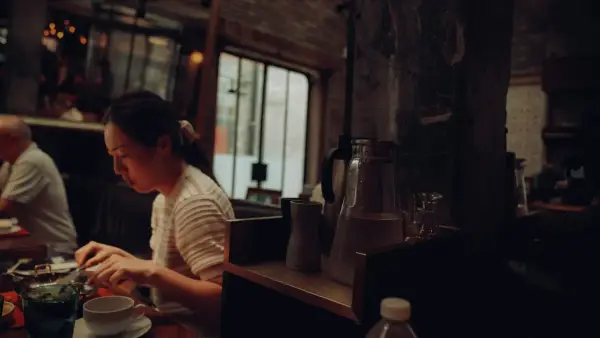
He's 55 and has quietly realized that the reason he has dreaded his own birthday dinner every year for three decades is not modesty and it is not introversion - it is that a boy who grew up in a house where being the center of attention meant being the center of a target never learned how to sit at a table surrounded by people who came because they wanted to, and every candle at fifty-five still flickers like a spotlight he has been trying to step out of since he was seven
The week before the candles
Every year around the second week of October, something tightens in my chest. Not pain. Not anxiety in the way a doctor would recognize it. More like a slow constriction - the feeling of a room getting smaller even though nothing has moved.
My wife will ask the question she asks every year. “What do you want to do for your birthday?” And every year my answer sounds casual, sounds easy, sounds like a man who simply doesn’t need much fuss. “Let’s keep it low-key. Maybe just the two of us. Nothing big.”
She smiles and says okay and I can see she’s trying not to look disappointed. Because she knows people who would come. She knows friends who would happily sit around a table and raise a glass. She knows our kids would drive in. She knows this.
And I know it too. I know it in the part of my brain that handles facts and calendars and reasonable expectations.
But there’s another part - older, faster, not interested in facts - that knows something else entirely. That part knows what it means to be the person everyone is looking at. And what it knows is: nothing good happens when all the eyes in the room are on you.
The table where attention was a weapon
I was seven the first time I understood that being noticed was a risk.
It was Thanksgiving. My mother’s family. A long table in a narrow dining room and too many adults with too many opinions. I’d done something - said something, probably. Something a seven-year-old says because he doesn’t yet know that some rooms require you to be invisible.
My uncle turned to me. Not kindly. Not playfully. With the specific energy of an adult who has been drinking since noon and has decided that a child’s comment is an opportunity. He repeated what I’d said in a voice that made it sound stupid. Then he looked around the table for confirmation, and the adults laughed - not all of them, but enough.
My father didn’t say anything. My mother gave me a look that meant “don’t react.” And I sat there, face burning, learning something that would shape every birthday, every celebration, every moment of supposed honor for the next forty-eight years.
I learned that the center of the table is the center of the target.
The anatomy of the flinch
A 2017 study published in the Journal of Personality and Social Psychology examined what researchers called “attention aversion” - the measurable discomfort certain individuals experience when they become the focal point of a group, even a group composed entirely of people who wish them well. What they found was that for a significant subset of participants, the discomfort wasn’t social anxiety in the clinical sense. It was a conditioned threat response - the nervous system had learned, through repeated early experience, to associate focused group attention with danger.
Not potential danger. Actual danger. The same neurological signature as hearing a loud noise. The same cortisol spike as being physically startled.
I read that and thought - that’s what the candles are. Each one is a tiny spotlight. And when everyone goes quiet and sings and looks at you, the room contracts to a single point, and you are standing in it, and your body doesn’t know these people love you. Your body only knows that the last time this many people looked at you at once, something went wrong.
That’s the flinch. The one that shows up disguised as modesty. Disguised as introversion. Disguised as “I just don’t like being the center of attention,” which is true but not for the reasons people assume.
What the birthday became
Here’s what my birthday has looked like for thirty years.
My wife plans something. I scale it back. She suggests a dinner with friends. I suggest just the two of us. She proposes a small party. I propose takeout. Every year we negotiate, and every year the event shrinks to fit the size of the room my nervous system can tolerate, and by the time the actual evening arrives, it’s so modest that she spends it wondering if I’m happy, and I spend it wondering if I’ve disappointed her, and neither of us says any of this out loud.
Some years people come anyway. My kids show up. A couple of friends. And the dinner is fine. The food is good. The conversation moves around the table the way it should. But when someone clinks a glass, or when my wife brings out a cake, or when the whole table turns to me and sings - there it is. The constriction. The heat behind my ears. The boy at the Thanksgiving table trying to disappear into the back of his chair.
I smile. I blow out the candles. I say thank you. And nobody knows that what I’m actually doing is surviving the moment, holding my face together while something inside me scans every pair of eyes for the one that’s about to turn.
The boy who learned to exit
After that Thanksgiving, I became an expert at a very specific skill: leaving the center without anyone noticing I’d left.
I learned to deflect attention with humor. I learned to redirect conversations toward other people. I learned to sit at the edges of rooms, to arrive late enough that the focus had already settled on someone else, to leave early enough that my absence felt natural rather than noticed.
Developmental psychologist Edward Tronick has studied how children develop what he calls “regulatory strategies” - the techniques young children invent to manage overwhelming emotional environments. Some children freeze. Some withdraw. Some become hypervigilant monitors of the room’s emotional temperature, scanning constantly for shifts in tone, in posture, in the direction of someone’s gaze.
I was the third kind. I became the boy who could read a room the way a sailor reads weather. I knew before anyone spoke whether the mood was shifting. I knew which adult was about to turn their attention outward. I knew when the air got thin and someone was about to pick a target.
And I knew how to not be that target. You make yourself useful but not visible. You speak when spoken to but never first. You laugh at other people’s jokes but never tell your own. You become a supporting character in your own life, and you get so good at it that everyone assumes it’s your personality.
The difference between modesty and survival
People have been calling me modest my entire adult life. And I’ve accepted the label because it’s so much easier than the truth.
Modesty is a choice. It’s what a confident person does when they decide they don’t need the spotlight. It comes from fullness - from knowing you’re enough and choosing not to perform it.
What I have isn’t modesty. What I have is the inability to believe that attention could ever be safe. There’s a canyon between those two things, and I’ve spent thirty years pretending the canyon isn’t there.
A 2020 study in Frontiers in Psychology examined adults who reported persistent discomfort with celebrations in their honor - birthdays, retirement parties, award ceremonies, even toasts at weddings. The common thread wasn’t introversion. Introverts may find such events tiring, but they don’t dread them weeks in advance. They don’t negotiate them down to nothing. They don’t spend the actual event in a state of controlled panic.
The common thread was a childhood environment where attention was unpredictable. Where being noticed could mean praise one moment and criticism the next. Where the spotlight wasn’t warm - it was interrogative. These adults hadn’t grown up hating attention. They’d grown up learning that attention was a trap. It felt good until it didn’t. It felt safe until someone decided it wasn’t.
And so they built a life around staying one step outside of it. Not in the dark, exactly. Just in the periphery. The place where nobody’s eyes are focused hard enough to hurt.
The people who came because they wanted to
My wife said something last year that I haven’t been able to stop thinking about. We were in bed the night before my birthday - my fifty-fourth - and I’d just finished explaining why I didn’t want her to invite anyone, and she was quiet for a moment, and then she said:
“You know they’d come because they love you, right? Not to evaluate you. Not to watch you perform. Just because they want to sit near you for an evening.”
I said I knew that.
But lying in the dark afterward, I realized I don’t. Not really. Not in the place where it matters. Intellectually, I understand that my friends are not my uncle. That my children are not the adults at that Thanksgiving table. That a birthday dinner in 2025 has nothing to do with a dining room in 1978.
But the body doesn’t do intellectual. The body does pattern. And the pattern says: when everyone looks at you, something is about to go wrong. Stand near the edge. Keep your voice down. Don’t be the reason the room focuses.
Daniel Goleman wrote about emotional memory - the way the amygdala stores experiences not as narratives but as sensations, ready to fire at the first hint of a matching pattern. The amygdala doesn’t check dates. It doesn’t differentiate between a dining room full of hostile relatives and a dining room full of people who drove an hour to spend the evening with you. It just recognizes the shape - you, center, eyes - and pulls the alarm.
That’s what fifty-five candles feel like. Not celebration. Alarm.
Learning to stay in the chair
I don’t have a neat resolution for this. I’m not going to tell you that I threw myself a party and wept with gratitude. That’s not how this works. Forty-eight years of patterning doesn’t dissolve because you name it.
But I’ll tell you what I’m trying.
This year, I told my wife she could invite people. Not many. Not a spectacle. But more than two. She looked at me like I’d said something in a foreign language, and then she smiled, and I could see her trying not to make a big deal out of it because she knows that making a big deal out of it would be the fastest way to make me take it back.
And I’m going to sit at the table. I’m going to let people sing. I’m going to feel the constriction and the heat and the old, old impulse to deflect, to redirect, to make a joke so the focus slides off me and onto someone else.
And instead of following the impulse, I’m going to try something that the seven-year-old at the Thanksgiving table never got to do. I’m going to look at the people looking at me and let myself believe - for thirty seconds, maybe sixty - that the eyes in this room are not the eyes in that room. That attention, in this specific place, with these specific people, is not a spotlight.
It’s just a candle. Small and warm and flickering because someone took the time to light it.
I’m fifty-five years old. I’ve been stepping out of the center of every room since I was seven. I’m not sure I know how to stop. But I’m learning that some tables are safe. Some rooms are kind. And some people really did show up because they wanted to.
The candles aren’t spotlights. They never were. They’re just the room’s way of saying: this one evening, it’s okay to be seen.