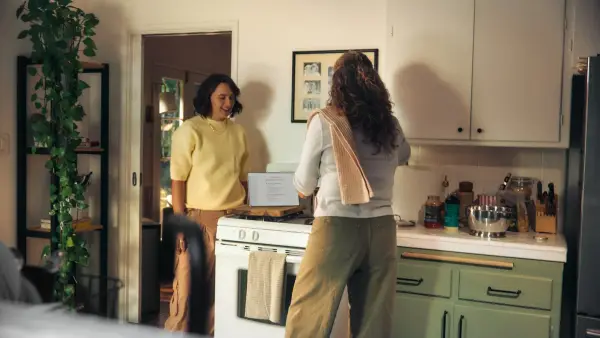
He's 57 and has quietly realized that his wife of thirty years doesn't actually know him - not because she stopped caring but because somewhere around year twelve the marriage became about logistics and nobody noticed the rest falling away

She asked what he wanted for dinner and he almost said “to be known”
There’s a moment I keep coming back to. A friend of mine - let’s call him Dan - was sitting at his kitchen table on a Tuesday night. His wife was across from him, scrolling through her phone, asking whether they should do chicken or pasta.
And something broke open in him. Not dramatically. Not the kind of breaking that makes noise. The kind that settles into your chest like cold water and stays there.
He wanted to say something real. He wanted to tell her that he’d been having the same dream for three weeks, that he was afraid of retiring, that he couldn’t remember the last time she’d asked him a question she didn’t already know the answer to.
Instead he said chicken.
He’s 57. They’ve been married for thirty-one years. They have three kids, two grandchildren, a mortgage that’s almost paid off, and a shared calendar that runs their entire existence. By every external measure, the marriage works. It functions beautifully.
But Dan told me something that I haven’t been able to shake. He said, “She knows everything about my schedule and nothing about my inner life. And I’m not sure she’d notice the difference.”
I don’t think Dan’s marriage is unusual. I think it’s the norm. And I think there are millions of men and women in their 50s and 60s sitting with this exact same quiet devastation and no language for it.
The slow replacement nobody talks about
Here’s what I’ve come to understand about long marriages. The intimacy doesn’t usually die in a fight. It doesn’t get killed by infidelity or cruelty or even neglect in the way we typically imagine neglect.
It gets replaced.
Somewhere around year ten or twelve, the marriage starts running on a different operating system. The kids need to be driven to soccer. The roof needs fixing. Someone’s parent gets sick. The credit card bill is higher than expected. There’s a school meeting on Thursday and the dog needs to go to the vet on Friday.
And all of that is real. All of that matters. But slowly, almost imperceptibly, the logistics become the marriage. The coordination becomes the connection. You stop asking “how are you feeling” because there’s no time and also because the answer might require something neither of you has the bandwidth to give.
A 2014 study published in Psychological Science found that couples who had been together for longer periods consistently overestimated how well they understood their partner’s preferences, emotions, and inner states. The researchers called it the “closeness-communication bias” - the longer you’ve been with someone, the more you assume you know them, and the less you actually check.
That finding has haunted me since I first read it.
Because it means the feeling Dan described isn’t a failure of his marriage. It’s a feature of how long-term relationships naturally drift when nobody actively resists the drift.
The busyness was never neutral
I want to be careful here because I’m not blaming anyone. Not Dan’s wife. Not Dan. Not the institution of marriage itself.
But I do think we need to name something honestly. The busyness of raising a family and maintaining a household - the sheer relentless volume of tasks that fill a shared life - is not a neutral force. It doesn’t just take up time. It actively reshapes what a relationship is for.
When you’re deep in the parenting years, the marriage becomes a management partnership. You divide and conquer. You develop shorthand. You stop having conversations and start having briefings. “I’ll handle the morning drop-off. Can you grab milk? The electrician’s coming at two.”
And there’s something almost beautiful about how efficient it becomes. Two people operating as a unit, keeping an entire household alive through sheer coordination.
But here’s what nobody warns you about. When the kids leave - when the house gets quiet and the calendar empties out - you turn to face each other and realize you’ve been standing side by side for twenty years without actually looking at each other.
The busyness wasn’t just filling time. It was filling the space where intimacy used to live. And when it’s gone, what’s left is an enormous, echoing silence between two people who share a bed and a bank account and almost nothing else that touches the soul.
The loneliness that has no name
Dan told me he feels lonelier in his marriage than he ever felt when he was single. And when he said it, he looked almost ashamed - like he was confessing to something ungrateful.
That shame is part of the trap.
Because from the outside, everything looks fine. The marriage is stable. Nobody is yelling. Nobody is leaving. The grandkids come over on Sundays. There’s a vacation planned for September. If you described this life to someone who was struggling, they’d say you were lucky.
And you are lucky. And you’re also profoundly alone. Both of those things can be true at the same time.
Dr. John Gottman, who has spent over four decades studying what makes marriages work, identified what he calls “turning toward” - the small moments where one partner makes a bid for emotional connection and the other responds. His research, published across multiple studies, found that couples who consistently turned toward each other’s bids stayed together and reported higher satisfaction. Couples who turned away - not with hostility, but simply with distraction or indifference - slowly eroded the foundation of their bond.
What strikes me about Gottman’s work is the scale of what he’s describing. We’re not talking about grand gestures. We’re talking about whether you look up from your phone when your partner sighs. Whether you notice when they seem quieter than usual. Whether you ask one real question per day.
And when those micro-moments stop happening - when the turning-toward gets replaced by the efficient co-management of a household - something in the marriage goes cold. Not dead. Cold. There’s a difference. Dead things you grieve. Cold things you just endure.
What men carry differently
I write a lot about men’s emotional lives, and this is one of the places where the weight falls in a particular way.
Many men in their 50s and 60s were raised in a culture that taught them emotional intimacy was something women did. Connection was her department. His job was to provide, protect, and keep things running. And for decades, that framework held because the marriage was running on logistics anyway.
But when the logistics thin out and the quiet arrives, these men often discover they have no practice at being known. They never built the vocabulary. They don’t know how to say “I feel invisible in this marriage” without it sounding like an accusation.
A 2019 study published in the Journal of Social and Personal Relationships found that men in long-term marriages reported significantly lower levels of emotional disclosure than their wives - not because they had less to say, but because they had fewer relational contexts in which emotional vulnerability felt safe or even relevant.
So they sit with it. They carry this ache to the golf course, to the garage, to the morning coffee they drink alone before anyone else wakes up. And they tell themselves it’s fine. That wanting more is asking too much. That a good marriage means a stable one.
But something in them knows that’s not true. Something in them remembers a version of their wife - or a version of themselves - that used to talk about things that mattered at midnight. That used to ask questions with no practical purpose. That used to be curious about each other in a way that had nothing to do with calendars.
Forgiveness as the first honest act
Here is what I want to say to anyone who recognizes themselves in this.
You’re not ungrateful. You’re not broken. And your marriage isn’t necessarily a failure.
What happened to you is what happens to almost everyone. The current of daily life carried you somewhere and you didn’t notice because you were busy doing important things. Raising humans. Paying for their lives. Keeping it all from falling apart.
That’s not nothing. That’s enormous. You should be proud of the life you built together.
But pride in what you built doesn’t have to mean silence about what got lost.
The first step - and I know this sounds almost too simple - is forgiveness. Not for a specific offense. Forgiveness for the drift itself. Forgiving yourself for not noticing sooner. Forgiving your partner for the same. Forgiving the years for going so fast. Forgiving the life you built for being so demanding that it consumed the very connection it was supposed to protect.
Brene Brown talks about how vulnerability is not weakness but the birthplace of connection. I think about that a lot in the context of long marriages. Because the most vulnerable thing a person can do after thirty years is say, “I miss you. And you’re right here.”
The conversation nobody wants to start
Dan hasn’t said any of this to his wife yet. He’s thinking about it. He told me he’s afraid - not of her reaction, but of finding out that she feels the same way. That confirmation, he said, might be worse than the not-knowing.
I understand that fear.
But I also think the alternative - another ten or twenty years of chicken-or-pasta silence - is its own kind of devastation. The quiet kind. The kind that doesn’t announce itself. The kind you only recognize in retrospect, when it’s too late to do anything about it.
If you’re reading this and you feel that cold space in your marriage, I want you to know something. The fact that you can feel it means something is still alive in you that wants more. That want isn’t a flaw. It’s the most human thing about you.
You didn’t fail at marriage. You just got very, very good at maintaining a life and forgot that maintaining a life isn’t the same thing as sharing one.
And the person lying next to you tonight - they might be carrying the same quiet. They might be waiting for someone to break the surface. They might be choosing chicken when what they really want to say is “do you still see me?”
It’s not too late to ask.